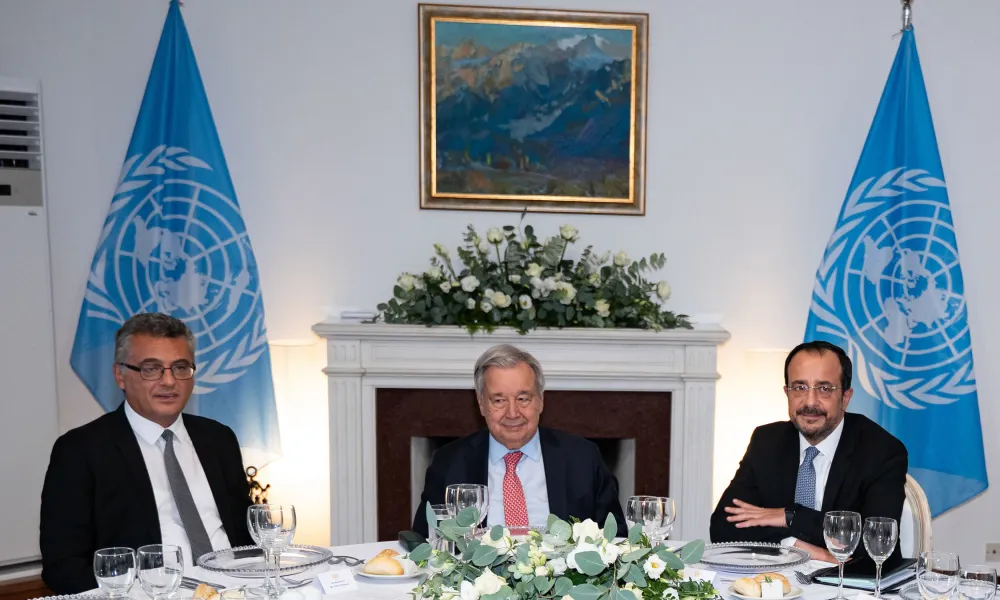

Turkish Cypriot leader Tufan Erhürman and Greek Cypriot leader Nikos Christodoulides will meet under United Nations auspices at 4 p.m. on Wednesday, Aug. 26, for talks expected to test whether sufficient common ground exists to prepare a new expanded conference on Cyprus.
The meeting is due to take place at the residence of the UN Secretary-General’s Special Representative in Cyprus, Khassim Diagne, in the buffer zone near the former Nicosia airport.
UN Secretary-General António Guterres, who visited the island on July 27-29 and met both leaders, has made another informal 5+1 conference involving the two Cypriot sides, Turkiye, Greece, Britain and the UN conditional on adequate preparation in three areas: confidence-building measures, negotiating methodology and substantive issues.
The talks will not mark the formal resumption of negotiations. They will instead provide the first major indication of whether Erhürman and Christodoulides can complete the preparatory work requested by Guterres and create the conditions for an expanded meeting.
Prospects have been complicated by Turkish Cypriot accusations that the Greek Cypriot side is undermining confidence outside the negotiating room by attempting to restrict Turkish Cypriot diplomatic, cultural and sporting contacts while publicly supporting confidence-building measures within the UN process.
A meeting about more than crossing points
The immediate agenda is expected to concentrate on new crossing points, recording the convergences reached in previous negotiations and agreeing on a schedule for more frequent meetings between the leaders. Erhürman has proposed meeting Christodoulides weekly, arguing that serious preparation for a new 5+1 conference cannot be conducted through occasional ceremonial encounters.
The two sides’ representatives, Mehmet Dana and Menelaos Menelaou, agreed in principle on Aug. 20 that the leaders should meet more frequently. The precise schedule remains to be decided by Erhürman and Christodoulides. Greek Cypriot sources have spoken of meetings once or twice a week, suggesting that the disagreement may no longer concern whether the leaders should meet regularly but how that engagement will be structured and what it is expected to produce.
That procedural opening should not be mistaken for a political breakthrough. The Dana-Menelaou meeting produced an extensive discussion but no new agreement on crossing points. Work also continued on a UN document recording the convergences reached in earlier negotiating rounds, particularly those preserved in UN records through the collapse of the Crans-Montana conference in 2017.
Canadian UN official John McGarry has reportedly been coordinating that exercise, while Guterres’ personal envoy, María Angela Holguín, is expected to present the eventual document. For Erhürman, preserving previous convergences is essential to ensuring that the next process does not start from zero. For Christodoulides, returning to the point at which negotiations stopped is central to the case for reviving a bi-zonal, bi-communal federal process.
That apparent similarity conceals important differences. The Greek Cypriot side wants the convergences placed firmly within the established federal framework. Erhürman wants confirmation not only of the accumulated negotiating acquis but also of political equality, effective participation and safeguards against another open-ended process that collapses without consequences.
Erhürman’s four-point methodology
Erhürman’s approach is built around four conditions that should be understood as a negotiating methodology rather than as a rejection of negotiations.
First, political equality and effective participation must be accepted from the beginning, including meaningful Turkish Cypriot involvement in federal decision-making rather than a system in which the larger community can govern alone. Second, convergences reached in previous negotiations must be preserved. Third, the talks must be conducted within a defined timeframe. Fourth, failure cannot simply restore an unequal status quo in which the Greek Cypriot side retains international recognition while the Turkish Cypriot side returns to isolation.
His formulation is that negotiations must be conducted to reach a solution, not merely to perpetuate the process of negotiation. This presents both an opportunity and a risk. Properly handled, the four points could prevent another indefinite process. If converted into rigid preconditions that must be settled fully before substantive engagement begins, however, they could reproduce the procedural stalemate they are intended to prevent.
The Aug. 26 meeting will indicate whether the parties can transform Erhürman’s methodology into mutually accepted rules for negotiation. Agreement to talk is not yet agreement on the destination, the method or the consequences of another failure.
The complicated arithmetic of crossings
Crossing points offer the most visible opportunity for progress, but even their number and definition remain contested.
The principal package includes Mia Milia (Haspolat) and proposed connections involving Louroujina (Akıncılar), Lymbia, Athienou, Pyroi (Gaziler) and Aglantzia (Eylence). The dispute is not simply about opening gates. It concerns routes, control, security, territorial implications and whether the benefits are distributed equitably between the two communities.
The Greek Cypriot proposal pairs Mia Milia with an Athienou-Pyroi-Aglantzia corridor, treating the latter as one continuous crossing. The Turkish Cypriot side regards Athienou-Pyroi and Pyroi-Aglantzia as two distinct crossings. That difference in counting determines whether the package contains two or three openings and whether Louroujina should be restored to preserve reciprocity.
A second disagreement concerns the route itself. The Greek Cypriot side favours using much of the old Nicosia-Larnaca road through the buffer zone. The Turkish Cypriot proposal envisages constructing a new road north of the buffer zone, with the Turkish Cypriot side offering to finance it. Neither has accepted the other’s map.
The Greek Cypriot side has also linked the return of Louroujina to a crossing through the Turkish-controlled Kokkina (Erenköy) enclave in the northwest. Turkish Cypriots regard Kokkina as a separate security and territorial question. They argue that adding it would create a fifth crossing primarily benefiting Greek Cypriot communities without producing a comparable gain for the Turkish Cypriot side.
These disagreements illustrate why even ostensibly humanitarian measures become entangled in sovereignty. If the leaders reach a compromise, the crossings could demonstrate that the communities can solve practical problems without prejudicing their respective legal positions. Failure would reinforce the argument that Cyprus cannot reach agreement even on the supposedly easy issues.
Diplomatic briefings become a confidence test
The atmosphere deteriorated after reports that the Cyprus Republic Foreign Ministry had telephoned foreign missions and discouraged diplomats from attending a briefing by Erhürman’s special representative, Mehmet Dana.
Dana’s proposed meeting was not unprecedented. Menelaou had briefed foreign diplomats approximately two weeks earlier on the Greek Cypriot side’s positions. The Turkish Cypriot side sought an equivalent opportunity to explain its perspective.
Erhürman deliberately framed the affair as a question of confidence rather than launching a rhetorical confrontation. He asked whether preventing diplomats from hearing one side helped create trust or destroyed what little trust already existed. He also called on the UN and European Union to examine what had happened.
Politis reported on Erhürman’s comparison between the two briefings and his insistence that international representatives should be able to hear both sides. The significance lies not merely in whether the telephone calls achieved their objective. Diplomats themselves allegedly witnessed an attempt to restrict their contact with the Turkish Cypriot representative immediately before a leaders’ meeting officially devoted to confidence-building.
From the Turkish Cypriot perspective, the episode reinforces a long-standing complaint: the Greek Cypriot side claims internationally to represent the entire island and then uses that recognition to prevent the other community from presenting its case directly.
From EXIT to Barcelona: culture becomes political territory
The same confrontation has spread into culture and sport.
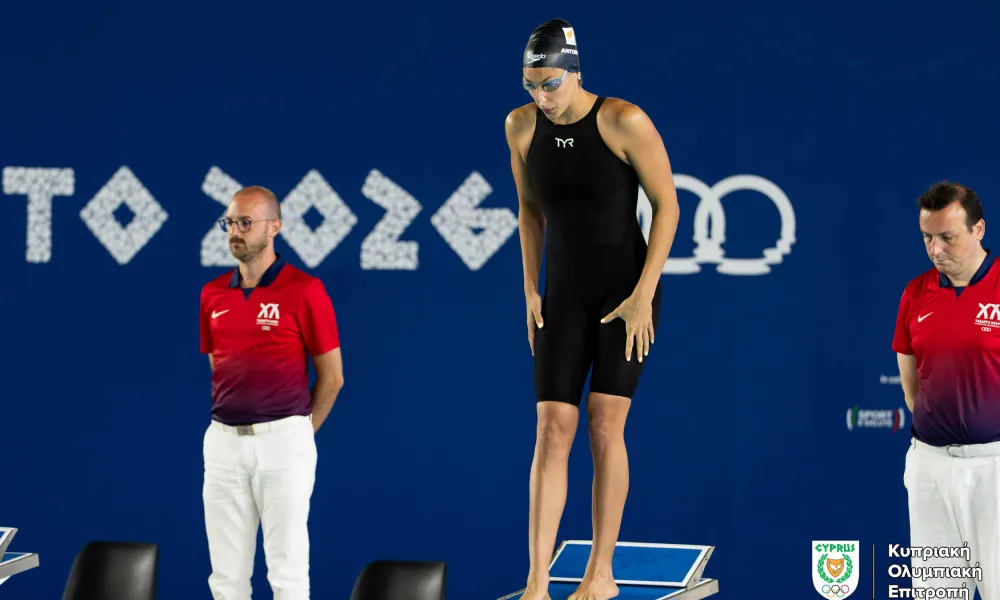
Serbia’s EXIT organisation withdrew from NEXUS, an electronic music event planned for Sept. 18 near Kyrenia Castle, following a coordinated campaign involving ELAM, other Greek Cypriot political figures and diplomatic contacts with Serbia. ELAM member of the European Parliament Geadis Geadi claimed credit for contacting Serbian embassies and government officials. DISY MEP Loukas Fourlas also approached Serbian President Aleksandar Vučić, while the Foreign Ministry reportedly pursued the matter through diplomatic channels.
EXIT said it had intended to use music to bring people together but had underestimated Kyrenia Castle’s historical and emotional significance for Greek Cypriots. It withdrew despite acknowledging serious legal and financial consequences. The organisation confirmed its own withdrawal from NEXUS, although it was initially unclear whether the local organisers might attempt to proceed without the international brand.
The Greek Cypriot argument is that holding international events at historic sites in the north risks normalising territorial division and conferring implied recognition on the Turkish Cypriot administration. The Turkish Cypriot response is that preventing musicians, artists and audiences from meeting entrenches separation rather than overcoming it.
ELAM has since demanded the cancellation of two further events: the Zamna music festival scheduled for Oct. 10 and FC Barcelona’s “Lefkosa Camp” for young footballers at Near East University. The Barcelona camp is advertised for Sept. 7-11 and Sept. 16-20, with the club’s website listing its location as “Lefkosa, Northern Cyprus.”
As of Aug. 24, only EXIT’s withdrawal from NEXUS had been confirmed. Available reporting showed that ELAM was seeking the cancellation of Zamna and the Barcelona camp, but neither event had yet been confirmed as cancelled.
Nevertheless, ELAM explicitly urged the Spanish government and the Foreign Ministry to intervene. The campaign therefore fits the broader pattern identified by Erhürman, even though ELAM’s actions should not automatically be attributed to the Christodoulides government unless official involvement is established.
Erhürman refuses the provocation trap
Erhürman responded on Aug. 24 with some of his sharpest language since taking office, but paired it with a commitment to restraint.
He said there appeared to be a competition over who could do more to prevent Turkish Cypriot youth from engaging with the world. He also accused opponents of trying to stop diplomats and the international community from seeing, hearing and understanding Turkish Cypriots.
Yet his central message was that the Turkish Cypriot side would not be provoked into abandoning its settlement policy. He said Turkish Cypriots would proceed with “patience, composure, seriousness and determination” and would not allow anger to dictate their response. BRT reported that Erhürman’s diplomatic initiatives, representations and international contacts were continuing intensively.
This is politically significant because one possible consequence of the pressure campaign is to reinforce the argument that Turkish Cypriot contact with the world inevitably advances recognition or partition. Erhürman is attempting to reverse that logic: international engagement is necessary precisely because Turkish Cypriots have demonstrated a will for a negotiated settlement.
His immediate challenge is to prevent the isolation issue from consuming the entire Aug. 26 agenda. He must present it as evidence that confidence-building requires reciprocity while continuing to demonstrate his readiness to negotiate practical agreements.
The premise behind isolation
The Turkish Cypriot critique focuses on an enduring Greek Cypriot assumption: international contact with the north will make the status quo more comfortable and reduce incentives for a comprehensive settlement.
Under that logic, direct trade, international flights, cultural events and sporting contacts should remain restricted until a final settlement is achieved. Measures that ease isolation are regarded as rewards that should be exchanged only for movement on the central political, security and territorial questions.
Turkish Cypriots see the same policy as evidence that they are expected to negotiate under permanent coercion. They argue that isolation did not produce a settlement after the Greek Cypriot rejection of the 2004 Annan Plan and is unlikely to build confidence now. Blocking youth camps, cultural events or diplomatic briefings does not impose costs only on an administration. It deepens the separation of the communities themselves.
The contradiction can be stated simply: Greek Cypriot policymakers fear that genuine confidence-building will make partition more sustainable, while Turkish Cypriots argue that the absence of genuine confidence-building makes reconciliation less likely.
Ankara’s security umbrella and diplomatic opening
Ankara approaches the process from a broader strategic perspective. President Recep Tayyip Erdoğan has reiterated that no initiative ignoring Turkish Cypriot sovereign equality, security or legitimate Eastern Mediterranean interests can succeed. He has also said Turkiye will not permit Cyprus to be incorporated into regional military alignments that threaten the Turkish Cypriot side.
That warning has acquired greater weight amid the military buildup around Cyprus during the wider regional conflict. Turkiye deployed F-16 aircraft and air-defence capabilities to northern Cyprus as Western and Greek forces reinforced positions elsewhere around the island. Ankara presents those deployments as precautionary deterrence under its guarantor responsibilities rather than preparations for offensive action.
The Blue Homeland framework forms the maritime and strategic backdrop. It connects Cyprus to continental shelf claims, offshore energy resources, naval access and the emerging security competition across the Eastern Mediterranean. Blue Homeland is not itself expected to be negotiated on Aug. 26, however, and the proposed Turkish Maritime Jurisdiction Areas Law remains pending rather than enacted.
Ankara’s political position also does not entirely coincide with Erhürman’s language. Erdoğan continues to foreground sovereign equality, equal international status and a two-state basis. Erhürman is testing whether a negotiated settlement remains possible if political equality, effective participation, preserved convergences, time limits and consequences for failure are guaranteed.
Rather than conceal that distinction, the Aug. 26 meeting should be assessed partly on whether Erhürman can rely on Ankara’s security support without allowing the process to be reduced to a two-state-versus-federation slogan. Reports that Erdoğan authorised Turkiye’s support for Guterres’ latest initiative suggest Ankara is prepared to test a serious process, provided it does not again leave Turkish Cypriots isolated after another failure.
What to watch on Aug. 26
The most immediate measure of progress will be whether the leaders can announce one or more crossings, agree on a route or at least establish a binding technical timetable. A vague instruction to their representatives to continue discussing the same maps would constitute continuity, not progress.
The second test will concern the convergences document. The leaders need not resolve every disagreement, but they should agree that previous convergences will not be casually reopened and that remaining differences will be identified transparently.
The third test will be the frequency and purpose of future meetings. Weekly or twice-weekly encounters would be meaningful only if accompanied by a structured work programme covering confidence-building measures, methodology and substantive issues. More meetings without deadlines, assigned work or required decisions could merely institutionalise another managed frozen conflict.
The fourth will be how Christodoulides addresses the campaign against Turkish Cypriot visibility. He may distinguish his government from ELAM, but silence regarding the diplomatic briefing controversy, NEXUS and the attempts targeting Zamna and the Barcelona camp would make that distinction less persuasive.
Finally, the meeting must clarify the route to the next 5+1. Guterres has signalled that he will convene an expanded meeting only after adequate preparation. The two leaders must decide whether that requirement becomes an incentive for results or another mechanism for indefinite delay.
The Aug. 26 meeting will not resolve Cyprus. Its importance lies in a smaller but more fundamental question: can two leaders who say they want negotiations create enough political space for both communities to be heard, connected and treated as partners before asking them to take the much greater risks required by a settlement?
If they cannot agree even on crossing points, reciprocal diplomatic access and the right of young people to participate in international cultural and sporting life, confidence-building will remain a slogan. If they can, the meeting may provide the first credible evidence that the next 5+1 will be more than another conference about holding another conference.