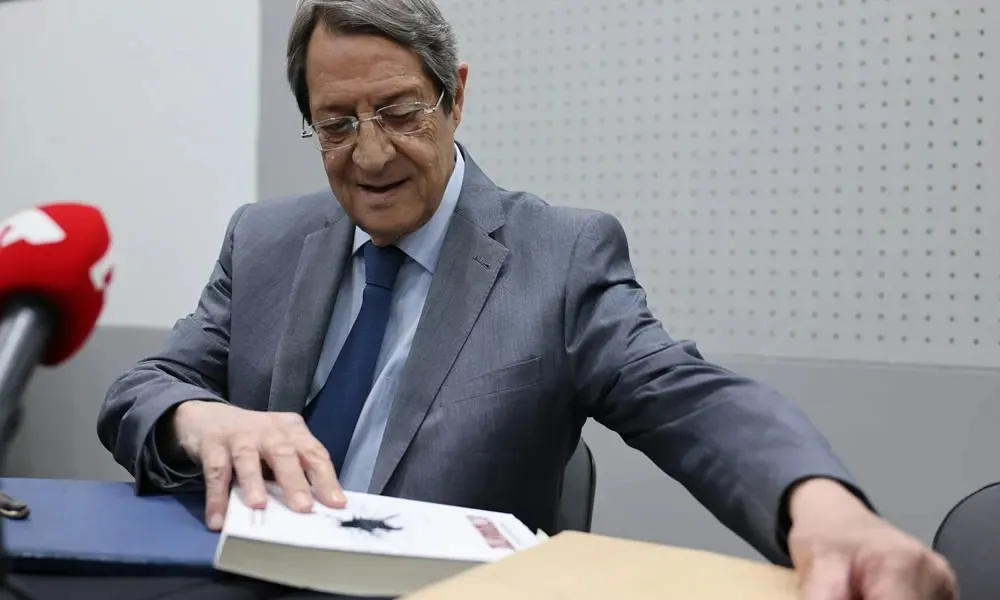

Former president Nicos Anastasiades has launched a fresh attack on the Anti-Corruption Authority over its findings relating to the book Mafia State by journalist Makarios Drousiotis, arguing that the body's conclusions are based on factual and legal errors.
In a lengthy written intervention, Anastasiades disputes the Authority's recommendations concerning seven potential criminal offences and maintains that the investigation breached fundamental legal principles, including his right to be heard.
On the occasion of the publication of the Anti-Corruption Authority's announcement regarding the results of the investigation into the book Mafia State (hereinafter "the Authority's Announcement"), dated 16 June 2026, I would like to point out the following:
(a) Following a thorough study of the Announcement, it becomes evident that the Authority's findings and recommendations concerning possible criminal liability on the part of the former President do not correspond to the actual facts, or are the result of error or influence by the prevailing atmosphere.
(b) Despite the fact that the Authority rejected in their entirety the author's allegations of corruption through illicit enrichment, misappropriation of money or property, or any allegedly damaging actions against the Republic of Cyprus, both the author and the advocates of nihilism, exploiting the Authority's "findings", distort the truth by persisting in the verdict of public tribunals.
In order to restore the truth, I set out below, with supporting evidence, not only the errors regarding the Authority's findings and recommendations, but also the distorted version promoted by advocates of populism.
As pointed out in Paragraph 30 concerning the standard of proof:
"It is important, and must be particularly emphasised, that the standard of proof applied in investigative procedures such as the present one is that of the balance of probabilities, in contrast to that applied in criminal cases, namely proof beyond reasonable doubt."
While in the Authority's concluding observations, Paragraph 80 states:
"Furthermore, it is emphasised that the fact that other allegations advanced in the Book are not contained in the present Announcement means that they have not been proven even to the minimum degree required in investigative procedures."
In simpler terms, after two and a half years of investigations, at a cost of €1.5 million, involving 150 witnesses and documentary evidence from 41 legal and governmental departments amounting to 793 exhibits, the defamatory allegations contained in the book Mafia State regarding the alleged receipt of financial benefit and/or self-serving actions by the former President, whether for his own benefit or to the detriment of the Republic, collapse and are rejected by the Authority as unfounded and legally unsustainable.
More specifically:
1. Chapter 1: "The Oligarch and His Fiefdom"
In this chapter and its subsections, no reference is made by the Authority to the allegations that:
(a) The "Rybolovlev Law" was passed by the House of Representatives following intervention by Anastasiades in exchange for financial benefits from Rybolovlev. No such reference appears in the Authority's Announcement and therefore it has not been proven even to the minimum degree required in investigative procedures. In simple terms, it constitutes the author's fiction.
(b) In the subsection "Manipulation of Justice", all allegations are unrelated to the former President and therefore no reference is made to them in the Authority's Announcement.
(c) In the subsection "The Arrest of Rybolovleva", although there is no reference whatsoever to any act indicating knowledge or intervention by Anastasiades, the Inspecting Officers, through error or inexcusable negligence, connected allegations entirely unrelated to the actual facts and consequently reached the unacceptable conclusion that the former President may have committed the offence of trading in influence by accepting an undue advantage.
More on this will follow when addressing the offences allegedly committed or attempted by the former President.
(d) In the subsection "The Oligarch Demands Answers", there is not the slightest reference to the former President.
(e) As for the fiction regarding the alleged plan to remove Costas Clerides, which is the subject of the subsection bearing that title, the Authority's Announcement avoids any comment or reference because the author's false claims were found entirely baseless.
(f) There is no comment and no reference whatsoever in the subsection "Influencing Judges", once again proving that the author's allegations are a product of falsehood.
2. Chapter 2: "The Offshore President"
In this chapter and its subsections, the Inspecting Officers found nothing improper or true in the author's claims regarding:
(a) The purchase of land by the President's wife from the Archbishopric.
(b) In the subsection "The Truth About Focus", the defamatory allegation that the former President appropriated €450,000 intended to cover the transportation costs of voters in the 2008 presidential elections and an additional €100,000 for the 2009 European Parliament elections was disproved both by the criminal investigation conducted by Attorney General Costas Clerides and by the payment receipts issued to Holiday Tours and DISY.
Consequently, the Authority rejected these allegations as unsupported.
Equally important was the Attorney General's finding that:
"Any undeclared financing to political parties, during the material period, did not constitute a criminal offence."
(c) In the subsection "Passports and Jets", the Inspecting Officers found that the author's allegations concerning:
- The naturalisation of Saudi national Abdul Bin Mahfouz, his brothers and their families;
- The naturalisation of former Pakistani Prime Minister Shaukat Aziz;
- The granting of citizenship to four Russians who, instead of investing, allegedly created a fund to cover the former President's air travel expenses;
- The alleged concealment of the former President's first visit to the Seychelles;
- The alleged free travel arrangements for that visit;
- The alleged control of Bank of Cyprus through the appointment of Vladimir Strzhalkovsky;
- The alleged purchase of passports;
were legally unsupported, unfounded and therefore false.
3. Chapter 3: "The Hornet's Nest"
The author's defamatory allegation in this chapter is that the former President sought to seize a vast area of land belonging to the Turkish Cypriot community and, to that end, created a multi-party trust to secure political backing, characterising his actions as "fraud of colossal proportions".
The same narrative portrays Attorney General Costas Clerides as an accomplice who allegedly provided tailor-made legal opinions to appease the former President.
It is particularly significant that this entire chapter was removed from the second edition of Mafia State published in March 2024, only to be restored later following criticism aimed at the author.
The Inspecting Officers rejected these allegations, stating:
"The Inspecting Officers consider that no evidence was presented at the relevant meeting showing that the former President promised or did anything improper in order to advance the request of the private company."
They further noted:
"Although the former President's interventions appear to have been made in good faith during a period of economic crisis and were not intended to secure any personal benefit, such actions did not fall within the duties of the President of the Republic."
This reference concerns the allegation that the former President granted permission to a woman of Turkish origin to enter the Republic of Cyprus illegally through the Green Line.
4. Chapter 5: "A Snitch in My Palm"
The only issue examined in this chapter was whether the police had failed to effectively investigate the author's allegations that he had been placed under surveillance.
Apart from the fact that the defamatory allegations concerning the former President's involvement in monitoring the author were rejected from the outset, the Authority's Announcement makes no reference whatsoever to this chapter.
5. Chapter 6: "The Moral Instigator"
As stated in the terms of reference:
"The only issue to be investigated is the involvement of Strzhalkovsky as a financier of Mr Nicos Anastasiades' presidential campaign or any relationship with other persons from which possible acts of corruption may arise."
Consequently, the author's malicious allegations that Mr Anastasiades:
i. Was bought off through Strzhalkovsky and turned into a puppet of President Putin and Russia.
ii. Rejected the first Eurogroup agreement on Putin's instructions.
iii. Sought to control Bank of Cyprus in order to protect his Russian clients.
were rejected from the outset as unworthy of investigation.
In the Authority's Announcement, the Inspecting Officers considered the author's allegations and ultimately found no grounds warranting any reference to this chapter.
Observations
Based on everything set out above, and always on the basis of the Authority's Announcement and the standard of proof applicable to investigative procedures, it is beyond obvious that the author's allegations in Mafia State have, almost in their entirety, been rejected as legally unsustainable and/or unfounded and therefore as products of fiction or falsehood.
For this reason, I consider it regrettable, unfortunate, if not unacceptable, that both the Inspecting Officers and the five members of the Anti-Corruption Authority, succumbing to the prevailing atmosphere created by public tribunals and nihilists, proceeded with findings attributing possible criminal offences to the former President on the basis of the balance of probabilities.
And because I am fully aware of the seriousness of what I am saying and writing, I shall immediately proceed to address the Authority's findings and its entirely unfounded recommendations that I may have committed offences, even under the balance-of-probabilities standard.
Introduction
Before commenting individually on each recommendation concerning possible offences, I wish to make the following observations:
(a) The Anti-Corruption Authority's Announcement falls far short of what one would expect from an investigation of such breadth and public importance. Rather than constituting an independent finding of the Authority following detailed study of the Inspecting Officers' work, it amounts largely to a referral to their conclusions, which, as will become evident below, are the product of inexcusable negligence.
(b) Despite rejecting the overwhelming majority of the author's allegations as legally unsustainable, the Authority restricted itself to a brief concluding observation in paragraph 80 stating that allegations not contained in the Announcement "have not been proven to the degree required".
In a case concerning the former President of the Republic, one would have expected an explicit reference, chapter by chapter, identifying which allegations had failed to meet the required threshold and therefore constituted either fiction or defamatory assertions.
(c) The extremely serious allegations made against the former President by the author, which are based on malicious assertions not supported by evidence or contradicted by exhibits and documentation submitted by the former President, did not lead the Authority to comment on the credibility of the author.
(d) Another inexcusable omission is the failure of the Authority to investigate whether offences may have been committed under Article 22 of the Anti-Corruption Authority Law, despite what I regard as obvious and proven bad faith on the part of the author in numerous allegations.
It should be noted that all seven recommendations suggesting possible offences by the former President are based on the balance of probabilities and arise either from mistaken chronological linking of events, legally untenable conclusions or testimony of doubtful reliability.
(e) Equally unacceptable, and contrary to every principle of justice, is the unprecedented failure of the Inspecting Officers to present to the former President, or give him the opportunity to respond to, the matters that led them to the conclusions and seven recommendations concerning possible offences.
The mistaken disregard of the principle that no person should be judged unheard will become evident in the analysis that follows.
(f) I wish to emphasise that, despite the criticism I express, I do not attribute bad faith either to the Inspecting Officers or to the President and members of the Authority. What I attribute to them is a lack of strong determination to resist the prevailing atmosphere created by public judges, myth-makers and character assassins.
Findings of the Inspecting Officers and the Anti-Corruption Authority
As stated in paragraph 69 of the Authority's Announcement, the potential corruption offences and the individuals allegedly involved are examined chapter by chapter in accordance with the terms of reference of the investigation.
The observations and comments that follow are confined solely to matters relating to the former President.
Chapter 1: "The Oligarch and His Fiefdom"
(a) The Arrest of Rybolovleva
(b) The Oligarch Demands Answers
(c) The Plan to Get Rid of Costas Clerides
Of these three subsections, the only one that the Inspecting Officers considered worthy of examination under the balance-of-probabilities standard was The Arrest of Rybolovleva. The other two were dismissed because they "had not been proven to the required degree" and therefore constitute either unproven allegations or fiction.
With regard to the Rybolovleva matter, the Authority concluded that the former President may have committed the offence of trading in influence.
Specifically, the Authority states:
"The former President is alleged to be a person who received or accepted an undue advantage in order to exercise, or propose that he would exercise, improper influence over the decision-making process of public officials."
Rather than offering further commentary, I wish to address the substance of this allegation by presenting indisputable facts and several questions that the Inspecting Officers either overlooked or ignored.
The Inspecting Officers, whether through misunderstanding or a failure to appreciate the author's own narrative, assumed that the one-way private jet trip undertaken on 21 March 2014 constituted the "consideration" or "undue advantage" accepted by the former President in exchange for his alleged involvement in the arrest of Ms Rybolovleva.
According to the facts set out in Mafia State, however, Ms Rybolovleva's arrest occurred on 24 February 2014.
The author further states that on 6 March 2014 an urgent meeting took place between the former President and Rybolovlev in Dublin. According to the book, the purpose of that meeting was to agree on a new strategy designed to exert financial pressure on Elena Rybolovleva.
The same narrative makes clear that the alleged "new plan" concerned legal assistance procedures in Switzerland and the United Kingdom relating to documentation surrounding a diamond transaction.
It is therefore obvious that the alleged plan related to legal proceedings, not political intervention.
Most importantly, what escaped the attention of the Inspecting Officers was the author's own assertion that the alleged private-jet arrangement was connected not with the arrest itself, but with this later "new cooperation".
Consequently, the alleged benefit supposedly provided after the arrest cannot logically constitute consideration for influencing the arrest itself.
Furthermore, the trip was an official journey. Therefore, any financial saving would have benefited the State and not the former President personally.
Based on the above, a series of questions arises which, I believe, further demonstrates the error and weakness of the Authority's recommendation that the former President be investigated for the possible commission of this offence.
(a) How is the arrest of Ms Rybolovleva connected to a trip that was allegedly agreed after her detention had already taken place?
(b) What was the undue advantage allegedly received or accepted by the former President in order to "exercise or propose to exercise improper influence" concerning the arrest of Ms Rybolovleva?
(c) What personal advantage was obtained by the former President when the journey in question was an official one and any savings accrued to the Republic rather than to him personally?
(d) At what point in the sequence of events described by the author is there any indication that the former President intervened with any public official or state functionary concerning the arrest of Ms Rybolovleva?
(e) In relation to whom, and when, did he exercise or propose to exercise improper influence?
(f) Why, during my four-day appearance before the Inspecting Officers, was such an allegation never raised with me?
Comment
The above demonstrates how a misunderstanding of the facts led the Inspecting Officers and the Authority, lightly and without sufficient foundation, to stigmatise the former President on the basis of the balance of probabilities instead of fully exonerating him on the basis of the actual facts.
Chapter 2: "The Truth About Focus"
The author's narrative is that the late Andreas Vgenopoulos, through the company Focus Maritime, financed political parties in Cyprus.
More specifically, it is alleged that Focus covered the costs of transporting voters to Cyprus for the 2008 presidential elections and the 2009 European Parliament elections.
Following the negative publicity generated after the collapse of Laiki Bank and the public disclosure of the donations, former Attorney General Costas Clerides ordered an investigation to determine whether criminal offences had been committed.
Upon completion of that investigation, the Attorney General announced on 27 January 2016 that the evidence did not disclose the commission of any criminal offence, since political party financing during the relevant period did not constitute a criminal offence under Cypriot law.
Another defamatory allegation advanced by the author is that Nicos Anastasiades, then President of DISY, appropriated a total of €550,000 which had allegedly been intended for the party.
According to the findings of the Inspecting Officers themselves, recorded in paragraphs 73.14 to 73.19 of the Authority's Announcement, these allegations were disproven entirely, as evidence established that the money in question was paid either to Holiday Tours for the transportation of students during the 2008 presidential election or to DISY for campaign needs relating to the 2009 European Parliament elections.
The new error of the Inspecting Officers and the Authority
Despite the above, the Inspecting Officers concluded that Focus Maritime was used as a vehicle through which the late Andreas Vgenopoulos made payments to political parties and persons in positions of influence in Cyprus whom he wished to influence.
On the basis of this conclusion, the Inspecting Officers suggested that there may have been an offence of abuse of power.
According to their findings, while the Focus Maritime investigation was ongoing, Mr Anastasiades allegedly met and communicated with then Attorney General Costas Clerides, expressing dissatisfaction with the investigation and requesting that interrogations be halted on the grounds that no criminal offences had been identified.
The Inspecting Officers further suggested that the former President may have had a personal or political interest in stopping an investigation that could allegedly reveal his involvement in securing funding for DISY.
Observations
Despite the seriousness of such an allegation, the Inspecting Officers never considered it necessary to put these claims to the former President and give him an opportunity to respond.
As a result, I was deprived of the opportunity to rebut the allegations and to prevent the formation of adverse impressions and erroneous findings.
The truths that answer the findings
1. The contributions concerned DISY and not Anastasiades personally. According to the Attorney General's announcement, the evidence disclosed no criminal offence because party financing during the relevant period was not criminalised.
2. What personal or political benefit did Anastasiades allegedly derive, given that such benefit is a prerequisite for establishing the offence in question?
3. In 2008 and 2009 I was President of DISY and outside government. I exercised no executive authority whatsoever.
4. I never met or communicated with Attorney General Costas Clerides in order to express dissatisfaction with the investigation or request an end to interrogations.
An important element supporting the falsity of this allegation is an interview given by Mr Clerides on 10 October 2016, during which he explicitly stated:
"I must be clear. Never. I never received any direct intervention whatsoever from anyone. And I would like to believe that the reason I never received any intervention is that it has become understood that any such intervention would be unacceptable."
5. The alleged personal or political benefit collapses because:
(a) As acknowledged by the Inspecting Officers themselves, Anastasiades did not personally receive a single cent from the funding.
(b) The Attorney General concluded that no criminal offence had been committed.
Consequently, why would the former President seek to halt an investigation into conduct that was not criminal?
(c) If such intervention had actually occurred, why was it never reported at the time, particularly in light of Mr Clerides' public statement denying any intervention?
I do not believe further observations are required to demonstrate how denying the person under investigation the right to be heard can lead to seriously flawed findings and recommendations.
Subsection: "Bribes from the Banks"
The next issue requiring comment is the subsection titled "Bribes from the Banks" in Chapter 2, The Offshore President.
According to the findings of the Inspecting Officers, and on the balance of probabilities:
(a) The law firm Nicos Chr. Anastasiades & Partners was among the law and accounting firms receiving commissions from banks for referring foreign depositors to them.
According to the findings, the law firm bearing the former President's name was one of the largest intermediaries of the Bank of Cyprus, while also receiving commissions from Laiki Bank.
(b) Although it had been claimed that Mr Anastasiades was merely a silent partner, the Inspecting Officers concluded from the private Partnership Agreement dated 9 September 2001 that:
"He bore overall responsibility for supervising the operations of the partnership,"
and maintained that role until 26 February 2013.
They further concluded, on the balance of probabilities, that he had decisive involvement in negotiations concerning the level of commissions paid by the banks.
(c) The Inspecting Officers also concluded that, at the end of 2011, a transaction amounting to €250,000 took place which was allegedly intended as financial support for the 2013 presidential campaign but was presented as a fee or commission.
According to the allegations, this transaction was agreed between the late Andreas Vgenopoulos and Mr Anastasiades.
Ultimately, the Inspecting Officers alleged that Anastasiades exploited the practice of banks paying commissions for client referrals and received money from Laiki Bank in support of his 2013 presidential campaign under the guise of commissions.
On that basis, they suggested that by receiving those sums, considered by them to constitute improper advantages, Mr Nicos Anastasiades may have engaged in passive trading in influence.
Observations and responses to this new error
Although I was among the last persons called to provide testimony before the Inspecting Officers, the findings set out under this subsection were never put to me.
Had I been asked, the Inspecting Officers would have discovered that their findings are based upon:
- A mistaken interpretation of documents.
- False testimony.
- Conclusions founded on error.
The actual facts
1. The finding that Anastasiades was not a silent partner but exercised general supervision over the partnership known as Nicos Chr. Anastasiades & Partners is entirely incorrect.
It was common knowledge throughout Cyprus that following his election as President of DISY, Mr Anastasiades spent his days at party headquarters, devoting his time to political and parliamentary duties.
The provision of the partnership agreement cited by the Inspecting Officers appears in the initial articles defining the roles of partners, but it is superseded by a later provision explicitly stating that because of his political involvement, Mr Anastasiades would not participate actively in the firm's operations and would instead remain a silent partner.
The earlier clause merely recognised the firm's hierarchy, given that Anastasiades held a majority shareholding of 60% and was by far the most senior partner.
Consequently, the finding of the Inspecting Officers is entirely unfounded.
2. There was never any agreement whatsoever with Andreas Vgenopoulos to contribute money to the presidential campaign of Mr Anastasiades.
Consequently, allegations that contributions were disguised as commissions, that false invoices were issued or that payments were routed through shell companies derive from false or misleading testimony.
3. Contributions to political parties or candidates were legal and therefore there was no reason to conceal them, as has falsely been claimed.
4. In whose name were the alleged invoices issued, and how exactly were they connected to the then President of DISY?
5. The alleged offence identified by the Authority is passive trading in influence on the basis that the sums supposedly received constituted an improper advantage.
I must point out that the offence requires the existence of an improper advantage.
The obvious question is:
What exactly was the improper advantage?
What was supposedly exchanged by the presidential candidate for the payment he allegedly received from Laiki Bank?
Subsection: "Passports and Jets"
According to the Authority's Announcement, the Inspecting Officers examined allegations of money laundering involving the former President and the law firm Nicos Chr. Anastasiades & Partners through offshore companies, as well as allegations of misleading statements concerning his participation in the firm after 1997.
The Authority divided the matter into two separate sections.
The first concerns an article published on 14 August 2019 by the OCCRP under the title:
"Bank Records Link President of Cyprus to Troika Laundromat"
The second concerns the Pandora Papers disclosures published by the International Consortium of Investigative Journalists (ICIJ) on 3 October 2021.
Observations
1. Before commenting on the findings, I reiterate what I have already stated: allegations that I concealed active participation in the law firm after 1997 are false.
2. For reasons known only to the Inspecting Officers, neither the allegations nor the findings in this subsection were put to me during my testimony.
3. The Authority itself does not accuse the former President of money laundering and therefore makes no recommendation concerning such an offence.
Instead, the findings attempt to attribute other potential offences to him on the basis of the balance of probabilities.
First section: OCCRP publication of 14 August 2019
According to the findings, OCCRP published an article accusing the former President of serious wrongdoing and alleging that the law firm Nicos Chr. Anastasiades & Partners facilitated Russian businessman Alexander Abramov in laundering hundreds of millions of dollars.
The Inspecting Officers repeated the already-disputed allegation that the former President remained actively involved in the law firm's affairs until his election to the presidency.
According to them, his public request that MOKAS investigate the allegations could constitute abuse of power or attempted abuse of power because of his relationship with the law firm.
Yet the OCCRP article itself explicitly stated:
"There is no evidence in the cited documents that the law firm or its associates violated any law or committed any offence."
Despite this, political opponents exploited the publication, characterising it as a massive corruption scandal.
Faced with these accusations, and unaware that MOKAS had already begun investigating the matter on its own initiative, I publicly requested a full investigation to determine whether any offences had in fact been committed and by whom.
Despite this self-evident right of any citizen, and especially a Head of State confronted with such allegations, the Inspecting Officers reached what I consider wholly unacceptable conclusions.
According to them:
- My use of the presidential office to influence a matter touching upon personal interests raised serious concerns regarding improper institutional intervention.
- MOKAS failed to conduct a sufficiently thorough investigation and accepted explanations despite allegedly incriminating evidence.
- The Attorney General agreed with the findings of MOKAS.
Ultimately, they concluded that:
"The arbitrary nature of this action (the former President's public call for an investigation) may establish potential criminal liability for the offence of abuse of power or attempted abuse of power."
Following the above, I believe a number of questions demonstrate even more clearly how detached from reality the findings of the Inspecting Officers and the Authority are.
Questions
(a) In what country in the international community is a President considered to be abusing his powers because he publicly requests an investigation into serious allegations levelled against him?
(b) If the former President truly wished to suppress or conceal matters, would he not have intervened privately with the head of MOKAS rather than publicly calling for an investigation?
(c) According to the Authority's logic, should the President of a country first resign and only then request an investigation into allegations made against him, in order to avoid being accused of abusing his powers?
(d) Paragraph 5 of the Authority's Announcement records that:
"Because publicity had been given to the matter... then President Anastasiades sent a letter dated 29 November 2022 also requesting that the Authority conduct an ex officio investigation."
While paragraph 6 states:
"As a result of the above developments, the Authority decided to conduct an ex officio investigation."
Did the former President also commit abuse of power by requesting the present investigation by the Anti-Corruption Authority?
What exactly is the difference between MOKAS and the Anti-Corruption Authority?
Did the Inspecting Officers and members of the Authority feel pressured because Mr Anastasiades asked them to investigate him?
Since the Authority leaves clear implications regarding an allegedly inadequate and possibly favourable MOKAS investigation, further questions arise:
(a) Why do the Inspecting Officers and the Authority not direct the same criticism at former Attorney General Costas Clerides, who, according to their own findings, had the decisive authority to accept or reject the MOKAS report and ultimately accepted it?
Did the former President somehow exert institutional pressure on the Attorney General as well?
(b) If the Attorney General accepted the results of MOKAS' investigation, why is he not accused of abuse of power or neglect of duty, just as the head of MOKAS is implicitly criticised?
(c) Since the findings suggest that "despite the existence of incriminating evidence justifying a further criminal investigation", MOKAS accepted the explanations provided, how did the Inspecting Officers reach this conclusion?
Did they conduct their own independent investigation, or did they merely adopt the defamatory allegations of an unreliable author?
(d) If there truly existed incriminating evidence warranting further criminal investigation, why did the Attorney General adopt MOKAS' conclusions?
Was Mr Costas Clerides also involved in the alleged cover-up?
I do not believe any further comments are necessary regarding the unprecedented findings of the Inspecting Officers and the Authority on this first section.
Second section of the subsection "Passports and Jets"
The second section concerns publications released on 3 October 2021 as part of the Pandora Papers investigation.
According to the findings, the International Consortium of Investigative Journalists disclosed more than 12 million leaked documents covering the period from 1970 to 2020.
These documents allegedly referenced the law firm Nicos Chr. Anastasiades & Partners, claiming that the firm acted as an intermediary for offshore companies and helped Russian clients conceal their true assets.
The findings further state that Russian businessmen Alexander Abramov and Leonid Lebedev applied for Cypriot citizenship through the law firm.
According to the Inspecting Officers, the former President, acting in his capacity as a political leader and Member of Parliament, possessed significant political influence and institutional access, and under that capacity met with the then Interior Minister regarding the progress of Mr Abramov's citizenship application.
In support of this allegation, they note that Abramov's application was submitted on 14 December 2009 and approved on 2 August 2010.
They further note that Abramov's wife initially had her application rejected on 17 December 2010 and that a note was allegedly found in the file stating:
"The matter concerning the wife should be resolved."
Eighteen days later, on 4 January 2011, the Council of Ministers amended the relevant regulations to permit the exceptional naturalisation of spouses and dependants of naturalised investors.
As a result, Abramov's wife and two children subsequently obtained Cypriot citizenship.
On the basis of the above, the Inspecting Officers concluded that there were sufficient indications, on the balance of probabilities, to support potential acts of corruption by the former President and the law firm bearing his name.
As regards the former President personally, they suggested:
(a) Possible commission of the offence of abuse of power or, alternatively, attempted abuse of power.
(b) Trading in influence.
According to their reasoning, the alleged meeting with the Interior Minister constituted an attempt to exert institutional pressure and bypass the lawful procedure.
Regarding trading in influence, the Authority alleges that the former President abused the influence he may have exercised over others in order to secure favourable treatment for the citizenship application.
What is even more extraordinary is the suggestion that the rejection of Abramov's wife's application, followed by the amendment of the regulations just 18 days later, could somehow support an inference of improper influence by the then leader of the opposition.
The error exposed through the actual facts
1. Between 2008 and February 2013, President of the Republic was the late Demetris Christofias, former General Secretary of AKEL.
2. DISY, led by Nicos Anastasiades, was the principal opposition party.
3. During 2010 and 2011, Cyprus was suffering the consequences of a severe economic crisis linked to the global financial crisis.
4. As part of efforts to attract investment, the government amended the Cyprus Investment Programme, first reducing investment requirements and then, on 4 January 2011, extending eligibility to dependants of qualifying investors.
5. Relations between the government and the opposition were characterised by intense political confrontation on domestic issues.
Accordingly, findings suggesting abuse of power or improper influence through "significant political power and institutional access" are arbitrary and unsupported by the political reality of the time.
6. It is unreasonable to suggest that decisions of the government of the day resulted from pressure exerted by the leader of the opposition.
7. It is equally unprecedented to suggest that a decision of the Council of Ministers to extend citizenship rights to dependants of investors resulted from improper influence exerted by the opposition leader.
8. Most importantly, what the Inspecting Officers overlooked through inexcusable negligence completely undermines their conclusions.
Former Interior Minister Neoclis Sylikiotis, giving evidence under oath before the Nicolatos Inquiry, was asked whether there had been any intervention from the Presidency or political officials concerning the citizenship programme.
He replied:
"I repeat that there was no recommendation whatsoever in favour of approving any applicant... First of all, let me say that I have said this publicly before and I repeat it now. The issue arose after a name was published in the newspaper Alithia. Then Mr Anastasiades' office called me and I explained that the information had not come from the Ministry but from Parliament. My communication with Mr Anastasiades related to those matters and nothing else."
It is therefore obvious that no intervention or recommendation was made by Anastasiades regarding the approval of citizenship applications.
Following publication of the Authority's findings, I contacted Mr Sylikiotis, who confirmed his previous testimony and expressed surprise that he had never been called to testify before the Inspecting Officers.
These findings, which are disconnected from the facts, create a reasonable belief that had the former President been given the opportunity to be heard, the recommendation regarding possible criminal offences would never have been made.
Following the above, I believe a number of questions demonstrate even more clearly how detached from reality the findings of the Inspecting Officers and the Authority are.
Questions
(a) In what country in the international community is a President considered to be abusing his powers because he publicly requests an investigation into serious allegations levelled against him?
(b) If the former President truly wished to suppress or conceal matters, would he not have intervened privately with the head of MOKAS rather than publicly calling for an investigation?
(c) According to the Authority's logic, should the President of a country first resign and only then request an investigation into allegations made against him, in order to avoid being accused of abusing his powers?
(d) Paragraph 5 of the Authority's Announcement records that:
"Because publicity had been given to the matter... then President Anastasiades sent a letter dated 29 November 2022 also requesting that the Authority conduct an ex officio investigation."
While paragraph 6 states:
"As a result of the above developments, the Authority decided to conduct an ex officio investigation."
Did the former President also commit abuse of power by requesting the present investigation by the Anti-Corruption Authority?
What exactly is the difference between MOKAS and the Anti-Corruption Authority?
Did the Inspecting Officers and members of the Authority feel pressured because Mr Anastasiades asked them to investigate him?
Since the Authority leaves clear implications regarding an allegedly inadequate and possibly favourable MOKAS investigation, further questions arise:
(a) Why do the Inspecting Officers and the Authority not direct the same criticism at former Attorney General Costas Clerides, who, according to their own findings, had the decisive authority to accept or reject the MOKAS report and ultimately accepted it?
Did the former President somehow exert institutional pressure on the Attorney General as well?
(b) If the Attorney General accepted the results of MOKAS' investigation, why is he not accused of abuse of power or neglect of duty, just as the head of MOKAS is implicitly criticised?
(c) Since the findings suggest that "despite the existence of incriminating evidence justifying a further criminal investigation", MOKAS accepted the explanations provided, how did the Inspecting Officers reach this conclusion?
Did they conduct their own independent investigation, or did they merely adopt the defamatory allegations of an unreliable author?
(d) If there truly existed incriminating evidence warranting further criminal investigation, why did the Attorney General adopt MOKAS' conclusions?
Was Mr Costas Clerides also involved in the alleged cover-up?
I do not believe any further comments are necessary regarding the unprecedented findings of the Inspecting Officers and the Authority on this first section.
Second section of the subsection "Passports and Jets"
The second section concerns publications released on 3 October 2021 as part of the Pandora Papers investigation.
According to the findings, the International Consortium of Investigative Journalists disclosed more than 12 million leaked documents covering the period from 1970 to 2020.
These documents allegedly referenced the law firm Nicos Chr. Anastasiades & Partners, claiming that the firm acted as an intermediary for offshore companies and helped Russian clients conceal their true assets.
The findings further state that Russian businessmen Alexander Abramov and Leonid Lebedev applied for Cypriot citizenship through the law firm.
According to the Inspecting Officers, the former President, acting in his capacity as a political leader and Member of Parliament, possessed significant political influence and institutional access, and under that capacity met with the then Interior Minister regarding the progress of Mr Abramov's citizenship application.
In support of this allegation, they note that Abramov's application was submitted on 14 December 2009 and approved on 2 August 2010.
They further note that Abramov's wife initially had her application rejected on 17 December 2010 and that a note was allegedly found in the file stating:
"The matter concerning the wife should be resolved."
Eighteen days later, on 4 January 2011, the Council of Ministers amended the relevant regulations to permit the exceptional naturalisation of spouses and dependants of naturalised investors.
As a result, Abramov's wife and two children subsequently obtained Cypriot citizenship.
On the basis of the above, the Inspecting Officers concluded that there were sufficient indications, on the balance of probabilities, to support potential acts of corruption by the former President and the law firm bearing his name.
As regards the former President personally, they suggested:
(a) Possible commission of the offence of abuse of power or, alternatively, attempted abuse of power.
(b) Trading in influence.
According to their reasoning, the alleged meeting with the Interior Minister constituted an attempt to exert institutional pressure and bypass the lawful procedure.
Regarding trading in influence, the Authority alleges that the former President abused the influence he may have exercised over others in order to secure favourable treatment for the citizenship application.
What is even more extraordinary is the suggestion that the rejection of Abramov's wife's application, followed by the amendment of the regulations just 18 days later, could somehow support an inference of improper influence by the then leader of the opposition.
The error exposed through the actual facts
1. Between 2008 and February 2013, President of the Republic was the late Demetris Christofias, former General Secretary of AKEL.
2. DISY, led by Nicos Anastasiades, was the principal opposition party.
3. During 2010 and 2011, Cyprus was suffering the consequences of a severe economic crisis linked to the global financial crisis.
4. As part of efforts to attract investment, the government amended the Cyprus Investment Programme, first reducing investment requirements and then, on 4 January 2011, extending eligibility to dependants of qualifying investors.
5. Relations between the government and the opposition were characterised by intense political confrontation on domestic issues.
Accordingly, findings suggesting abuse of power or improper influence through "significant political power and institutional access" are arbitrary and unsupported by the political reality of the time.
6. It is unreasonable to suggest that decisions of the government of the day resulted from pressure exerted by the leader of the opposition.
7. It is equally unprecedented to suggest that a decision of the Council of Ministers to extend citizenship rights to dependants of investors resulted from improper influence exerted by the opposition leader.
8. Most importantly, what the Inspecting Officers overlooked through inexcusable negligence completely undermines their conclusions.
Former Interior Minister Neoclis Sylikiotis, giving evidence under oath before the Nicolatos Inquiry, was asked whether there had been any intervention from the Presidency or political officials concerning the citizenship programme.
He replied:
"I repeat that there was no recommendation whatsoever in favour of approving any applicant... First of all, let me say that I have said this publicly before and I repeat it now. The issue arose after a name was published in the newspaper Alithia. Then Mr Anastasiades' office called me and I explained that the information had not come from the Ministry but from Parliament. My communication with Mr Anastasiades related to those matters and nothing else."
It is therefore obvious that no intervention or recommendation was made by Anastasiades regarding the approval of citizenship applications.
Following publication of the Authority's findings, I contacted Mr Sylikiotis, who confirmed his previous testimony and expressed surprise that he had never been called to testify before the Inspecting Officers.
These findings, which are disconnected from the facts, create a reasonable belief that had the former President been given the opportunity to be heard, the recommendation regarding possible criminal offences would never have been made.
Questions
1. The first and most important question is why the minister who was directly responsible for the matter at the time was never called to give evidence by the Inspecting Officers. What weight was given to his sworn testimony, and on what allegedly more credible evidence did they reach the exact opposite conclusion?
2. After all of the above, how much seriousness or legitimacy can be attached to the actions of those who, lightly and without reliable evidence, attribute non-existent criminal offences to a former President, thereby damaging his reputation?
3. Even setting aside the above facts, can it seriously be argued that a Member of Parliament abused his supposed authority to apply institutional pressure on a government minister in a manner that bypassed the lawful procedure?
4. How much credibility should be attached to the finding that a decision of the Council of Ministers to grant citizenship to dependants of investors resulted from trading in influence or institutional pressure allegedly exercised by the leader of the opposition?
5. Since when, and in what country, is executive power exercised by the opposition or the legislature rather than by the lawfully elected government?
Following the foregoing, I do not believe further comment is necessary.
Chapter 3: "The Hornet's Nest"
The final matter that remains to be addressed is Chapter 3 entitled "The Hornet's Nest".
Before discussing the Authority's findings, I consider it necessary to point out that the author's specific allegation was that the former President's goal was, in cooperation with a multi-party trust, to seize a vast Turkish Cypriot property and that this constituted a scandal of enormous proportions.
In the same narrative, the author accused former Attorney General Costas Clerides of providing tailor-made legal opinions intended to appease the former President.
Worth noting regarding the author's credibility is the fact that, in the second edition of Mafia State, he removed the entire chapter, only to reintroduce it later after facing criticism.
In their findings, the Inspecting Officers rejected the author's allegations and summarised the facts surrounding the matter.
According to the findings, Turkish national Susan Dikraz claimed ownership of a property in Dromolaxia covering more than three donums of land which was registered in the Land Registry as Turkish Cypriot property.
Believing herself to be the lawful owner, she entered into a long-term lease agreement with a private company.
The company's attempt to register the agreement was rejected by both the Land Registry and the then Interior Minister, the late Socrates Hasikos.
Through lawyers and company officials, assistance was sought from the former President on the grounds that the rejection was mistaken because Turkish court decisions and legal opinions allegedly supported the argument that the land was Turkish rather than Turkish Cypriot property.
Responding to the request, the former President convened a broad meeting on 3 September 2013, attended by, among others:
- Interior Minister Socrates Hasikos
- Transport Minister Tasos Mitsopoulos
- Former Assistant Attorney General Rikkos Erotokritou
- Representatives of the Land Registry
- Representatives and lawyers of the private company
- MP Georgios Varnava
Despite the author's allegations that the former President intended to seize Turkish Cypriot land, the Inspecting Officers themselves found that:
"No evidence was presented at the meeting showing that the former President promised or undertook anything improper in order to advance the company's request."
Nevertheless, the Inspecting Officers recorded that on 4 August 2014 Ms Dikraz entered the government-controlled areas illegally through the Green Line.
They concluded, on the balance of probabilities, that her unlawful entry and that of her entourage occurred following intervention or instructions by the former President, despite his having no authority in such matters.
On this basis, the Inspecting Officers suggested potential liability for abuse of power or attempted abuse of power.
To support this recommendation, they stated:
"Although the former President's interventions appear to have been made in good faith during a period of economic crisis and were not undertaken in order to obtain personal benefit, such actions did not fall within the President's duties."
They then referred to constitutional provisions defining the powers of the President and concluded:
"The Inspecting Officers therefore attribute to the former President possible responsibility for abuse of power or, alternatively, attempted abuse of power."
Observations
(a) The late Interior Minister Socrates Hasikos, until his death on 5 April 2021, never made any allegation that the former President intervened in the exercise of his lawful powers.
(b) The allegation that the former President bypassed the minister or abused his powers originates in the fiction promoted by the author, namely the claim that I intended to seize the Turkish Cypriot property. The Inspecting Officers themselves rejected this allegation.
(c) It is regrettable to find that the former President is acknowledged as acting in good faith and without personal gain, yet the Inspecting Officers still chose to recommend possible criminal liability without giving him the opportunity to be heard.
(d) To whom exactly did the President supposedly issue instructions, whether with or without the minister's knowledge, such that he can be accused of bypassing the minister and abusing his powers?
Final observations
From everything set out above, it is evident that the Inspecting Officers and the members of the Anti-Corruption Authority violated fundamental legal principles governing any investigation, particularly given the seriousness of the allegations and the powers of the institution conducting the inquiry.
The fact that investigative proceedings apply the standard of the balance of probabilities does not justify disregard for fundamental legal principles such as:
(a) The failure to put allegations and findings before the former President and give him the opportunity to respond before recommending possible criminal offences in all seven cases.
(b) The failure to evaluate the credibility of the author, especially given that many chapters containing allegations of corruption, enrichment, misappropriation and dishonourable conduct were not substantiated even to the minimum degree required in investigative proceedings.
How is it possible that the Authority states, in paragraph 11 of its Announcement, that references are based on the original 2022 edition of the book and not subsequent editions?
How can the credibility of the author be properly assessed when the second edition removed an entire chapter and altered or withdrew numerous allegations contained in the original edition?
To what degree would a proper assessment of the author's credibility have affected the balance-of-probabilities test?
Why did the President of the Authority issue a statement on 20 April 2026 clarifying that investigations concerning the author's "Santi" allegations would not affect the Mafia State investigation?
(c) Following the rejection of allegations accusing the former President of corrupt enrichment and personal gain, why did the Authority not investigate Makarios Drousiotis under Article 22 of the Anti-Corruption Authority Law?
Article 22 expressly provides that:
"Any person who intentionally provides the Authority with false or misleading information, data or evidence, knowing them to be false or inaccurate, commits an offence punishable by imprisonment of up to three years, a fine of up to €50,000, or both."
(d) Another issue that raises questions is the Authority's failure to comment on statements by the author expressing certainty regarding the outcome of the investigation.
Anastasiades then cites several social media posts by Drousiotis from May and June 2026 in which he referred to the forthcoming findings of the Mafia State investigation and suggested they would vindicate his claims.
Anastasiades states that he does not adopt media reports concerning alleged links between the lead inspector and the author's lawyer, but argues that the silence surrounding those reports and Drousiotis' statements raises legitimate questions for those who advocate complete transparency.
As a final observation, Anastasiades refers to paragraph 78 of the Authority's Announcement, which states:
"We consider it appropriate to remind everyone once again of the presumption of innocence and the fact that only a court is competent to determine a person's guilt."
He also notes paragraph 79, which refers to:
"the enormous publicity attracted by the investigation and the existence of an intense and, at times, toxic climate."
Anastasiades asks how those correct observations can be reconciled with the actions and omissions of the Authority which he has outlined.
He concludes:
"The independence and integrity of institutions are not established by adapting their verdicts to those of public tribunals and the prevailing atmosphere, but through courageous and objective consideration of the facts, so that the law is not polluted, reputations are not tarnished, and the belief does not take hold that the rule of law is being sacrificed by those entrusted to protect it for the sake of temporary popularity."
Nicos Anastasiades
24 August 2026