
You may be sitting in your living room waiting for your team's league match to begin, only to be stunned by the lead story in the evening news bulletin. The expression is figurative, because the stories that follow gradually bring some order to the chaos of the first images.
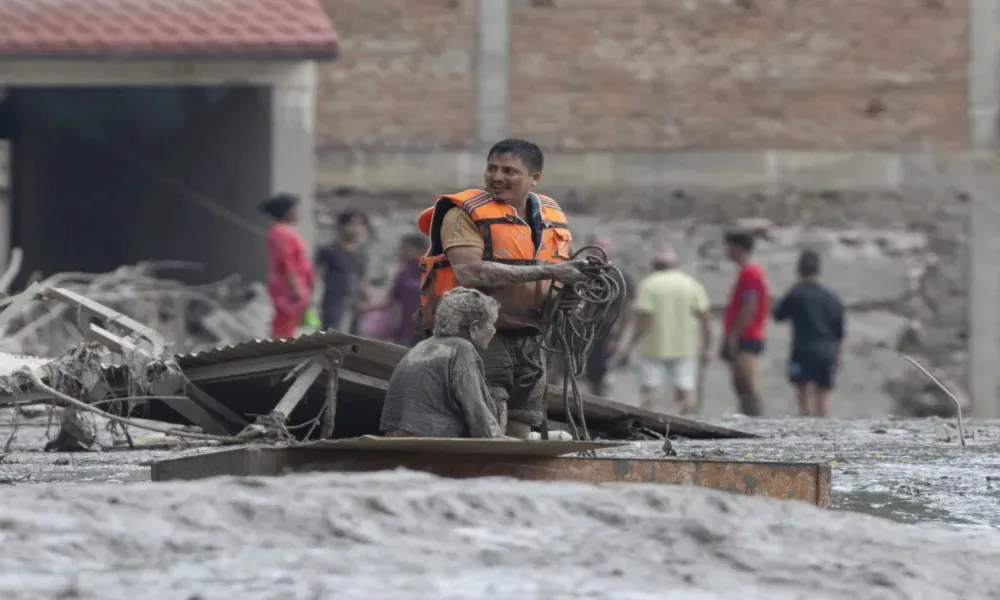
The scenes from Nepal are difficult to comprehend. You watch with your mouth open, struggling to believe that what you are seeing is actually happening. Reporters covering the disaster reach for every possible description: "Biblical catastrophe", "an endless act of God", "death beneath mountains of mud", "total destruction and disaster".
Watching from the safety of your sofa, you wonder how such devastation can occur. Tiny figures racing across the screen are human beings. In the background, torrents of mud cascade down mountainsides. The danger is obvious, yet it remains difficult to imagine what it would be like to find yourself at the centre of what many call an act of God.
An act of God? No act of God at all. We humans, incapable of fully grasping the force of nature's response, have simply shifted responsibility as high as we can. We have placed it on God.
The truth, however, is more troubling and more frightening. Anyone willing to think calmly for a moment will understand that no god causes such natural disasters. Humanity's inability to impose its will on the forces of nature has always been a reality. Across the centuries and millennia, countless examples of natural destruction have shaped human history.
What was Vesuvius, which buried Pompeii? What was the volcanic eruption on Santorini that consumed the Minoan civilisation? The list of catastrophes throughout the Earth's history is endless.
If we truly reflected on them, we might be reminded of the film 2012, in which the planet's poles reverse, America and Europe disappear beneath floodwaters and the Chinese save a selected group of wealthy survivors aboard futuristic arks. A few ordinary people also manage to survive, emerging into the sunlight of a new beginning.
The immense destruction in Nepal is not the result of the anger of an offended deity punishing humanity for its sins.
American cinema, and more broadly American popular culture wrapped in the language of science fiction, has long treated nature's excesses as events that are ultimately inevitable. Whether it is Armageddon or The Day After Tomorrow, with glaciers swallowing cities, populations and entire regions of the planet, the same question remains: who will be the final victor in the contest between nature and humanity?
Humanity's deep-seated insecurity about its future on Earth lies so far beneath the surface that every dramatic outburst of nature is instinctively interpreted as divine punishment.
It is a misguided approach. What drives us towards such explanations is the tendency to assign morality to nature itself. Yet that is a profound intellectual error. Nature and God are neither moral nor immoral. Humanity alone invented morality.
And humanity, in the end, may only save itself individually, somehow, somewhere and at some unknown time.
Let us not take the thought any further.
For now, Nepal remains far away from us.