
By Giorgos Koumoullis*
On 30 August 1974, a voice was violently silenced before it had the chance to grow old: the voice of Doros Loizou. The poet, activist and educator of a generation searching for light in the darkness was killed by EOKA B in an ambush targeting Vassos Lyssarides. His image remains one of the clearest representations of Cypriot social democracy: a man who resisted fascism not with slogans, but through actions, poetry and personal example.
I consider myself fortunate to have been his friend, his colleague at The English School and his fellow activist in EDEK. I will never forget the day when, at his own urging, I entered his classroom to observe a history lesson. I was astonished. In his hands, history was not a school subject. It was storytelling, it was breath, it was an invitation for students to become citizens. Above all, in an atmosphere of paranoia and junta-style fascism, he had the courage to cultivate democratic consciousness, critical thinking and resistance to every form of chauvinism.
That courage came at a professional cost. The climate in Cyprus between 1967 and 1974 was a mixture of fear, polarisation and political blindness. With few exceptions, the Cypriot Right, unlike its counterpart in Greece, uncritically embraced the narrative of the military junta, presenting the dictatorship in Greece as a "national government" and portraying the abolition of democracy as a patriotic act.
The hypocrisy was such that the rhetoric of the coup plotters was presented as institutional normality, while resistance to the junta, mainly from EDEK and figures such as Vassos Lyssarides and Takis Hadjidemetriou, was branded "anti-national" and dangerous.
Within this toxic environment, Doros Loizou could hardly avoid becoming a target. Supporters of the self-styled "National Government" reported him to the then headmaster of The English School, David Humphries, accusing him of conducting "anti-national" or "communist propaganda" in the classroom.
In reality, what disturbed them was simple: Doros spoke about democracy at a time when some regarded it as a threat.
As is well known, on the morning of that terrible day in August 1974, two gunmen emerged from an unmarked parked vehicle and opened fire with Kalashnikov rifles on a car carrying Lyssarides, Loizou's wife and Loizou himself. Lyssarides was slightly injured, while Loizou was killed instantly.
The perpetrators of that brutal murder have never been officially identified or convicted. It remains one of the darkest and most unresolved chapters in Cyprus' political history.
The police, then deeply infiltrated by the EOKA B network, charged no one with the murder due to what was described as a lack of evidence.
Put simply, the murder of Doros Loizou was never solved because there was never a genuine determination to solve it.
The findings of investigator Antonis Ioannides, dated 30 June 1975, record that the police "did not do what was necessary to locate the perpetrators. Key testimonies were ignored or not utilised."
Yet even after EOKA B's influence within the police was removed, no meaningful investigation followed.
Evidence disappeared and the case was effectively closed without ever being resolved.
That is why, 52 years later, the killers still walk freely among us.
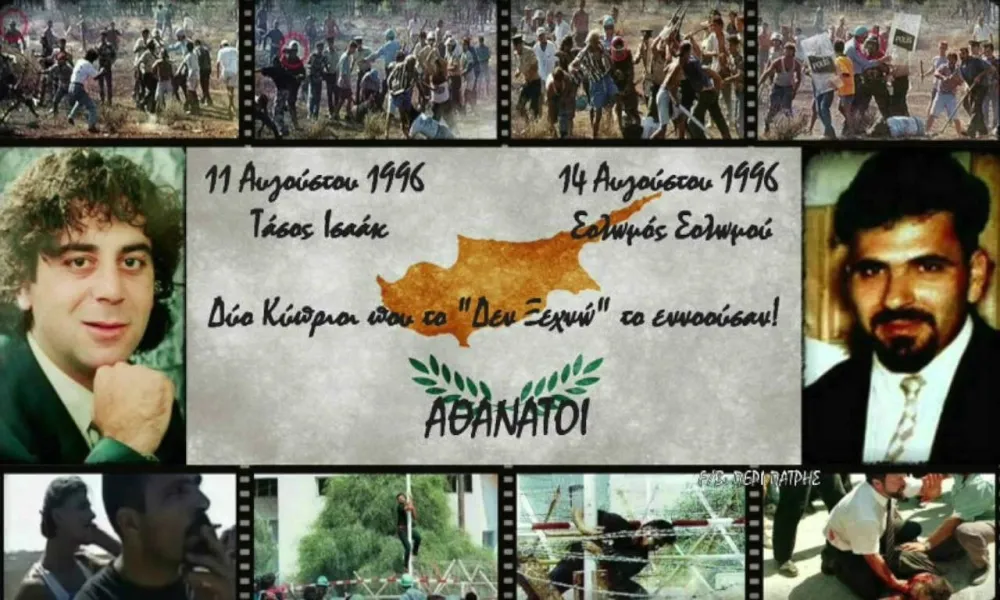
In the cases of Tassos Isaac and Solomos Solomou, the Republic of Cyprus rightly offered rewards for information leading to the arrest of the suspects and sought their punishment internationally, invoking international law and the protection of human rights.
By contrast, in the case of Doros Loizou's murder, there was neither an official reward nor political willingness to reopen the file.
No one was brought to justice, even though the perpetrators were Greek Cypriots and not individuals beyond the state's jurisdiction.
This leads to the conclusion that the Republic is strict when the perpetrator is "the other" – a Turk, a settler or a member of the occupying forces – but falls silent when the perpetrator is "one of us".
The essence of these three murders is that there is a truth the Cypriot state avoids confronting directly: our Republic has been, and in many respects remains, selectively sensitive when it comes to justice.
The comparison is unavoidable and uncomfortable.
The Republic of Cyprus places the killers of Isaac and Solomou on wanted lists, denounces them internationally and seeks their prosecution. Rightly so.
But in the case of the murder of Doros Loizou and the attempted assassination of Vassos Lyssarides, the state chose silence.
And silence, in such cases, is not neutrality. It is a position.
The murder of Doros Loizou did not occur on foreign soil or at the hands of soldiers belonging to an occupying power. It was carried out by Greek Cypriot extremists in Nicosia, only weeks after the invasion.
The perpetrators were not beyond reach. For the police, they belonged to known circles, followed known routes and maintained known connections.
And yet no one was arrested. No one was seriously questioned. No one appeared before a court.
The case was closed without ever truly being opened.
If this does not constitute hypocrisy, then what does?
How can the Republic appear relentless when the murderer is "the other", yet freeze when the murderer is "one of our own"?
How can it seek international justice for crimes committed in 1996 while lacking the courage to confront crimes committed in 1974?
How can the Republic of Cyprus persistently request operational assistance from Europol to capture the killers of Isaac and Solomou while showing complete indifference towards punishing equally ruthless killers within its own house?
*Economist and social scientist