
By George Koumoullis*
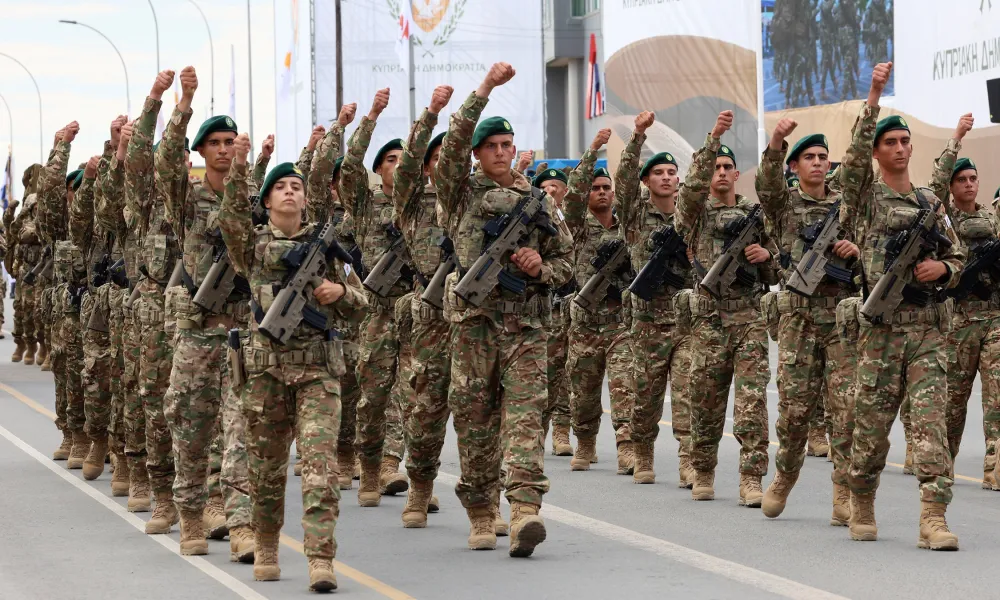
The parade held on Thursday to mark the anniversary of the independence of the Republic of Cyprus inevitably, I would say, triggered negative associations.
First of all, I was reminded of the world record Cyprus appears to hold in national holidays: nine in total, four observed by Greek Cypriots and five by Turkish Cypriots (April 23, Turkey's National Sovereignty Day; May 19, Atatürk Day; July 20, Freedom Day; August 1, the founding of TMT; and November 15, the declaration of the TRNC).
Most countries have one national holiday, and some have none at all. England, with all its rich history, does not have a single official national holiday. Poor thing! It could celebrate Trafalgar, which for the English is the ultimate naval victory that secured British dominance at sea for more than a century. Or the Battle of Waterloo, considered the decisive moment that permanently ended Napoleon's ambitions and established Britain as the dominant European power. Or even, limiting myself to just three examples, the Battle of Britain in 1940, the country's "finest hour", when the RAF repelled the Luftwaffe and prevented a German invasion, preserving Britain's independence.
The fact that we have so many national holidays would not be a problem per se were it not for the way they reinforce a predisposition towards intercommunal conflict that could lead to a new national tragedy and obstruct a viable settlement.
National holidays act as multipliers of tension, offering right-wing nationalist groups opportunities for mobilisation and displays of strength (see Dangerous Days: The Impact of Nationalism on Interstate Conflict in Security Studies). In the case of Cyprus, this translates into recurring rhetoric about the "liberation of the occupied territories", namely the notion that the expulsion of Turkish troops can be achieved through military means. This is a position that is not only politically dangerous but also strategically unrealistic, feeding illusions of strength and undermining any prospect of a peaceful settlement.
In short, Greek Cypriots and Turkish Cypriots have entered a vicious circle: more holidays lead to stronger nationalist sentiment, which in turn leads to even more holidays.
If we truly want to break this vicious circle before it swallows us, let us establish one day of the year as a common Cypriot day of remembrance. On such a day, Greek Cypriots and Turkish Cypriots would honour the victims of both communities, the human cost of the conflict, and the need for peace and reconciliation.
This would not erase history. Rather, it would demythologise it and turn it into common ground instead of a field of confrontation.
This does not mean abolishing all national holidays. It means giving them a different meaning. Moving from the reproduction of conflict to the memory of coexistence. From displays of national strength to recognition of shared trauma. From ritual polarisation to political maturity.
And if some react by saying that words are meaningless, I would answer with another proverb: "If the bride and groom are willing, the father-in-law does not matter."
Yes, the Republic of Cyprus celebrated its independence day "magnificently" the day before yesterday. Yet the state itself remains contested in the historical memory of a large part of both communities.
For Greek Cypriots, independence in 1960 was never the ideal destination. On the contrary, it was a compromise that halted the pursuit of Enosis. Independence was never our objective. In fact, our independence was "won" because EOKA was defeated, but that is not politically correct for our leaders to say, nor, of course, is it mentioned in school history textbooks.
For Turkish Cypriots, the period of independence between 1963 and 1974 is associated with fear, insecurity and violence. Furthermore, there is a prevailing perception that the Greek Cypriot side "seized" the state and turned it into a mono-communal entity.
That narrative is today dominant in Turkish Cypriot public discourse and is reinforced by their political leadership, which emphasises that Turkish Cypriots are "equal founding partners" who were sidelined after 1963.
Thus, the national holiday of the Republic of Cyprus does not function as a shared site of memory, but as a reminder that Cyprus never acquired a unified national narrative.
That void is filled by other commemorations: March 25, October 28, July 20 and November 15. Each carries a burden that is not merely historical but political as well.
The parades, speeches, symbols, military marches, flags and references to "heroes" and "enemies" function as ritual representations of each community's national narrative. And because those narratives are competing ones, the celebrations do not unite but, on the contrary, divide.
In short, we celebrate our independence as if it has never been questioned, as if it has never been wounded, as if it has never failed to protect all of its citizens.
This ritual rigidity creates negative associations because it stands in complete contrast to historical experience: a state that failed to prevent partition, failed to build a common political identity between Turkish Cypriots and Greek Cypriots, and continues to function with two parallel memories and two parallel narratives.
Yet every year the October 1 parade is presented as a display of "national unity". In practice, however, it does not unite. It simply reproduces the same lines of division that sustain partition and political mistrust between the two communities.
Instead of serving as a moment of reflection, the anniversary serves to reaffirm a narrative that suits those who do not want anything to change.
That is why the negative associations are not accidental.
*Economist and social scientist.