
By Giorgos Koumoullis, economist and social scientist.
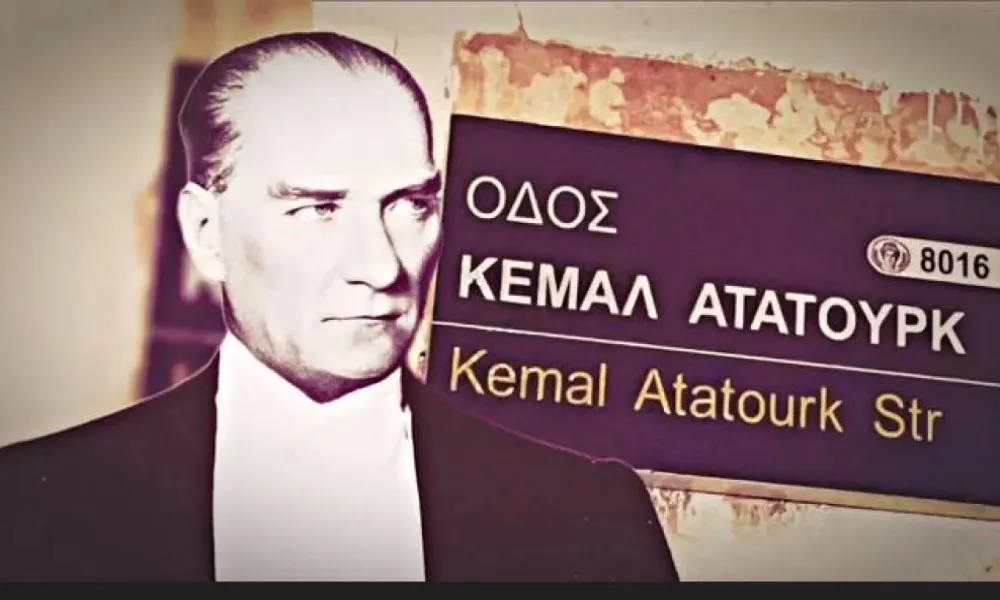
On 5 October, just a few days ago, the Paphos Municipal Council voted by majority to rename Kemal Atatürk Street in the Mouttalos neighbourhood to Memory and Hope Street. The municipal groups of DISY and ELAM supported the renaming, while those of DIKO and AKEL abstained. In other words, not a single municipal councillor opposed the proposal.
Equally disappointing was the government's stance, maintaining complete silence despite the Municipality of Paphos requesting an official position on the matter. And for some inexplicable reason, the issue did not receive the media attention one would have expected, whether in breadth, intensity or prominence. Why?
The decision by the Municipality of Paphos is not merely unfortunate. It is an act of political awkwardness, a move that shows we still have not decided whether we want to be a serious state or an emotionally reactive community. When for decades we have condemned the alteration of place names by the occupation regime, we cannot imitate, even on a smaller scale, the very same practices. That is not consistency. It is self-sabotage.
The Republic of Cyprus needs consistency, seriousness and a clear strategic orientation. It needs to differ from the example of the so-called "TRNC", not imitate it. The Republic loses the moral advantage it invokes internationally: that unlike the occupation regime, it does not tamper with historical memory.
Acting mayor of Paphos Angelos Onisiforou argued that the new name "symbolises respect for history, peace and hope for a better future".
What irony.
The reality is the exact opposite. The renaming shows no respect for history and undermines hope for a better future.
"Memory" does not mean erasure. It means recognition.
The historical memory of Mouttalos is specific. It was a Turkish Cypriot neighbourhood, with street names reflecting the identity of the community that lived there. Erasing those names is not memory. It is selective amnesia.
Nor is "hope" built upon the distortion of history. Hope for peaceful coexistence does not emerge from eliminating the difficult parts of our shared journey. On the contrary, it comes from accepting them. Reconciliation requires the courage to view history as it is, not as we wish it to be.
That is why the new name represents a profound irony, because it cancels out its own title.
How can an act that removes memory be called "Memory"?
How can an act that undermines the consistency of the Republic of Cyprus be called "Hope"?
Even the mottled goat would laugh.
Reconciliation, members of the Paphos Municipal Council, is achieved not through erasure but through recognition. If we want genuine peace and coexistence, we must show respect for the historical presence of Turkish Cypriots in the south rather than trying to erase it. Preserving the name is not a tribute to Atatürk. It is respect for historical reality.
Some ardent Greek nationalists will object that Atatürk was the greatest enemy of the Greeks and should not be honoured.
But Atatürk was not honoured by the Republic of Cyprus. Greeks did not choose the name. It was chosen by the Turkish Cypriot community that lived in Mouttalos before 1974.
Therefore, this is not a Greek concession. It is a historical fact.
Preserving a historical fact does not mean accepting it. It means respecting reality as it was, not as we would prefer it to have been.
If we begin erasing everything that makes us uncomfortable, then we are no different from the occupation regime, which does exactly the same thing: erasing memory.
Ultimately, changing the name does not correct history. It distorts it. And in a country struggling to restore historical truth, that is the wrong message at the wrong time.
The renaming of Atatürk Street inevitably brings to mind another equally unacceptable decision: that of the Municipality of Nicosia in the 1960s, when, for "national reasons", the name of George Canning was removed from a central side street off Diagorou Avenue.
At the time, the move was presented as "nationally necessary", but in reality it reflected the same logic of selective memory that we see being repeated today.
Perhaps those municipal councillors did not know the role Canning played in securing Greek independence.
As Britain's foreign secretary and later prime minister, Canning promoted the idea of an independent Greek state. He was the man who broke European inertia, brought the Great Powers to the same table and paved the way for Navarino, the first and only moment when international diplomacy chose to stand practically beside the Greeks.
He did not liberate Greece with an army.
He liberated it through political will.
Had it not been for Canning, Greece would not exist today, and we ourselves would likely have been Islamised long ago.
Instead of honouring Canning with a grand monument, as the Athenians did with Georgiou Canning Square, better known as Kaningos Square, Nicosia chose in the 1960s to erase his name from a small side street.
It was the very least recognition we could have offered him.
Yet even that was removed for "national reasons".
What can one say?
Ignorance of history? Ingratitude? Thanklessness? Pettiness?
Whatever the case, we should be ashamed.
The abolition of Atatürk and Canning streets is not a simple correction on a map.
It is evidence of a country struggling with its own memory.
When we erase what makes us uncomfortable, we do not build hope. We build oblivion.
And oblivion is not politics. It is avoidance.
Cyprus will not move forward by erasing names.
It will move forward by recognising its history.
All of its history.