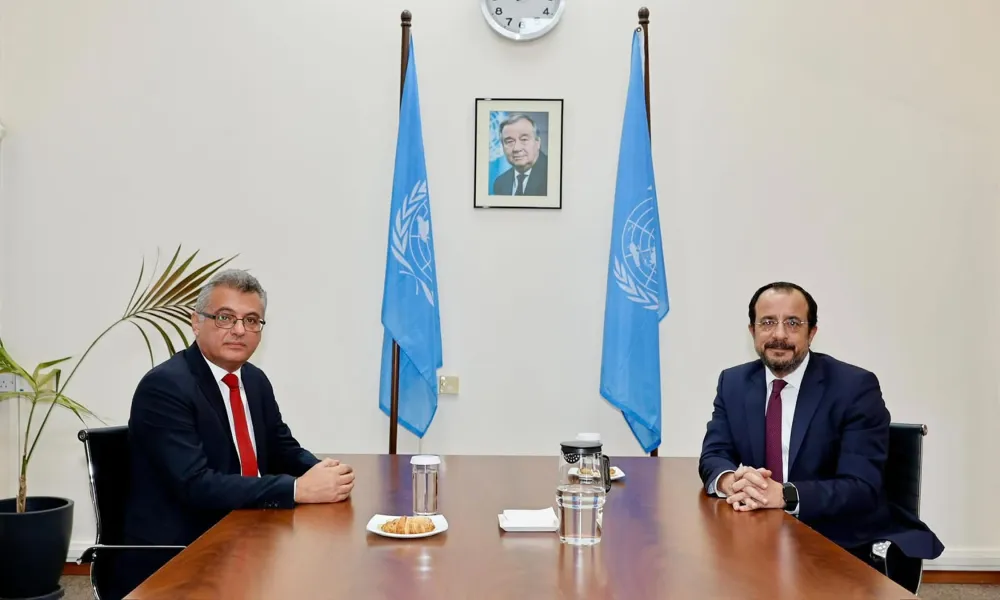

Cyprus has once again become the meeting point of two conflicting diplomatic currents. On the island, Turkish Cypriot leader Tufan Erhürman and Greek Cypriot leader Nikos Christodoulides are attempting to rebuild confidence and establish a workable framework for negotiations. Beyond its shores, however, the Eastern Mediterranean is experiencing renewed confrontation following eastern Libya’s endorsement of the 2019 Türkiye–Libya maritime delimitation memorandum.
The timing could hardly be more sensitive. While United Nations envoy María Ángela Holguín prepares to return to Cyprus on October 29, the European Union, Greece and the Greek Cypriot administration have intensified their objections to Türkiye’s maritime claims. Israel has also expressed concern, adding another dimension to the regional alignment surrounding Cyprus.
For the Turkish Cypriot side, these developments raise a familiar but increasingly consequential question: Can meaningful negotiations take place when the Greek Cypriot leadership enjoys the institutional backing of the European Union, while Turkish Cypriots remain excluded from the Republic of Cyprus’s international representation and much of the island’s external decision-making?
The answer matters because Cyprus is no longer simply a territorial and constitutional dispute. It has become inseparable from energy security, maritime jurisdiction, regional defence cooperation and the balance of influence between Türkiye and its Eastern Mediterranean neighbours.
A diplomatic opening overshadowed by maritime confrontation
The October 20 meeting between Erhürman and Christodoulides illustrated both the possibilities and limitations of the current diplomatic process. According to the United Nations, the leaders discussed confidence-building measures, negotiating methodology and substantive issues, agreed to pursue environmental and cultural heritage initiatives, and confirmed plans for separate meetings with Holguín before a trilateral encounter on November 9. They also agreed to meet again the following week.
These developments are encouraging, but their significance should not be exaggerated. The leaders have maintained direct contact, yet they have not resolved the disagreements that have prevented a return to comprehensive negotiations. Their immediate achievements concern cooperation in relatively uncontroversial fields, rather than the constitutional and security questions at the centre of the Cyprus problem.
The distinction is important. Joint work on environmental protection, cultural heritage and youth participation can create practical benefits and encourage interaction between the communities. Such initiatives may also help counter the accumulated mistrust of decades of division. Nevertheless, they cannot substitute for agreement on political equality, effective participation in federal decision-making, security arrangements or the structure of a future settlement.
For Erhürman, the negotiating methodology is particularly important. His insistence on prior acceptance of political equality, including a rotating presidency and an effective Turkish Cypriot vote in federal institutions, is intended to prevent another open-ended negotiating process in which previously established principles become bargaining instruments.
This position also reflects a concern that emerged from earlier negotiations, particularly the unsuccessful Crans-Montana conference in 2017. The Turkish Cypriot argument is that political equality must be recognised as a constituent principle of a settlement, not offered in exchange for concessions on security and guarantees.
Christodoulides approaches the sequence differently. His preference is to move more quickly toward substantive negotiations, drawing on earlier convergences and seeking stronger international involvement. The Greek Cypriot leadership also regards the European Union as an important diplomatic and institutional participant in any renewed process.
Neither approach is necessarily incompatible with negotiations. The difficulty arises when the parties disagree over whether essential principles must be accepted before talks resume or can be clarified during the negotiating process itself.
In his October 20 analysis for the Greek Cypriot newspaper Politis, Stefanos Evripidou reported that methodology and substance were expected to dominate Holguín’s forthcoming discussions. He also highlighted Christodoulides’ suggestion that progress in Türkiye–EU relations could influence prospects for a broader Cyprus conference.
That connection is becoming increasingly consequential.
Libya’s decision and the Cyprus dimension
The eastern Libyan parliament’s October 20 endorsement of the 2019 maritime memorandum has substantially strengthened Türkiye’s diplomatic position within Libya, but it has not settled the international dispute over the agreement.
The distinction between political legitimacy and international legal effect is essential. Ankara can now point to support from political institutions on both sides of Libya’s longstanding division. This weakens the argument that the memorandum is merely an arrangement with one Libyan faction. However, approval by the eastern parliament cannot, by itself, determine maritime boundaries affecting third countries.
The European Union responded by reaffirming its established rejection of the agreement. In a joint statement, European Council President António Costa and European Commission President Ursula von der Leyen maintained that the memorandum infringes upon third-state sovereign rights and cannot create legal consequences for them. The statement expressly reaffirmed solidarity with Greece and Cyprus.
From Ankara’s perspective, the European position reflects an enduring imbalance in the EU’s Eastern Mediterranean policy. Türkiye maintains that maritime delimitation must take account of coastal geography, proportionality and equitable principles, rather than automatically assigning maximal maritime effect to every island.
Greece and the Republic of Cyprus counter that the Turkish-Libyan delimitation disregards the maritime entitlements of Greek islands and overlaps with areas in which third states claim sovereign rights.
The legal disagreement is more complex than either side’s political slogans suggest. Islands can generate maritime entitlements under international law, but their precise effect in an equitable delimitation may vary with geography and other relevant circumstances. Equally, a bilateral agreement cannot conclusively determine the rights of states that are not parties to it.
For Cyprus, the significance extends beyond the precise location of the Türkiye–Libya maritime boundary. The memorandum has become part of a broader contest over who determines the Eastern Mediterranean’s maritime, energy and security arrangements.
The Greek Cypriot leadership sees the agreement as another demonstration of Ankara’s willingness to challenge maritime arrangements supported by Nicosia and Athens. Türkiye, conversely, sees the Greek Cypriot administration’s participation in regional energy initiatives as part of an effort to exclude Türkiye and Turkish Cypriots from decisions affecting their legitimate interests.
This competing understanding of exclusion lies at the heart of the regional dispute.
The EU’s institutional imbalance
The controversy exposes a structural weakness in the relationship between the European Union and the Cyprus settlement process.
The Republic of Cyprus joined the EU in 2004, despite the island’s continuing division and the rejection of the UN-sponsored Annan Plan by the Greek Cypriot electorate. EU law remains suspended in the northern part of the island where the internationally recognised government does not exercise effective control.
Consequently, the Greek Cypriot administration participates in European decision-making as the government of an EU member state, while Turkish Cypriots have no equivalent institutional voice.
This asymmetry does not invalidate the Republic of Cyprus’s EU membership or its internationally recognised status. It does, however, create a political problem for negotiations based on the principle that the two communities should participate effectively in determining the island’s constitutional future.
The EU’s immediate endorsement of the Greek and Greek Cypriot objections to the Libyan memorandum reinforces Turkish Cypriot concerns that Brussels is not positioned to act as an impartial intermediary in disputes involving Ankara and Nicosia.
EU foreign policy chief Kaja Kallas made the connection explicit following her meeting with Fidan in Brussels on October 21. She identified good neighbourly relations and progress toward a Cyprus settlement as priorities while reiterating objections to the Turkish-Libyan agreement.
For Ankara, this raises the question of whether improvements in Türkiye–EU relations can realistically be separated from the unresolved Cyprus problem.
For Nicosia, the answer appears increasingly clear: progress in the relationship should be accompanied by changes in Turkish policy concerning Cyprus and the Eastern Mediterranean.
For Turkish Cypriots, however, there is a danger that their constitutional and political concerns could become subordinate to a wider negotiation between Ankara and Brussels.
A sustainable settlement cannot emerge from such a hierarchy. Turkish Cypriot political equality cannot be treated as a concession that Türkiye must purchase through adjustments to its maritime or security policies.
The Great Sea Interconnector: A practical test
The Great Sea Interconnector, intended to connect the electricity systems of Greece, Cyprus and ultimately Israel, illustrates how regional energy cooperation can become entangled in unresolved maritime disputes.
For the Greek Cypriot administration, the project promises improved electricity connectivity, reduced energy isolation and stronger integration with the European energy market. It also carries strategic significance by linking Cyprus more closely to Greece and Israel.
For Türkiye, the central objection concerns activities in maritime areas where Ankara asserts continental shelf rights. Turkish officials have indicated that they do not oppose electricity interconnection as such, but dispute the assumption that surveys and infrastructure work can proceed in contested areas without addressing Turkish claims.
The distinction between the project’s purpose and the legal basis for conducting offshore activities matters. A project may offer genuine economic and environmental benefits while still encountering disagreements over the jurisdiction governing its construction.
The problem for Cyprus is that the electricity project is increasingly being treated as a demonstration of geopolitical resolve rather than primarily as infrastructure.
The October 20 Libyan decision adds to the tension because it strengthens Ankara’s political confidence in defending the maritime framework established by the 2019 memorandum.
Greece and the Republic of Cyprus, meanwhile, cannot readily accept a procedure that appears to recognise Turkish jurisdiction over areas they consider subject to Greek or Cypriot maritime rights.
This creates a familiar diplomatic dilemma: practical cooperation may be technically possible, but the parties fear that procedural accommodation could be interpreted as legal recognition.
For Turkish Cypriots, another issue deserves attention. The island’s electricity future should not be considered exclusively through the strategic preferences of Athens, Ankara or the Greek Cypriot administration. A comprehensive approach would also examine the benefits of electricity interconnection between the two communities, renewable energy integration and possible connections with Türkiye.
Such cooperation would not require the parties to abandon their political positions. It would, however, demonstrate that regional energy security need not depend entirely on competing geopolitical blocs.
Israel, Greece and Cyprus: Converging interests, different priorities
Israel’s criticism of the Türkiye–Libya memorandum has reinforced the impression of an increasingly coordinated diplomatic response involving Israel, Greece and the Republic of Cyprus.
Yet these actors do not have identical interests.
Greece is directly concerned about maritime delimitation and the potential impact of the memorandum on areas south and east of Crete. The Greek Cypriot administration is concerned about its regional energy partnerships, its diplomatic position and the implications for relations with Türkiye. Israel’s concerns are more closely associated with regional security, energy connectivity and its wider strategic rivalry with Ankara.
Reporting by Pierros I. Tzanetakos in To Vima on October 22 described Athens’ efforts to mobilise European and regional partners following the Libyan vote. The analysis also noted Egyptian opposition to the agreement and renewed discussion of the Greek-Egyptian maritime delimitation framework.
The resulting alignment is politically significant, but it should not automatically be described as a unified anti-Turkish alliance. The participants have different priorities, and their willingness to accept diplomatic or economic costs in a confrontation with Ankara may differ substantially.
Nevertheless, the implications for Cyprus are serious.
As cooperation among Greece, the Republic of Cyprus and Israel becomes increasingly associated with strategic competition against Türkiye, the possibility of developing inclusive regional arrangements becomes more remote.
This is particularly problematic for the Cyprus settlement process. The more the island is integrated into competing security and energy alignments, the harder it becomes to persuade either community that a compromise settlement would improve its security rather than weaken its position.
Crossing points: A smaller dispute with larger implications
While the regional confrontation dominates diplomatic headlines, the most immediate test of the Cyprus process remains considerably more modest: whether the leaders can agree on additional crossing points.
The issue is practical, affecting commuting, family relationships, trade and everyday contact. Yet it has acquired symbolic importance because the parties have repeatedly failed to implement measures that are far less complicated than a comprehensive settlement.
Following the October 20 meeting, Christodoulides said one crossing proposal had been rejected while another remained under consideration. The Pyroi–Athienou crossing continued to feature prominently in the Greek Cypriot position.
The Turkish Cypriot side has emphasised the need for a balanced package that accommodates different communities and regions, including the Louroujina/Akıncılar area. The disagreement is not simply about road construction. It concerns reciprocity, the distribution of benefits and whether one side can secure its preferred crossing while postponing those requested by the other.
The United Nations has repeatedly encouraged the parties to make progress on confidence-building measures. Yet the inability to agree on crossings illustrates how the larger political dispute continues to shape even relatively modest initiatives.
A simultaneous package of openings, accompanied by agreed financing and implementation arrangements, would offer a more credible demonstration of cooperation than another series of unilateral proposals.
It would also help Holguín establish whether the leaders are prepared to move beyond public declarations of goodwill.
Varosha and the danger of bargaining over principles
The renewed discussion of Varosha/Maraş further demonstrates the sensitivity of linking confidence-building initiatives with substantive settlement questions.
Christodoulides has proposed arrangements involving the fenced-off area of Varosha under UN administration and the operation of Famagusta port under an EU framework. Erhürman has rejected the proposal as insufficiently balanced.
For the Greek Cypriot side, Varosha carries particular importance because of displacement, property rights and the longstanding UN resolutions concerning the area.
For the Turkish Cypriot side, the proposal raises questions about reciprocity, sovereignty, administrative authority and the relationship between territorial concessions and a comprehensive settlement.
The underlying problem is not that Varosha should be excluded from discussions. On the contrary, it will inevitably form part of any serious settlement process. The difficulty arises when proposals affecting such a politically sensitive area are presented without an agreed negotiating framework.
Erhürman’s insistence on methodology is therefore more than procedural caution. It reflects an attempt to prevent the negotiating process from reverting to a pattern in which political equality, security guarantees and territorial adjustments become interconnected before the parties have agreed on the principles governing those negotiations.
His position is not without risks. Excessive emphasis on pre-negotiation conditions could produce another prolonged preparatory phase. Nevertheless, the Turkish Cypriot concern that negotiations must not simply recreate earlier deadlocks deserves serious consideration.
A workable compromise would require the Greek Cypriot side to recognise political equality, including effective participation and rotating leadership, as an indispensable feature of the agreed federal framework, while allowing the detailed constitutional, territorial and security arrangements to be negotiated in a structured and time-bound process.
Holguín’s opportunity, and Guterres’ limited time
The diplomatic calendar now offers a narrow opportunity.
Holguín is expected to return on October 29, followed by separate meetings with the leaders and a trilateral encounter on November 9. The UN has confirmed these arrangements and the leaders’ intention to continue direct discussions.
The challenge is to turn this sequence of meetings into an agreed negotiating method.
Three elements are essential.
First, the parties need a clear understanding of political equality and effective participation. Without it, the Turkish Cypriot side is unlikely to accept a return to negotiations that could reproduce the difficulties of previous rounds.
Second, confidence-building measures must produce visible results. Progress on crossings, cultural heritage and environmental cooperation would help establish that agreements can be implemented.
Third, the parties need clarity on the status of previous convergences, the timetable for negotiations and the consequences of another failure. Open-ended talks without agreed objectives would be unlikely to restore public confidence.
The approaching conclusion of António Guterres’ term as UN Secretary-General on December 31 adds urgency. His administration has invested considerable diplomatic effort in preserving the possibility of a settlement, but time is running short for another substantial initiative under his leadership.
The coming weeks may therefore determine whether the process moves toward an enlarged meeting involving the two communities and the guarantor powers, or enters another period of diplomatic stagnation.
A choice between competing blocs and shared interests
The latest developments reveal a fundamental contradiction in Eastern Mediterranean diplomacy.
The region has considerable potential for cooperation in electricity, renewable energy, environmental protection, maritime transport, trade and security. Yet its governments increasingly approach these opportunities through competing claims of jurisdiction and strategic influence.
Cyprus sits at the centre of that contradiction.
The Greek Cypriot administration enjoys the diplomatic advantages of EU membership and increasingly close cooperation with Greece and Israel. The Turkish Cypriot side depends heavily on Türkiye for its security, economic connectivity and international engagement. Each community consequently views the regional environment through a different strategic lens.
Neither dependence can be ignored, but neither should determine the island’s political future.
A durable settlement would require restoring a workable balance between internal political equality and external security. That does not mean disregarding the internationally recognised status of the Republic of Cyprus or denying the legitimate concerns of Greek Cypriots. It means acknowledging that an arrangement which leaves Turkish Cypriots without effective participation in decisions affecting the island cannot produce lasting stability.
Equally, the security and rights of Greek Cypriots cannot be treated as secondary to Türkiye’s regional strategic objectives.
The challenge is to construct a settlement in which the two communities can exercise meaningful political authority while participating in shared institutions capable of managing their common interests.
The latest maritime confrontation makes this task more difficult, but also demonstrates why it remains necessary.
What comes next?
Four developments will determine the immediate direction of events.
The first is whether Erhürman and Christodoulides can achieve a tangible agreement on crossing points before or during Holguín’s visit. The second is whether the UN can secure agreement on negotiating methodology, particularly the treatment of political equality and previous convergences.
The third is whether the EU’s objections to the Türkiye–Libya memorandum remain diplomatic or begin to affect concrete decisions concerning Türkiye–EU relations, infrastructure financing and maritime activities. The fourth is whether the Great Sea Interconnector becomes a platform for technical accommodation or a new source of confrontation.
The most important conclusion, however, concerns Cyprus itself.
Libya’s parliamentary decision has strengthened Ankara’s diplomatic position in one part of the Eastern Mediterranean dispute, while simultaneously reinforcing the determination of Greece, the Greek Cypriot administration and Israel to resist Turkish maritime claims. Neither development resolves the island’s constitutional problem.
The two Cypriot leaders must therefore avoid allowing their negotiating agenda to become hostage to wider regional competition.
The October 20 meeting demonstrated that dialogue remains possible. The environmental and cultural initiatives showed that practical cooperation can still be pursued. But the continuing disagreement over crossings and methodology confirmed that goodwill alone is insufficient.
The real test is whether the leaders can transform limited cooperation into an agreed political process that recognises the security concerns of both communities and the political equality of Turkish Cypriots.
Without that foundation, Cyprus risks becoming an increasingly important strategic asset for competing regional powers while remaining politically divided and unable to determine its own future.