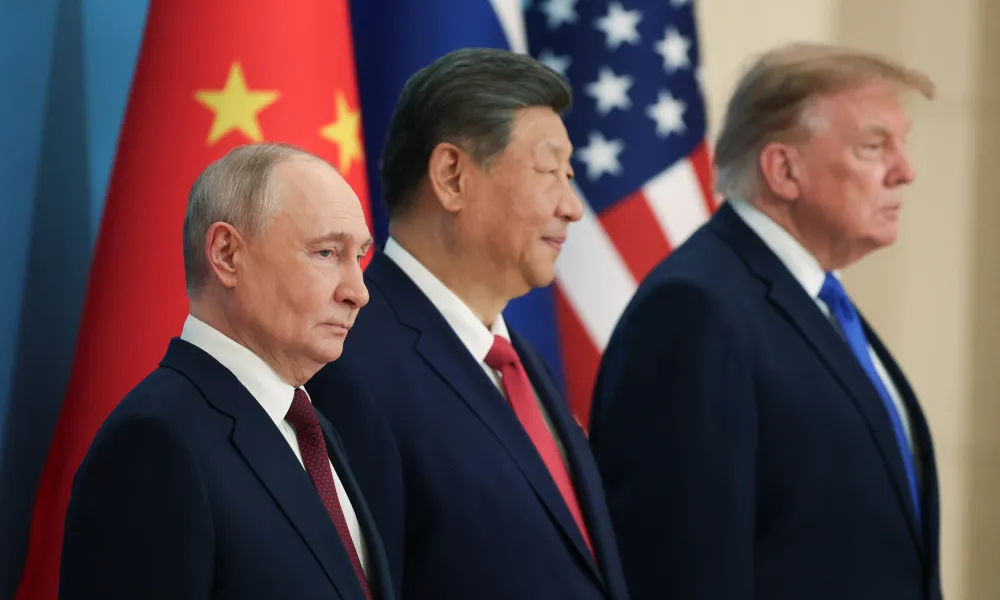

The summit meeting between Xi Jinping, Donald Trump and Vladimir Putin in Shenzhen allowed the Russian leader to present himself as a participant in shaping international security while Russia's invasion of Ukraine remained absent from the joint declaration. Beyond that, the meeting left little in the way of a major diplomatic breakthrough, while Europe's absence from the discussions was also notable.
In Shenzhen, three permanent members of the UN Security Council met to discuss international security while one of those countries continues to wage war against a neighbouring state. Yet in the declaration released by Beijing and Moscow, there was no reference to the war in Ukraine.
That omission may have been Putin's most significant diplomatic gain from the meeting. It enabled him to appear as a partner in discussions on strategic stability while Russia's invasion remained absent from the public outcome of the summit.
Discussion of reducing the nuclear threat has value in its own right. Washington has reasons to maintain channels of communication with both Moscow and Beijing, even at times of acute confrontation. In Shenzhen, however, the three leaders sought a broader role in managing international security and even discussed reform of the United Nations.
That ambition makes the silence on Ukraine more striking. The UN General Assembly has already condemned the Russian attack as a violation of the UN Charter and called for an end to the use of force.
The precedent of silence
The declaration leaves intact the prohibition on the use of force against the territorial integrity of a state. The precedent it may create is political rather than legal.
If a major power can invade a neighbouring country and, while the war is still ongoing, sign declarations on international security that make no mention of that invasion, it provides an argument for those who wish to downplay similar actions.
A territorial occupation that has already taken place can gradually come to be treated as a fact of negotiations. A future violation may be viewed as a cost that diminishes over time. The silence of a summit gains weight when it is repeated and begins to determine which events are considered worthy of mention.
The declaration's reference to immunity for state officials and the avoidance of what it described as abuse of the jurisdiction of the International Criminal Court reinforces that interpretation.
An arrest warrant remains outstanding against Putin. Moscow can therefore point to a declaration that omits the war while making room for language that is favourable to the Russian president in the wider debate on accountability.
Europe left out
The major absentee from the summit was Europe.
The European Union has extended its restrictive measures against individuals and entities deemed responsible for undermining Ukraine's territorial integrity, sovereignty and independence until September 2029.
Yet neither the EU nor Ukraine itself had a seat at the table in Shenzhen.
Those sanctions provide Europe with economic and political leverage. However, Europe's absence from the meeting demonstrates how easily the public agenda of a major summit can be shaped without European participation, even when the conflict in question directly affects the continent's security.
For Putin, the gain was the opportunity to claim a role in shaping the rules of international security without the summit declaration explicitly referring to the violation for which Russia has been condemned by the UN General Assembly.
For Ukraine and Europe, the question is whether this omission will remain a feature of a single trilateral meeting or whether it will be repeated in future gatherings.
If it is repeated, discussions on European security risk beginning with whatever the major powers are prepared to agree among themselves, while the right of a country to determine its own territory and future is treated as an issue that can wait.
That is a prospect with implications not only for Ukraine, but also for Cyprus.