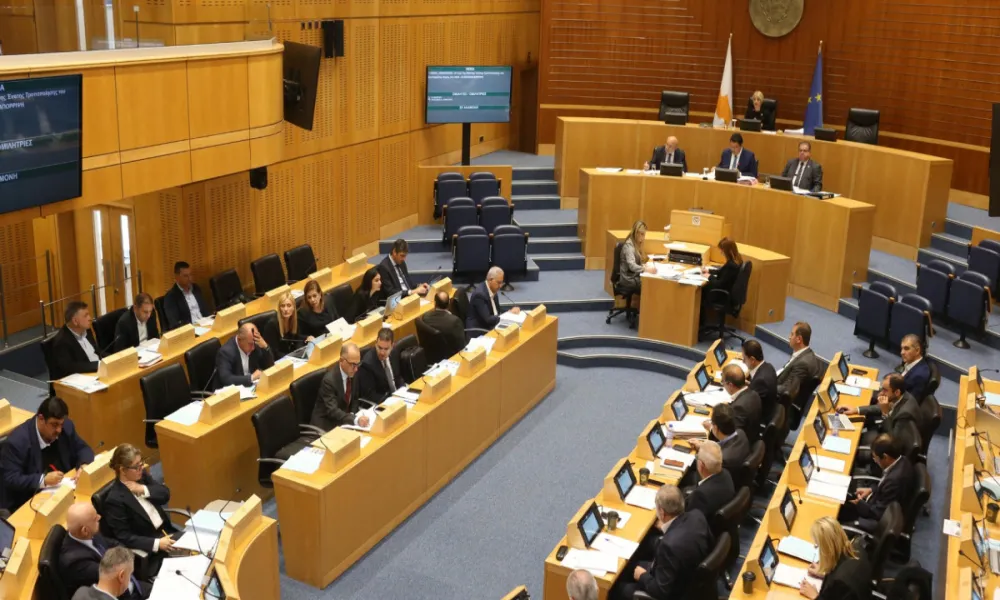
The House of Representatives was dissolved on Thursday, leaving the next parliament to decide on three bills that would increase both the number and salaries of parliamentary assistants employed by parties and MPs.
The move avoids a potentially sensitive vote on the issue just weeks before the parliamentary elections.
Parliamentary assistants are hired by parties and MPs to support their work in the House, but their salaries are paid by the state. There are currently 100 such assistants, with €5.6 million included in the House’s 2026 budget to cover their payroll.
The three bills provide for an increase in their number from 100 to 115, salary progression from scale A8 to the combined A8-10-11 scale, and stricter rules aimed at preventing nepotism in parliament.
If approved by the new House, the annual cost of employing parliamentary assistants will exceed €6 million. This amounts to an indirect state subsidy to political parties, in addition to the €7 million they receive each year based on their performance in the previous parliamentary elections.
Hired Without Open Competition
Parliamentary assistants are employed on contracts by parties and MPs, while their salaries are covered by the state. The positions are not publicly advertised, on the grounds that assistants must have the trust of the MPs and parties they serve.
With the exception of four or five assistants hired through written exams when the system was introduced about 25 years ago, the rest are recruited through summary procedures. Most are people personally known to MPs or party officials.
Under the law, parliamentary assistants must meet minimum requirements. They must be citizens of Cyprus or another EU member state, be at least 21 years old, hold a university degree, have a clean criminal record, have no blood or marital relation with serving MPs, and must not have been dismissed for disciplinary reasons from the public or wider public sector in Cyprus or the EU. Male candidates must also have completed or been legally exempted from military service.
€11,287,904 Paid in 2025
In the name of transparency and public accountability, the Treasury of the Republic published on its website on March 30, 2026, the grants paid by the state in 2025.
According to the data, parliamentary parties and their youth organisations received €7 million in direct state funding, as well as €4.2 million in indirect funding to cover the cost of employing parliamentary assistants. The total came to €11,287,904.
What The Bills Provide
Under the proposed changes, each parliamentary party would be entitled to employ twice as many parliamentary assistants as the number of seats it holds. Any independent MP would be entitled to employ two assistants.
As the election of an independent MP is considered unlikely, the parties entering parliament next month would employ a total of 112 parliamentary assistants, based on 56 seats multiplied by two.
Each representative of a religious group would continue to be entitled to one parliamentary assistant. This applies to the Armenian, Latin and Maronite religious groups. Their three assistants would bring the total to 115, up from the current 100.
The bills also expand the conflict-of-interest rules on family ties. The current first-degree kinship restriction would be replaced by a ban on employment where there is blood or marital relation up to the third degree with the MP or religious group representative signing the contract, as well as first-degree kinship with any other serving MP or representative.
The assistants’ salaries would also be calculated on the combined A8-10-11 pay scales, instead of the current A8 scale. Under the current system, assistants remain stuck on A8, with some having remained on that scale for 20 years.
New House, New Assistants
A large number of MPs will not seek re-election, while others may fail to return to parliament. Their parliamentary assistants will also leave with them.
At the same time, new parties expected to enter the House, as well as newly elected MPs, will move to hire their own assistants.