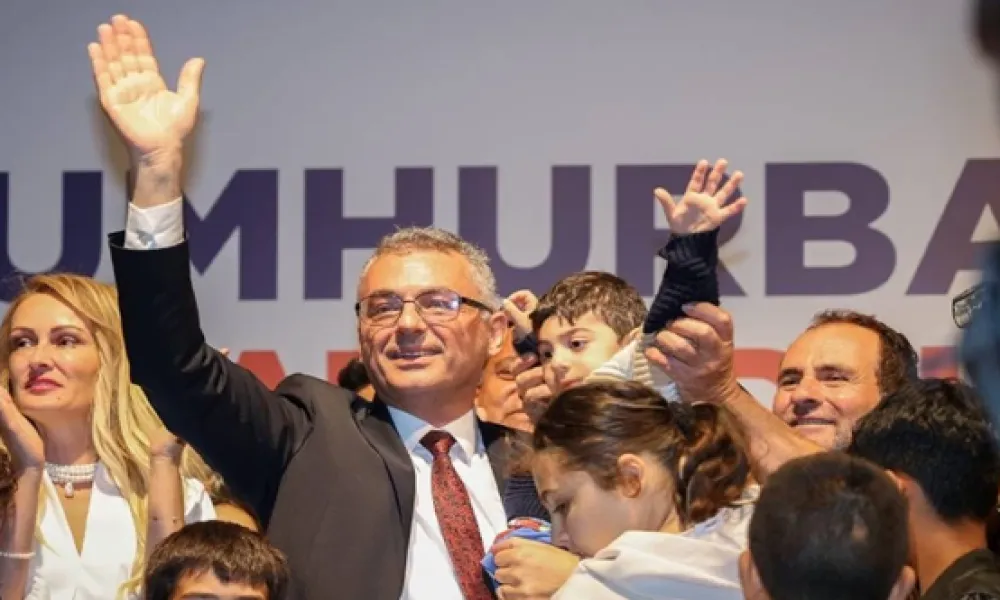

Turkish Cypriot leader Tufan Erhürman has criticised President Nikos Christodoulides over the Great Sea Interconnector electricity project linking Cyprus and Greece, and Energean’s proposal for a pipeline from Israel to Cyprus, arguing that “decisions on energy or maritime jurisdictions cannot be made while ignoring the sovereign rights and will of the Turkish Cypriots.”
Mr Erhürman said that “while Mr Christodoulides is calling for the resumption of comprehensive settlement talks, Turkish Cypriots are once again being ignored, as Greek Cypriots participate in efforts to transfer Israeli natural gas to Cyprus via an undersea pipeline.”
“This,” he added, “is not a positive sign in terms of sincerity,” stressing the need to create a positive climate for a Cyprus settlement.
Pipeline to Turkey
On Monday, Turkish daily Hürriyet published an analysis by columnist Hande Fırat, referring to comments made by US Ambassador to Ankara and Special Envoy for Syria, Tom Barrack, who ruled out the possibility of a conflict between Israel and Turkey, stating that the US seeks cooperation “from the Caspian Sea to the Mediterranean.”
Fırat suggested that the Ambassador’s comments reflect a new US strategic vision for the region, which could include “an energy and trade corridor linking Azerbaijan, Turkey and Israel,” implying that a gas pipeline from Israel to Turkey is being considered.
However, senior fellow at the Atlantic Council’s Global Energy Center, Charalambos Ellinas, told Politis that the US is in fact promoting a corridor aimed at strengthening energy flows from the Caspian region to Europe, utilising Azerbaijani resources through Turkey, while reducing Russian and Iranian influence.
An old idea
Ellinas told Politis that the idea of an Energean pipeline to Cyprus was first raised in 2017, when George Lakkotrypis was Energy Minister, but was rejected by the Cypriot government at the time.
He explained that the idea has now resurfaced through the initiative of the Cyfield Group, which aims to secure natural gas supply for its planned power generation unit at Mari in Larnaca.
Ellinas said Cyfield is right to seek solutions for the Mari power project, as the company cannot wait indefinitely for natural gas to arrive in Cyprus - the delays, he noted, are costing the group financially. However, he stressed that a study is needed to determine whether importing gas through two separate projects is economically viable, given the incomplete terminal at Vasilikos.
Due to Cyprus’s relatively small gas demand, he added, building two import projects could make gas more expensive for local consumers.
Turkish Cypriots and Turkey
Asked about Erhürman’s reaction, Ellinas said the Turkish Cypriot community may argue that it also needs natural gas and that any project should meet the energy needs of the whole island. This, he suggested, could be addressed by importing additional liquefied natural gas (LNG) through the Vasilikos terminal once it is completed.
He also referred to Turkey’s position, noting that Ankara seeks to have a say in all regional energy projects and views a pipeline from Israel to Cyprus as a move that would politically align the two countries more closely.
When asked whether the proposed Israel–Cyprus pipeline conflicts with the idea of a pipeline from Israel to Turkey, Ellinas clarified that any such project to Turkey would be undertaken by Chevron, not Energean.
He expressed scepticism, however, about the likelihood of any Israel–Turkey pipeline, pointing out that Israel already has an export agreement with Egypt through the Leviathan field. He added that there is little political will in Israel for a pipeline to Turkey, as Tel Aviv does not trust Ankara due to the volatility in bilateral relations.
Moreover, Ellinas noted that Israel does not have excess gas available for export to Turkey, and Turkey itself has significant Black Sea reserves that can meet around 30% of its domestic needs. He added that Europe also has no pressing need for additional gas via Turkey.
Asked whether Turkey might try to block a pipeline from Israel to Cyprus, Ellinas said Ankara would not be able to do so without risking confrontation with Tel Aviv, in which case, he argued, the United States would side with Israel.
The bigger picture
Ellinas went on to discuss the renewed US interest in the Eastern Mediterranean, noting that the new Trump administration is advancing plans to address regional conflicts and strengthen its foothold in the area vis-à-vis Russia and China, which have sought to expand their influence by exploiting divisions among regional states.
He explained that Washington aims for Europe’s full independence from Russian natural gas by 2028, a goal it intends to achieve through increased exports of American liquefied natural gas (LNG) to European countries and the development of new pipelines.
Ellinas noted that this decoupling from Russian gas primarily affects Eastern European and Balkan states, and that the US is promoting the establishment of the so-called Vertical Gas Corridor (VGC) - a pipeline network stretching from northern Greece to Ukraine.
He said the necessary infrastructure already exists in Alexandroupoli and that the affected countries have agreed to move forward, meaning the project should be completed soon.
Once that happens, Ellinas added, US attention will shift more directly to the Eastern Mediterranean, focusing on resolving maritime boundary and jurisdiction issues. Achieving this, he stressed, will require progress on the Cyprus problem, as a step toward normalising relations between Greece and Turkey - and addressing the complications caused by the Turkey–Libya memorandum.
He argued that the memorandum effectively divides the Eastern Mediterranean in two, and that Turkey uses it as leverage to secure influence over all energy projects in the region.
However, Ellinas pointed out that US officials have recently visited Libya and that Chevron is preparing to return to the country. The company has also been granted four offshore blocks south of Crete, which are affected by the Turkish–Libyan memorandum - a factor increasing the urgency to resolve these disputes.
He added that the US places significant importance on Greece’s role in the region and supports the 3+1 format (Greece, Cyprus, Israel, and the US), while also backing Greek Prime Minister Kyriakos Mitsotakis’s proposal for a 5x5 Multilateral Framework, bringing together five countries and five thematic areas. This framework includes Greece, Cyprus, Egypt, Turkey and Libya.