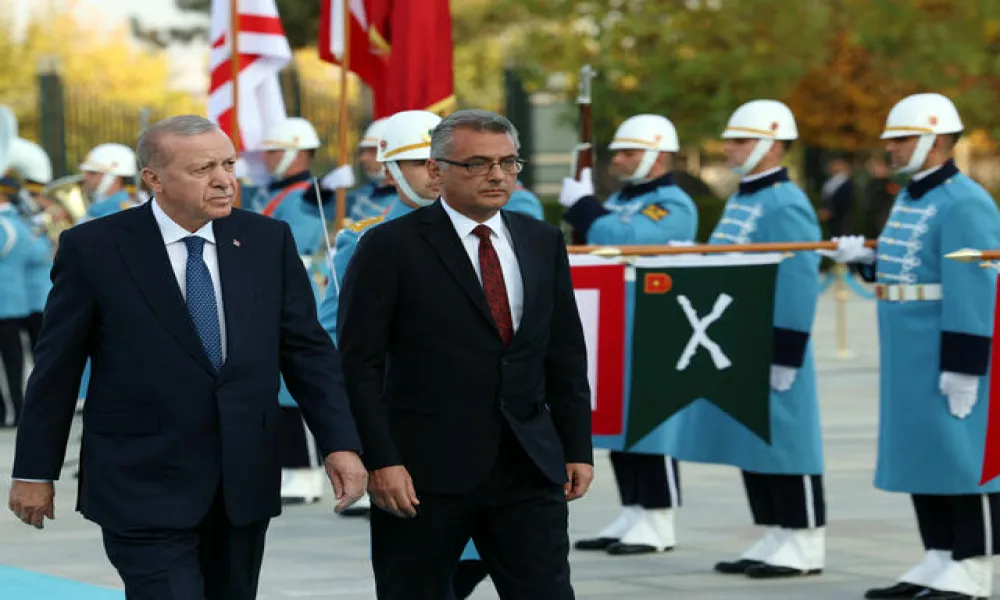
The meeting between the new Turkish Cypriot leader and the President of Turkey has, as expected, generated differing interpretations - both regarding the orientation the two interlocutors sought to give their discussion and over the real intentions of Recep Tayyip Erdoğan, which Tufan Erhürman is said to have readily “embraced”, according to certain Greek Cypriot media commentary. These analyses, based on superficial readings of the encounter, appear to draw conclusions that neither help their own arguments nor serve them politically, if their aim is to undermine a process still in its infancy.
For now, the official Greek Cypriot side has issued no response to the outcomes announced in Ankara. The President of the Republic’s real concerns will become clearer in the coming period, and especially after his first meeting with Tufan Erhürman, likely to take place within the coming week.
Erdoğan’s Position
What is clear at this stage is that there is no indication that the Turkish President attempted to block the restart of talks. As reported by Istanbul-based journalist Anna Andreou, citing Turkish Cypriot sources, Erdoğan has explicitly given the green light for the resumption of negotiations on the Cyprus problem. At the same time, he did not object to Erhürman’s proposal for a new methodology, which the Turkish Cypriot leader intends to present in his initial contacts with UN officials.
A shift driven by circumstances
Andreou’s reporting indicates clearly that there is no full alignment between Erhürman’s positions and Ankara’s. However, Erdoğan recognises that the current “timing and circumstances demand a different approach”, meaning that Turkey will not oppose a renewed UN-guided process.
This stance is viewed by several political forces within the Turkish Cypriot community as a notably positive sign for launching a new dialogue. According to sources who spoke to Politis, it would have been impossible for Erdoğan or Foreign Minister Hakan Fidan to ignore the fact that Erhürman arrived at the meeting as a political victor, enjoying unprecedented levels of support within his community in the post-Denktash era.
In short, the Turkish Cypriot leader’s first official visit to Ankara since his election offered the clearest indication yet of the new leadership’s intentions on the Cyprus problem. The statements that followed the meeting with Erdoğan suggested that the Turkish Cypriot side is not prepared to re-enter a negotiation process without rules, without timetables and without mutual commitments.
At the same time, Erhürman left open the possibility of a parallel track: if the two sides are not presently ready for full negotiations, it would be beneficial, he said, to proceed with concrete Confidence-Building Measures that would immediately improve daily life for both communities.
Differences and limitations
This does not mean that Ankara and the Turkish Cypriot side are in complete agreement. Although the overriding message is that they will coordinate their moves more closely particularly since Erhürman’s argument for reopening the dialogue within UN parameters has been accepted the references to coordination are not technical. They describe a political alignment that will be adjusted according to developments in the talks.
This also helps explain Andreou’s information that Erdoğan avoided signalling any rigid negotiating direction during the meeting, whether towards abandoning the federal framework or recognising the current entity in the north.
One takeaway is clear: the Greek Cypriot side cannot unilaterally define the framework of the negotiations.
In his statements following the meeting in Ankara, in his speech marking 42 years since the unilateral declaration of the regime in the north, and throughout his election campaign, Erhürman has consistently set out the parameters for any future settlement:
The Turkish Cypriot side will not enter talks in which its political equality is up for negotiation.
This position is directly linked to the experience at Crans-Montana, where Turkish Cypriot actors argue they paid the price for a negotiation structure that allowed all issues to be reopened at any stage - something Erhürman considers decisive going forward.
No return to the starting roint
Two arguments were repeated with particular emphasis in Erhürman’s post-Ankara narrative:
-
In 2004, Turkish Cypriots voted “yes” to the Annan Plan.
-
In 2017, at Crans-Montana, they were prepared to reach a settlement.
By contrast, they argue, the Greek Cypriot side either rejected or avoided agreement.
In this logic, the new Turkish Cypriot leadership maintains that it is neither “fair nor rational” for the current status quo to be treated as the “natural point of return” every time a negotiation collapses. Put differently, Erhürman argues that in any new process, failure cannot mean reverting to the post-1974 situation.
Many observers consider this demand — that the UN effectively pre-define the consequences of failure — to be unworkable. The UN cannot be expected to organise a process in which it must, in advance and depending on the outcome, determine the result of any future collapse. A predefined “failure outcome” is simply not possible within the parameters of an international negotiation.