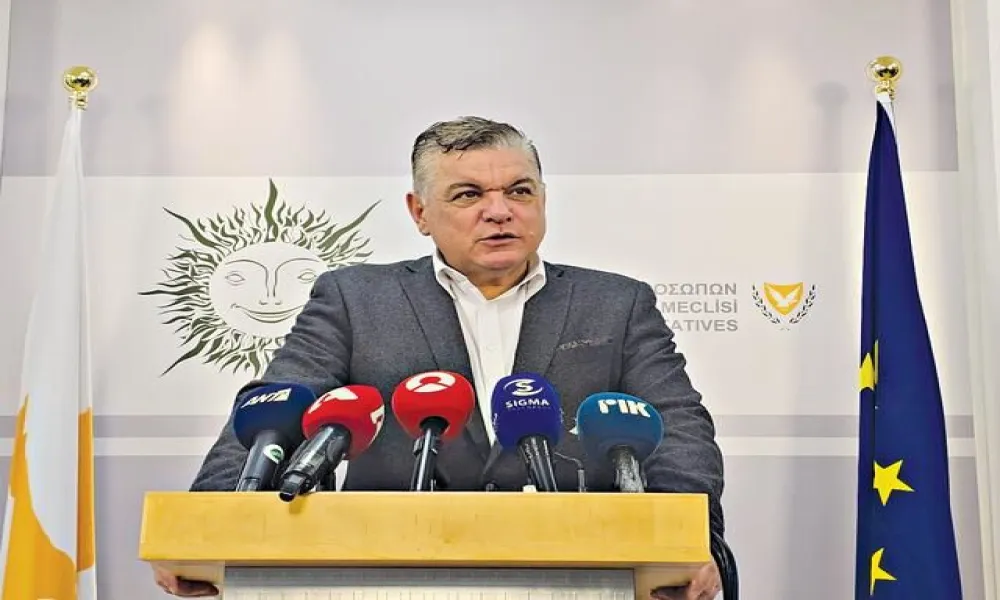

The application for the lifting of immunity sets out the events that allegedly took place in Greece, where the MP was staying with his partner, according to the complaint.
The green light given yesterday by the Supreme Court of Cyprus to lift the parliamentary immunity of Nikos Syka, an MP of Democratic Rally (DISY), effectively clears the way for his interrogation by police investigators examining a complaint involving allegations of physical and psychological violence against his partner.
Of particular interest is the content of the Supreme Court’s ruling. On the one hand, the decision was expected, following Mr Syka’s statement that he had no objection to the lifting of his immunity. On the other hand, the Court’s references to the facts of the case and to the withdrawal of the complaint indicate that sufficient legal grounds exist for the criminal investigation to proceed and for the investigative process to be completed.
In its ruling, the Supreme Court stresses that “parliamentary immunity cannot be used as a shield to protect an MP from the application of the State’s criminal law. Acts that do not fall within the scope of an MP’s parliamentary duties, such as personal or business activities, cannot draw protection from parliamentary immunity. An exception exists only in cases where there is suspicion of a genuine, serious and manifest political or party-political element behind the decision to prosecute an MP, with the aim of preventing them from properly and effectively exercising their parliamentary duties during their term of office.”
Key excerpts from the ruling
Among other important passages, the Supreme Court states:
“Based on the matters placed before us through the sworn affidavit accompanying the application and the documents attached thereto, it emerges that there is evidence which, when viewed objectively, implicates the Respondent in the commission of the aforementioned offences, which are alleged to have been committed in Greece.”
“The offences under investigation against the Respondent are serious, not only by their nature but also in light of the circumstances under which they are alleged to have been committed, as set out in the sworn affidavit supporting the application. Furthermore, the offences under investigation appear to bear no relation whatsoever to the political or party activities of the Respondent, whether within or outside the House of Representatives.”
“We consider that the application by the Attorney General is based on genuine and serious grounds and that there is no political, party-political or other element unrelated to the administration of justice.”
“The conduct and actions attributed to the Respondent require the immediate investigation of the case and, where justified, the bringing of the Respondent before the courts. The principles of the rule of law dictate equality before the law. All persons are equal before the law, regardless of status.”
“We conclude that the lifting of the Respondent’s immunity serves the public interest and that permission should be granted for all stages of the process, from the taking of an investigative statement to the execution of any sentence that may be imposed, without the need to seek fresh permission from the Supreme Court at each intermediate stage.”
Equality before the law
Elsewhere in its decision, the Supreme Court reiterates that the Attorney General’s application is founded on genuine and serious reasons and is not tainted by any political or extraneous considerations. It again underlines that the alleged conduct requires immediate investigation and that the principles of the rule of law demand equality and equal treatment for all, irrespective of status.
The offences under investigation
According to the application submitted by the Legal Service for the lifting of immunity, the police are investigating the following offences:
-
Use of violence, in violation of Article 3(1)(4) of the Violence in the Family (Prevention and Protection of Victims) Law, Law 119(I)/2000, and Article 5(1)(d) of the Criminal Code, Cap. 154.
-
Psychological violence, in violation of Article 6 of the Prevention and Combating of Violence against Women and Domestic Violence and Related Matters Law, Law 115(I)/2021, and Article 5(1)(d) of Cap. 154.
-
Assault causing actual bodily harm, in violation of Articles 243(1) and 5(1)(d) of Cap. 154 and Article 5 of Law 115(I)/2021.
-
Threats, in violation of Articles 9IA and 5(1)(d) of Cap. 154 and Article 5 of Law 115(I)/2021.
The facts of the case
The Attorney General’s application to the Supreme Court sets out the facts on which it is based, as derived from the sworn affidavit of the head of the investigation. The affidavit refers to statements given by the complainant, describing events that allegedly occurred between herself and the MP, with whom she was in a relationship between 31 December 2025 and 3 January 2026.
According to these statements, on 31 December 2025, while in Greece and prior to a night out, the complainant allegedly received insulting comments from the respondent. Following their return, she claims that he subjected her to physical violence and issued threats. Reference is also made to a medical report prepared following a medical examination carried out at Limassol General Hospital after her return to Cyprus, as well as to photographs handed over to the police.
Also attached to the sworn affidavit is a legal opinion dated 7 January 2026, prepared by an Athens-based lawyer and university lecturer, which concludes that the alleged facts constitute criminal offences under Greek law.
It is further noted that on 6 January 2026, the complainant attended police headquarters and submitted a document titled “Solemn Declaration”, stating that she did not wish to pursue criminal proceedings against the MP or to proceed further with the case. She additionally stated that she had no complaint against him and made no claims arising from her report. When asked orally by a police officer why she wished to withdraw the complaint, she said that the public exposure of the case, combined with the respondent’s status as a public figure, was causing her stress and psychological pressure, rendering her unable to cope with the continuation of the process.
DISY decisions pending
Beyond the strictly legal dimension of the case, political developments are also expected. From the outset, the leadership of DISY was alarmed by the allegations, but final decisions by the party’s Political Bureau were postponed pending the Supreme Court’s ruling on the lifting of Mr Syka’s immunity.
A new meeting of the Political Bureau is now expected imminently. According to information from Politis, the prevailing view is to adopt the recommendation of DISY President Annita Demetriou and the party’s Executive Bureau that the MP be excluded from the party’s electoral ticket. This position is also understood to be shared by the party’s parliamentary group, which discussed the matter in recent days.