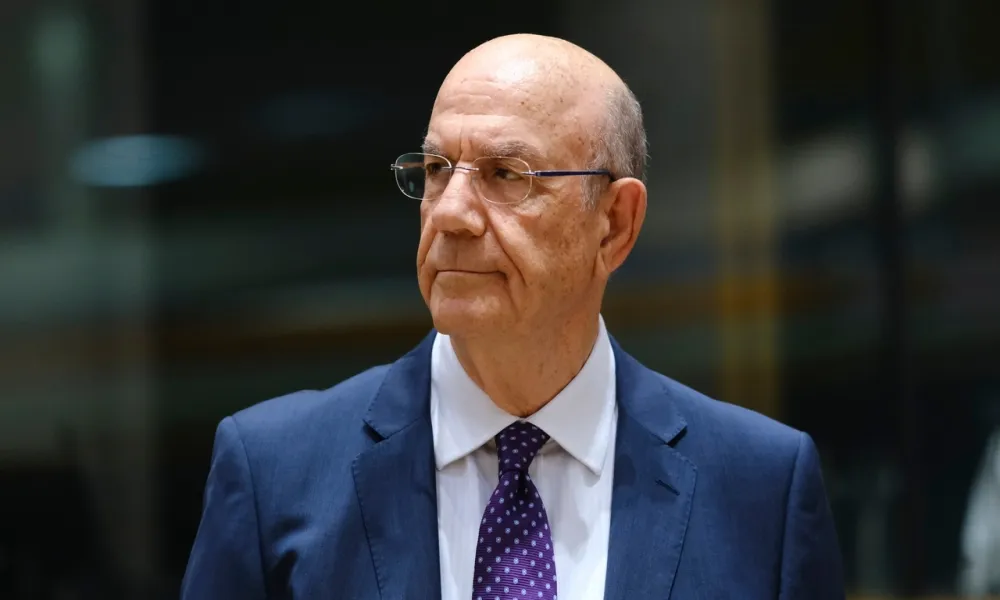
Cyprus’ priorities for its Presidency of the Council of the European Union were outlined by Finance Minister Makis Keravnos at the first meeting of EU finance ministers (ECOFIN) under the Cypriot Presidency in Brussels.
“Our presidency’s motto is ‘An autonomous Union, open to the world’,” Keravnos said. “Guided by this principle, we are committed to delivering an ambitious and impactful presidency. We aim to build momentum towards a thriving and more competitive Europe.”
He noted that Cyprus is assuming the Presidency “at a time of international geopolitical realignments and uncertainty”, with the EU facing multiple challenges. In the area of economic and financial affairs, strengthening the EU’s economic autonomy and its overall economic position will be among the Presidency’s core priorities over the next six months.
Financial support to Ukraine
Keravnos underlined the key role of ECOFIN in decision-making, saying finance ministers would be able to put forward concrete proposals and decisions within the political direction set by EU leaders.
He said the Cypriot Presidency intends to advance legislative work on the Savings and Investments Union (SIU), make tangible progress on the Capital Markets Union agenda, and promote initiatives aimed at enhancing competitiveness and deeper integration of the EU banking sector. In taxation, the Presidency will push forward the EU’s agenda on simplifying tax legislation as part of broader efforts to boost competitiveness.
The Presidency will also prioritise progress towards a modernised Customs Union. “A central priority will be ensuring that the EU continues to provide financial support to Ukraine,” Keravnos said, stressing Cyprus’ full commitment to securing timely and adequate funding to support Ukraine’s defence and future reconstruction.
Turning to Tuesday’s ECOFIN agenda, the Minister said ministers approved mainly technical and targeted amendments to the recovery and resilience plans of Finland, Germany, Ireland, the Netherlands, Spain and Sweden, aimed at accelerating their implementation.
Corrective measures
On the European Semester, no member states were identified as requiring in-depth macroeconomic reviews. ECOFIN will, however, continue monitoring the seven countries identified in 2025 as having macroeconomic imbalances.
Keravnos also referred to the opening of an excessive deficit procedure for Finland, after its public deficit exceeded the EU threshold in 2024, reaching 4.4 per cent, and is forecast to remain above the limit in 2025 at 3.5 per cent. Finland, he said, has been asked to report progress on corrective measures at least every six months and must end the excessive deficit by 2028.
During the informal breakfast session, finance ministers exchanged views on current economic challenges and political developments, including the situation in Greenland.
“The European Union stands firmly with Denmark and the people of Greenland,” Keravnos said. “We remain united in upholding the principles of international law, particularly territorial integrity and sovereignty.” He noted that EU leaders would meet in Brussels on Thursday evening to assess developments and coordinate next steps, with finance ministers ready to take follow-up action based on leaders’ guidance.
Solidarity with Greenland
Asked whether heightened geopolitical tensions could affect implementation of the Presidency’s programme, Keravnos said this was likely to have a positive effect. “It will require us to focus more closely on certain priorities, speed up procedures and take political decisions more swiftly, as developments are moving rapidly,” he said.
European Commissioner for Economy Valdis Dombrovskis expressed confidence in close cooperation with the Cypriot Presidency, welcoming its strong emphasis on competitiveness, defence and the digital euro. He stressed the need for unity and resolve in EU–US relations and reiterated the EU’s solidarity with Denmark and Greenland, calling any challenge to the sovereignty of a member state “unacceptable”.
On funding for Ukraine, Dombrovskis said the planned €90 billion support package is critical to ensuring fiscal sustainability, defence capacity and long-term security. He said the legislative process is expected to be completed by March, allowing the first disbursements to be made in April.