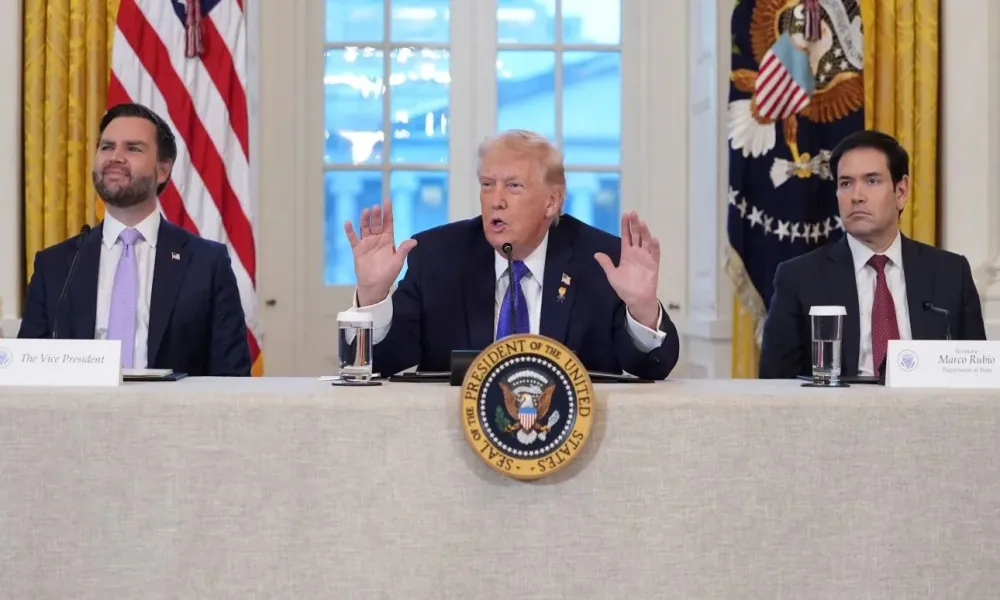
A letter of invitation from US President Donald Trump to the Republic of Cyprus, inviting it to take part in a Board of Peace for Gaza, has become a hot political issue for the Christodoulides government. The invitation is accompanied by documents that the Cypriot government is asked to sign if it wishes to participate. It appears the United States is seeking to create a new international body that would sidestep the United Nations, triggering concern among other states.
More than 60 countries have reportedly been invited to join the controversial organisation. According to Bloomberg News, which first broke the story, a draft charter of the new body states that each member state will serve a term of no more than three years after the charter enters into force, subject to renewal by the President (Donald Trump).
Bloomberg adds that the three-year term would not apply to member states that contribute more than $1 billion in cash to the Board of Peace within the first year of the charter coming into effect.
‘The invitation is being assessed’
Asked to comment on the reports carried by international news agencies, government spokesman Konstantinos Letymbiotis told Politis that Cyprus’s participation in the Board of Peace would not involve any financial obligations or payments by the Republic of Cyprus.
He said that if the government responds positively, Cyprus’s participation would last three years, with the possibility of renewed participation following a new invitation from the US President.
When asked whether a decision has already been taken, Mr Letymbiotis said that the invitation is currently under assessment.
He went on to defend his previous statements on the matter, arguing that the invitation explicitly recognises Cyprus’s role in the wider Middle East region. He said this carries particular political weight when such recognition comes from the United States, confirming what he described as Cyprus’s steady upgrade as a reliable, stable and responsible actor for peace and cooperation.
However, he avoided commenting on concerns raised in international media by Western officials and diplomats about the risks posed to the functioning of the United Nations, saying there had been no official statements before the government. He also declined to say whether the invitation includes a deadline for states to respond.
Growing concern
Despite the government spokesman’s emphasis on an upgrade of Cyprus’s international standing, Politis understands there is strong concern within the Presidential Palace over the development.
A government source told Politis that Cyprus is positive about contributing to efforts related to Gaza, but is worried that President Trump’s invitation concerns participation in an international organisation with broader powers extending beyond Gaza.
The source added that Cyprus, as the EU Council Presidency, is in contact with the European Council, which is due to meet in an extraordinary session on Thursday evening to examine the issue of Greenland.
Several issues remain unclear, the source said, including whether parliamentary approval would be required for Cyprus to take part in the Board of Peace.
UN disintegration
Referring to UN Security Council Resolution 2803 on the reconstruction of Gaza, Aris Konstantinidis, Associate Professor of International Law and Human Rights Law at the University of Cyprus Law Department, told Politis that the resolution provides for the establishment of a Board of Peace with international legal personality, meaning it would take the form of an international institution.
He said it was therefore known that an international body would be set up to oversee Gaza’s reconstruction.
However, he added, it now appears there is an effort for this body to acquire a broader role in international peace and security, with selected members chosen by the US President and with a decisive role for him personally.
If confirmed, Mr Konstantinidis warned, this would be extremely dangerous, raising issues of overlapping competences with the UN and complex conflicts between the obligations of member states of the new body and those arising from the UN Charter.
While Article 103 of the UN Charter states that obligations under the Charter prevail over other international obligations, he said that in practice the issues would be “labyrinthine, extremely difficult to resolve and could ultimately lead to legal chaos, with a real risk of the disintegration of the UN and the existing international order”.
These problems, he said, would be faced by all states that choose to participate in the new institution.
He also argued that any weakening or fragmentation of the UN would have consequences for the Cyprus problem, the operation of UNFICYP, and its role in monitoring the buffer zone. However, he stressed that information remains unclear and that it is necessary to wait until the picture becomes clearer.
‘Dark times’
International media report that governments have reacted cautiously to President Trump’s invitation, avoiding public statements and allowing officials to voice concerns anonymously about the negative impact the new organisation could have on the work of the United Nations.
Germany’s former foreign minister and current President of the UN General Assembly said the UN is the only institution with the moral and legal authority to bring together every nation, large or small. Annalena Baerbock warned that “if we call this into question… we will go back to very, very dark times.”
Meanwhile, a source close to French President Emmanuel Macron said yesterday that France does not intend to respond positively to the invitation to join the Board of Peace, stressing that it “raises serious questions”.