
A second reading of the Noverna poll for April makes clear something that has been simmering within Cyprus’s political system for years but is rarely recorded so clearly: the fragmentation of traditional party blocs and the inability to identify a clear favourite ahead of the 2028 presidential election.
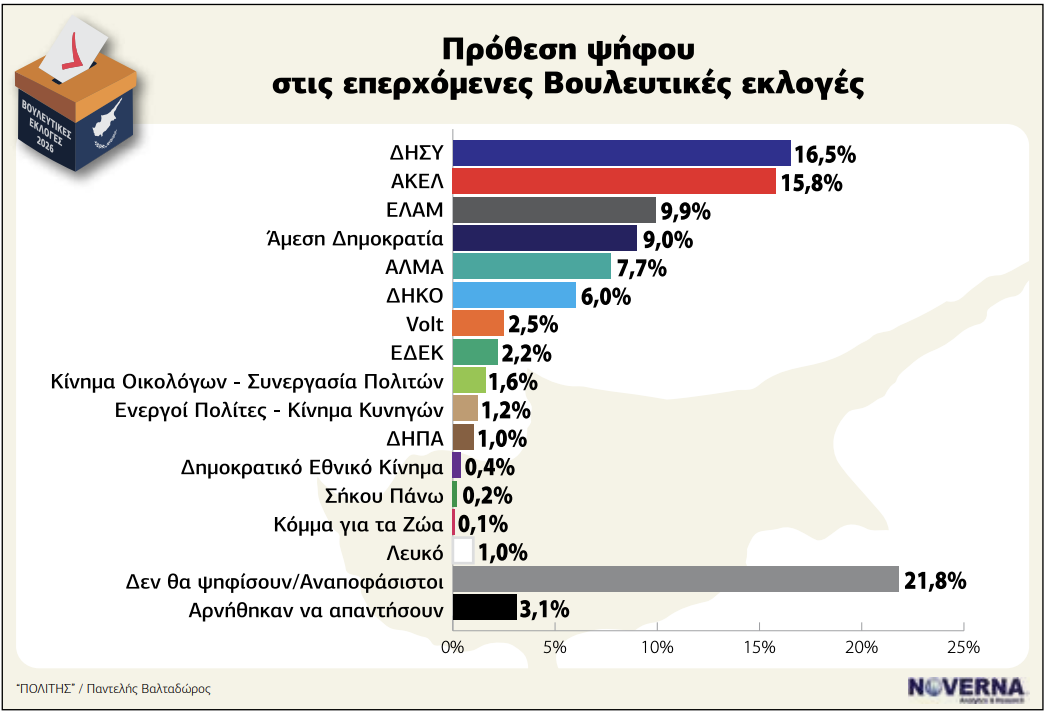
In terms of voting intention for parliamentary elections, the survey shows DISY and AKEL appearing essentially level, with 16.5% and 15.8% respectively. Behind them, a fragmented political landscape is emerging, with ELAM at 9.9%, Direct Democracy at 9% and ALMA at 7.7%.
However, the most significant finding is the large share of undecided voters. Nearly one in five respondents (21.8%)say they are undecided or intend to abstain, while 3.1% refused to answer.
This roughly 25% of the electorate constitutes the real “power reservoir” for the next elections. In such a fluid political environment, no candidacy can be viable without reaching beyond narrow party boundaries.
High rejection – low support
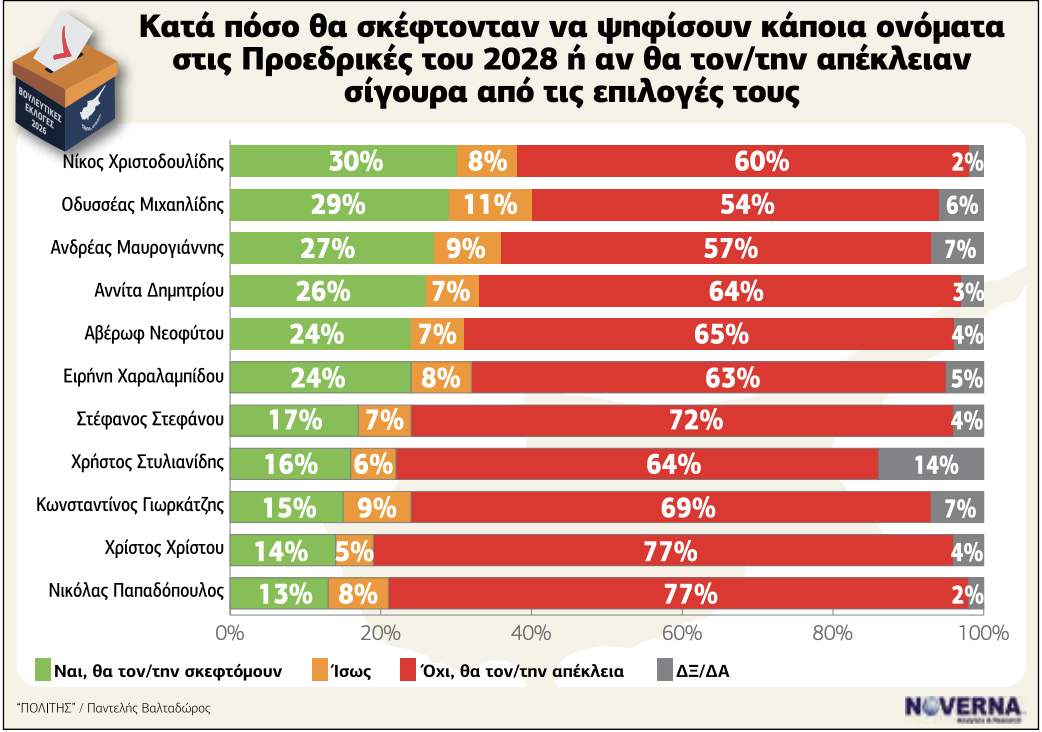
Given that 80% of respondents consider the parliamentary elections a prelude to the presidential race, the survey also examined the image of potential candidates for 2028.
The results reveal a troubling pattern: high negative ratings for nearly all candidates.
- Nikos Christodoulides: 30% positive – 60% negative
- Odysseas Michaelides: 29% positive – 54% negative
- Andreas Mavroyiannis: 27% positive – 57% negative
- Annita Demetriou: 26% positive – 64% negative
- Averof Neophytou: 24% positive – 65% negative
These figures show that no candidate begins from a position of strength. Instead, most face a significant electoral ceiling due to high rejection levels.
Candidates whose negative ratings exceed 70% face an even greater challenge, as expansion beyond their party base becomes extremely difficult.
In simple terms, the electorate does not appear to be searching for a leader. Rather, it appears to be avoiding political choices.
The battle for party cohesion
With limited cross-party acceptance, internal party cohesion becomes decisive.
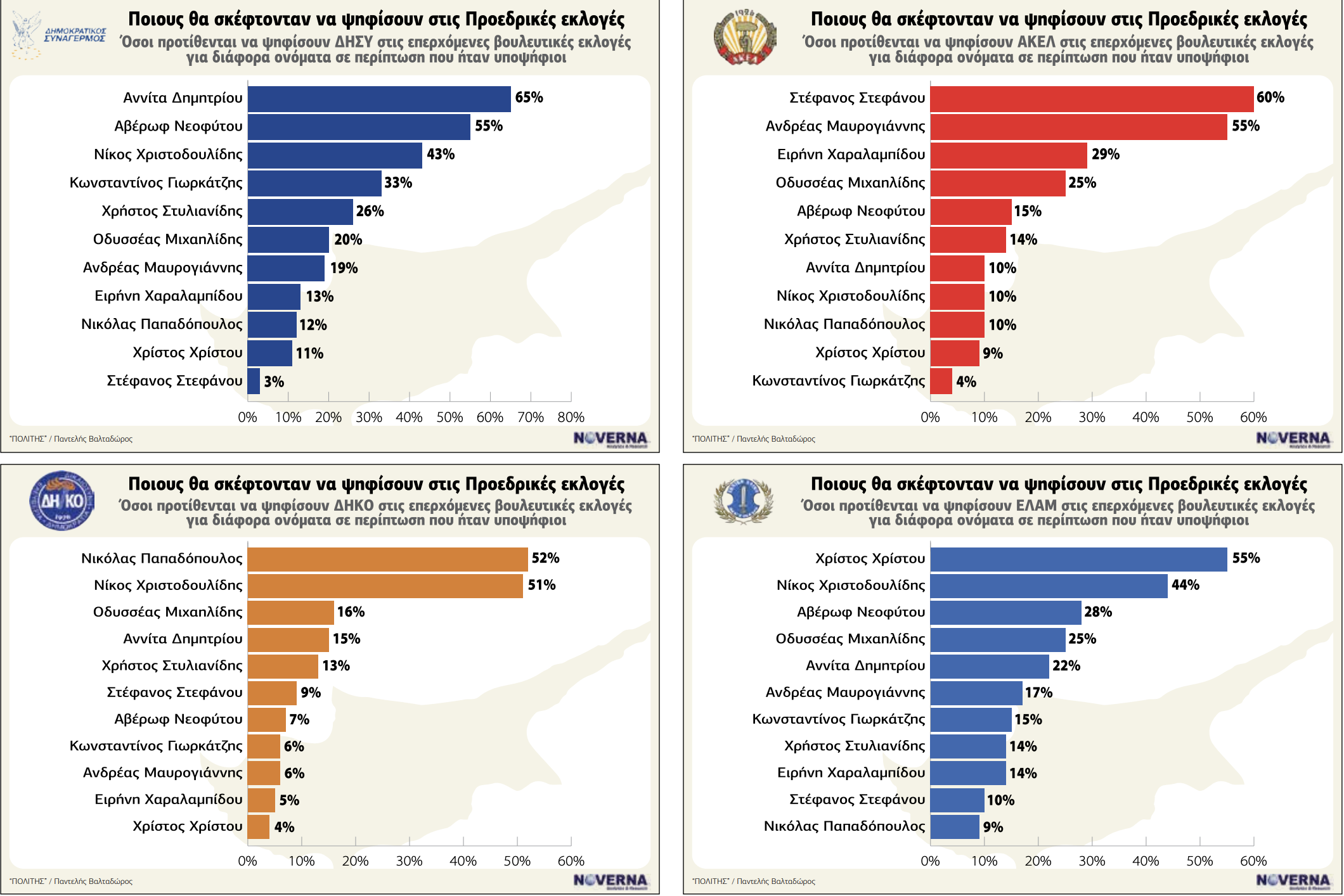
Within DISY, Annita Demetriou leads clearly with 65% support among party voters, followed by Averof Neophytou (55%) and Nikos Christodoulides (43%).
This indicates that Christodoulides does not dominate the centre-right space, despite holding the presidency. Both Demetriou and Neophytou appear to retain stronger support within the party core.
Within AKEL, the picture is more complex.
Stefanos Stefanou records 60% support among party voters, while Andreas Mavroyiannis follows closely with 55%, benefiting from broader cross-party acceptance.
Within DIKO, the situation is even more fluid.
Nikolas Papadopoulos (52%) and Nikos Christodoulides (51%) appear almost equally supported, indicating that DIKO’s electorate remains politically flexible.
Within ELAM, Christos Christou retains the lead with 55%, though Christodoulides records notable penetration with 44%, confirming his cross-party appeal.
The Michaelides phenomenon
A particularly notable case is Odysseas Michaelides.
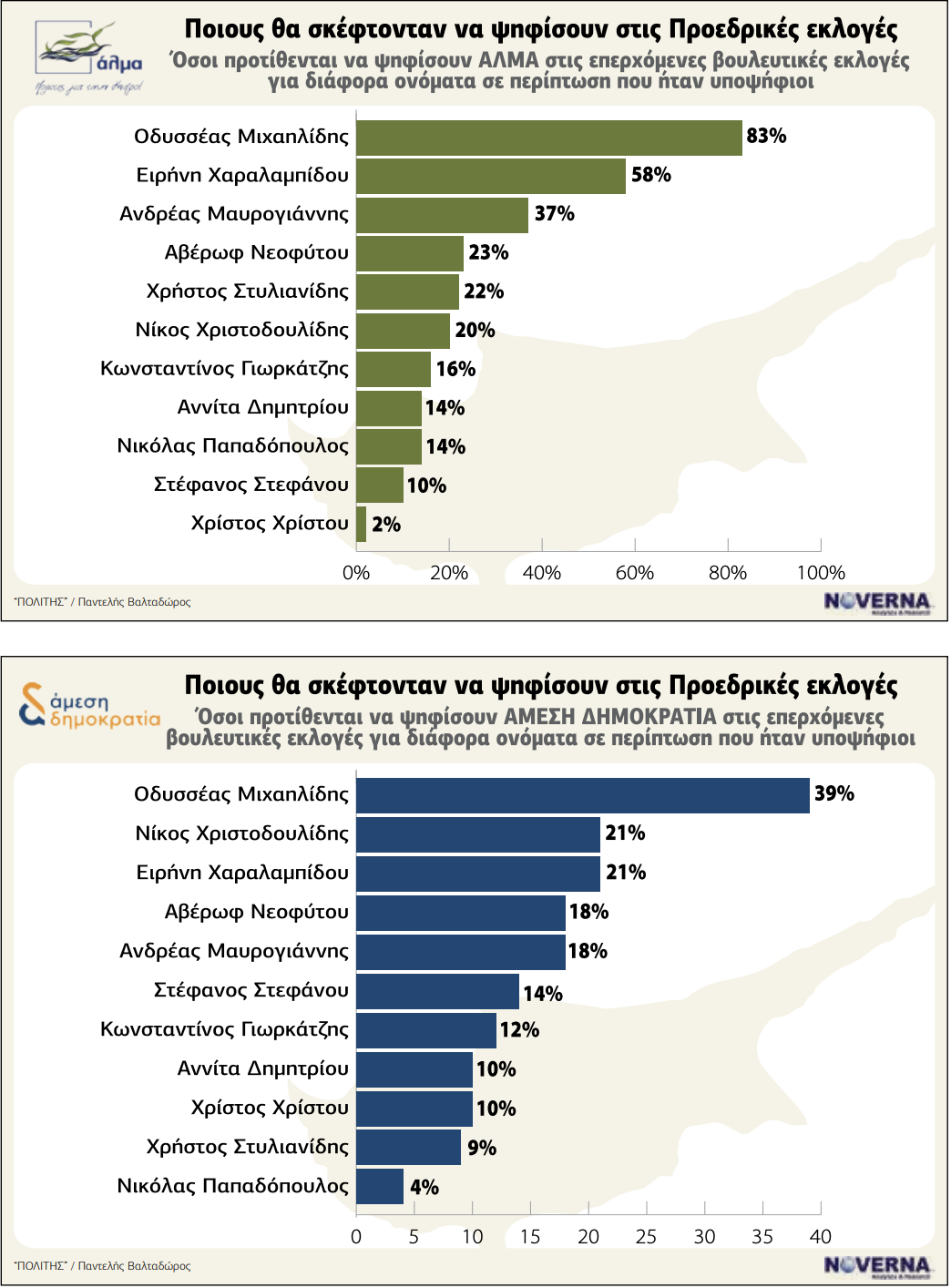
Within Fidias’s Direct Democracy movement, he records 39%, while within his own ALMA movement he reaches an impressive 83%, demonstrating near total dominance within that political space.
More importantly, Michaelides records comparatively lower rejection rates, giving him a strategic advantage in a political environment dominated by negative voting.
If he manages to translate this support into an organised political campaign and broaden his appeal, he could emerge as a serious contender in the 2028 presidential race.
Cross-party flows and the second round
The most significant conclusion of the Noverna poll is not who leads today, but how the path to the second round may evolve.
Nikos Christodoulides appears to be the most cross-party candidate, with strong presence among DISY, DIKO and ELAM voters. This positions him as one of the most likely contenders to reach the second round.
Andreas Mavroyiannis, if he secures full backing from AKEL, could also become a central electoral pole, particularly if he attracts centrist voters.
Current data show that he would receive support from:
- 20% of DISY voters
- 17% of ELAM voters
- 18% of Direct Democracy voters
- 37% of ALMA voters
Annita Demetriou, although strong within DISY, appears to face greater challenges beyond her party base.
Nevertheless, she records notable support across parties:
- ELAM: 22%
- DIKO: 15%
- ALMA: 14%
- AKEL and Direct Democracy: 10% each
Averof Neophytou also shows cross-party presence, with:
- 23% support in ALMA
- 28% in ELAM
- 18% in Direct Democracy
- 15% in AKEL
Odysseas Michaelides remains the most unpredictable factor.
He lacks a traditional party machine, but his appeal extends across different audiences:
- 20% of DISY voters
- 25% of AKEL voters
- 25% of ELAM voters
- 39% of Direct Democracy voters
- 16% of DIKO voters
The results for Christos Stylianides are also notable. After 12 years away from Cyprus’s political scene, and with 14% of respondents saying they do not know him, he still maintains meaningful cross-party acceptance.
However, he would need to rebuild political momentum to return as a serious contender.
Who is really ahead?
Based on the survey data, Nikos Christodoulides appears to hold a slight advantage, mainly due to the breadth of his support across parties.
However, his lead is neither clear nor secure. For example, if ELAM fields its own candidate in 2028, the electoral landscape could change significantly.
Andreas Mavroyiannis and Annita Demetriou follow, with their prospects depending heavily on party cohesion, while Odysseas Michaelides emerges as one of the key challengers capable of disrupting the balance.
In reality, the question of “who has the best chances” remains unanswered.
The electorate remains fluid, negative opinions are high, and party identities are weakening.
A political system in transition
What becomes clear from the survey is that Cyprus’s political system is undergoing a transition.
Traditional party alignments are no longer sufficient to explain voter behaviour.
The 2028 presidential election will depend not only on party strength, but also on the ability of candidates to build broader alliances and appeal to an increasingly disengaged electorate.
For now, one conclusion stands out: the race remains completely open.
The number of candidates in the first round will likely prove decisive in determining which two candidates reach the second round.