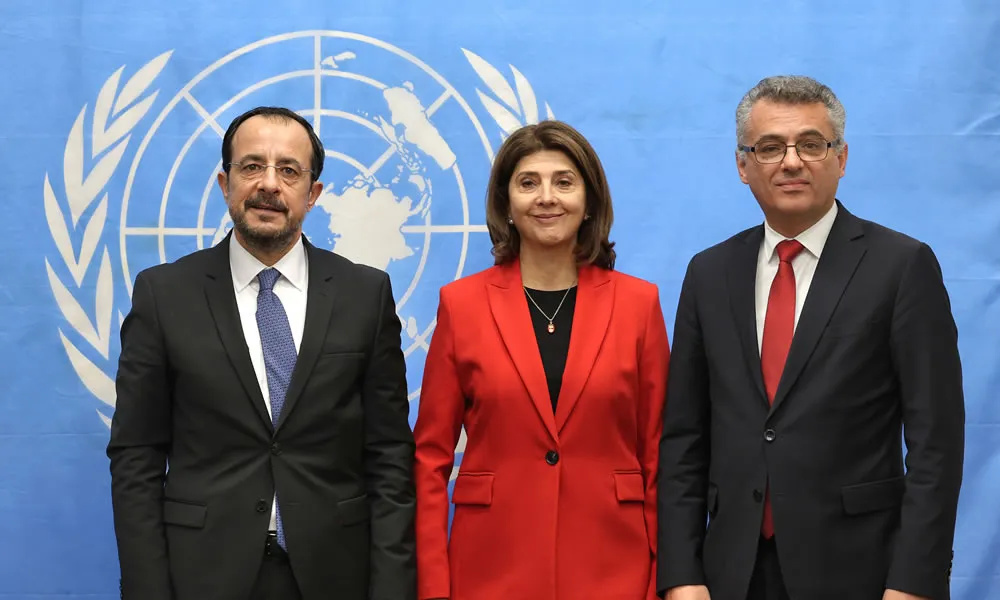

The latest trilateral of the two leaders and Maria Anhela Holguin will be held this coming Wednesday in Nicosia, immediately following the UNSG special envoy's separate meetings with President Christodoulides and the Turkish-Cypriot leaders on the previous day.
Arriving from Brussels, where she held talks with Kaja Kallas, EU High Representative for Foreign Affairs and Security Policy, the extent of Holguin's involvement this time around is still unclear, though the backdrop seems to be a UN attempt to weigh the two sides resilience and intentions.
Notwithstanding the low key public remarks, the current effort at diplomatic level is to establish whether there is even limited room to manoeuvre towards particular actions that could serve as oxygen, as described, towards a new initiative. It is obvious here that Holguin is looking for any new developments that might have transpired on the island following the previous trilateral in the first half of December.
The UN want to keep the process breathing
According to well informed sources, the mandate this time is not restricted to yet another run of the mill round of contacts. On the contrary, it is designed to forge part of a wider strategy by UN Secretary General Antonio Guterres to keep the Cyprus issue 'alive' on the international scene, at a time when other geopolitical crises are taking most of the attention.
Within this mandated framework, the special envoy is called upon to sound out possible convergences on confidence building measures but also establish when and if there is any fertile ground to organise a five party conference on Cyprus, as announced last year. The fundamental point of reference at this point in time, has to do with working out solutions on some of the CBM's that will actually lead to agreements.
Crossing points
A discussion on opening new crossing points on the buffer zone is considered to be the most fertile for the desired purpose, as it combines 'a practical result with limited political cost'. Backstage efforts are under way to develop a 'synthesis package' on crossing points to prevent any possibility of either side giving something up unilaterally.
According to the same sources, alternative scenarios are being looked into, both on the number and geographical breakdown of these new crossing points, always within the framework of the areas already discussed.
The hope here is that a possible deal on openings will possibly work as a way out towards agreement on wider talks. In other words, Holguin seems to be looking for something more than a low level deal, notwithstanding the actual importance of opening the crossing points themselves.
Her goal, according to diplomatic circles, is to utilise possible confidence building measures progress as a 'try out', as we were told, in order to establish whether the two sides are ready to enter a more structured dialogue process.
Success on the crossing points could work as an argument presented to Guterres that conditions are now there to further intensify UN efforts, possibly with a five party meeting in the near future.