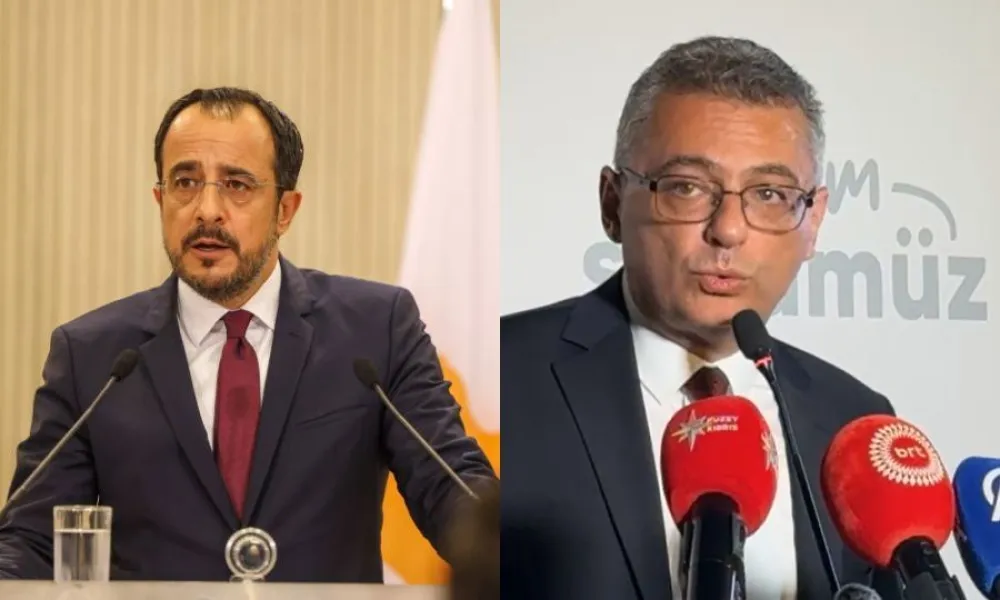
Just when it seemed that discussions on the Cyprus problem might resume from where they left off, new conditions and counter-conditions have once again taken centre stage. The exchange of proposals between President Nikos Christodoulides and Turkish Cypriot leader Tufan Erhürman has revived old arguments, raising questions about whether the process is moving forward or simply starting over.
A familiar exchange of conditions
It was hardly likely that Erhürman would leave matters there. He placed four points on the table as a precondition for the resumption of talks. Christodoulides responded swiftly with five points of his own.
If Erhürman were to return tomorrow with six preconditions, the response would presumably be seven. This is not a side that allows what it considers provocations to go unanswered. The situation resembles a football match where one goal is immediately followed by several in reply. In short, this is a struggle on all fronts.
The President’s team, under senior officials, is said to have studies ready and an entire arsenal of conditions that could be launched at the negotiating table if required. Erhürman, it seems, could be faced with a barrage similar to those seen in past negotiations, such as in the period before the referendums, when international proposals were met with lengthy counter-documents.
The President’s five-point proposal
Following his meeting with the UN envoy, President Christodoulides appeared restrained and, for the time being, remained with the five-point proposal he submitted during the joint meeting with Erhürman. His assertiveness, however, was displayed during the meeting itself, adopting a tone of irony towards both the envoy and the Turkish Cypriot leader.
The first point of the President’s proposal concerns the reaffirmation of the basis for a Cyprus settlement, grounded in United Nations resolutions and political equality, as outlined in the joint communiqué of 11 December. The stated basis remains a bi-zonal, bi-communal federation with what is described as the “correct content”.
In this model, the two zones would be predominantly inhabited by the two communities, each operating largely independently with its own government, alongside a federal government tasked with addressing the consequences of local governance. This approach, however, is rejected by Greek Cypriots, who view it as a red line, shaped by past experiences of economic crises, bail-ins, memoranda and international embarrassment. The concern is that repeating such mistakes within a federal framework would once again prove costly.
Revisiting convergences from the past
The second point calls on the United Nations to prepare a document compiling all convergences achieved up to Crans-Montana. This raises the question of why the process should begin again from the Gali plan of 1991 through to the Guterres framework of 2017, when it had been stated that talks would resume from where they left off.
This approach is seen as convenient, as it effectively postpones substantive progress well beyond the 2028 presidential elections. After that, a new President could revisit convergences in detail, extending discussions for years. Time, it seems, is considered plentiful, and caution is preferred over urgency.
Internal and external aspects of the talks
The third point proposes that convergences relating to internal aspects be presented to the two communities, while those concerning external aspects be discussed by all five participants in the conference, with only those approved by all retained.
This process is portrayed as complex and time-consuming, raising doubts over how distinctions will be drawn and which convergences will survive. The concern is that such a mechanism allows unwanted agreements to be discarded rather than facilitating agreement on those already in place.
The fifth point of the President’s proposal concerns the announcement of the opening of four crossing points at Kokkina, Louroujina, Mia Milia and along the Athienou–Pyroi–Aglantzia line, as previously suggested by the UN Secretary General at the July conference.
Erhürman’s four preconditions
On the other side, Tufan Erhürman sets political equality as his first precondition. This includes acceptance of political equality as non-negotiable, incorporating elements such as rotating presidency and effective participation with positive voting rights.
He also calls for a defined timetable for the talks, arguing that negotiations on Cyprus have been ongoing since 1964. His position is that previously agreed issues up to Crans-Montana should not be reopened.
The fourth precondition raises concerns, as it seeks guarantees that a failure of negotiations would not result in a return to the status quo, with Turkish Cypriots remaining without recognition and rights.
From a Greek Cypriot perspective, this demand is seen as problematic, as it implies that failure at the negotiating table could still lead to recognition for the Turkish Cypriot side. For many, the current status quo is viewed as a safeguard. Talks and discussions may continue, but without agreement, the situation would remain unchanged.
Source: Politis