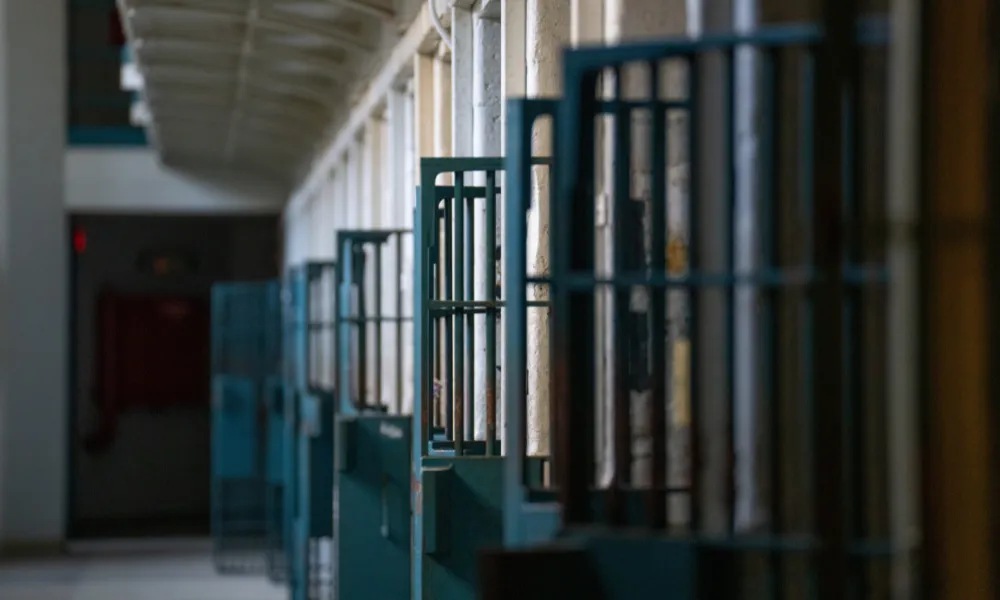
The Ministry of Justice and Public Order has announced plans for a new correctional facility with capacity for 1,250 inmates, to be constructed on state-owned land outside urban areas. According to the Minister, the project is expected to take between four and five years to complete and operate. The announcement was made during a press conference held on Monday in Nicosia.
Project timeline and government commitment
Minister of Justice and Public Order Kostas Fytiris stated that the construction and operation of the new correctional institution will take four to five years. He said the project must begin promptly to avoid delays similar to those experienced with the Coast Guard project, which remained at planning stage.
Location and land allocation framework
According to the presentation, the unified correctional facility will be built on 500,000 square metres of state land. The location will be in central Cyprus and outside the urban fabric to allow accessibility from all districts.
The facility will include high-security perimeter fencing. A surrounding security buffer zone of 40 to 60 metres will be established, with no buildings permitted within that zone.
Security structure and prison classification system
The complex will include three distinct prison categories:
- A closed maximum-security prison with strict movement controls and continuous surveillance. This section will house inmates convicted of serious criminal offences.
- A semi-open prison for lower-risk inmates, allowing controlled freedom of movement, employment opportunities and education.
- An open prison with minimal physical restrictions, focused on productive activity and preparation for social reintegration.
Consultation process with local communities
When asked about the exact location, Kostas Fytiris stated that the site will be announced after consultation with nearby communities within the month. He said institutional procedures require engagement with local communities.
The Minister expressed the view that communities are unlikely to react negatively, noting expected economic benefits, including absorption of local products and increased economic activity. He stated that the facility will not operate in a similar manner to Pournara, describing it as a closed facility that will also provide benefits to surrounding areas.
Current system challenges and justification for new infrastructure
The Minister highlighted existing problems within current prison facilities, including:
- Limited capacity
- High operating costs
- Limited rehabilitation and reintegration capabilities
- Incomplete multi-level security infrastructure
Transitional measures before new facility operation
During the transition period until the new facility becomes operational within five years, a series of measures will be implemented to improve the current correctional system.
These include:
- Tender procedures for the recruitment of 90 prison officers
- Recruitment procedure for a Prison Director, introducing organisational restructuring
- Implementation of operational protocols
- Use of modern technological security systems
Decongestion policies and administrative enforcement tools
According to the presented plan, prison decongestion remains an ongoing action and is implemented through:
- Electronic monitoring bracelet use
- Release through presidential pardon procedures
- Voluntary deportations
- Introduction of a new expedited deportation procedure for foreign nationals residing illegally
Additional institutional and training infrastructure measures
The plan also includes infrastructure interventions, upgrading of the Prison Officers Training School, and initiation of procedures for the development of new modern correctional facilities, aiming to support a more humane, secure and efficient correctional system.