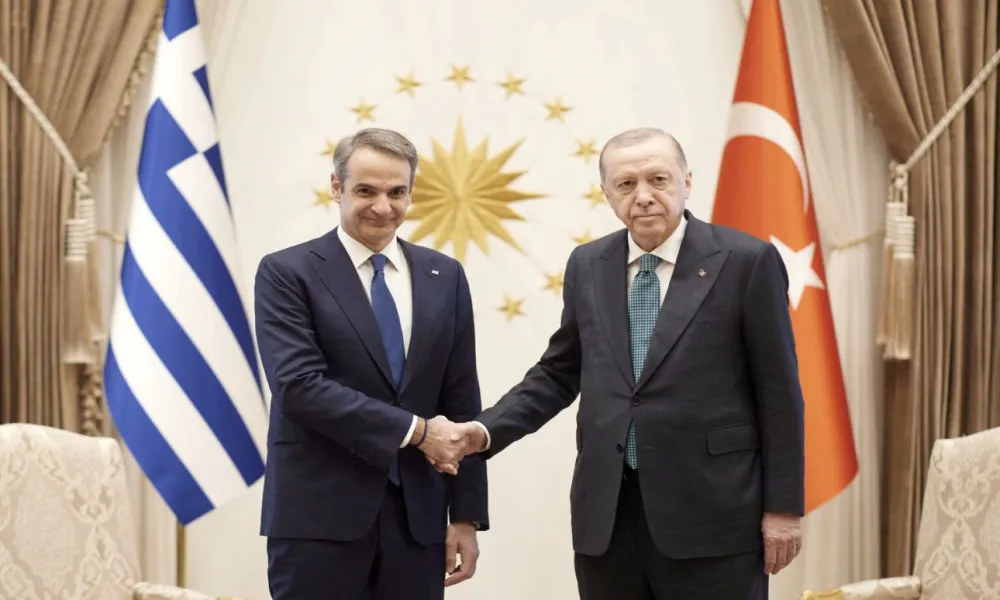

After twenty one months since May 2024, another meeting took place Wednesday, between the Greek Prime Minister Kyriakos Mitsotakis and the Turkish President Recep Tayyip Erdogan in Ankara. Although not much time has passed, dramatic international developments have unfolded, reshaping global politics and the geostrategic landscape.
Despite the turbulence affecting almost every corner of the planet, these shifts did not prevent the continuation of the so called theory of calm waters, a doctrine that took shape after a previous meeting in Istanbul following a period of fluctuations but without major upheavals. According to Turkish officials, the aim of both sides is for things to remain this way.
Amid the challenging circumstances of Greek Turkish relations, yesterday’s meeting between Mitsotakis and Erdogan, along with the contacts held between members of the Greek government and their Turkish counterparts, outlined the next steps within which the theory of calm waters is being consolidated. The discussions and meetings took place in the context of the sixth session of the Turkey Greece High Level Cooperation Council, which convened for the first time in almost two years.
The one to one meeting between the two leaders lasted, according to reports, an hour and a half. Before their statements, six agreements were exchanged between the two countries. In their joint remarks, Erdogan and Mitsotakis described their meeting as particularly positive and highlighted that the memoranda signed demonstrate the ongoing improvement in bilateral relations. Both leaders also emphasised the efforts made in recent years to maintain structured dialogue, promote a positive agenda and advance confidence building measures.
We can move forward
Based on the statements of the two leaders, it is clear that major and sensitive issues remain. However, both sides appear willing to continue their efforts to activate diplomacy as the foundation for improving relations, while maintaining their respective positions. Their remarks once again highlighted the fundamental differences, yet they agreed that these differences can be resolved on the basis of international law and good neighbourly relations.
President Erdogan focused on the situation in Gaza and developments in Syria, stressing the need to understand the broader regional context. Prime Minister Mitsotakis, for his part, emphasised the improvement in relations with Turkey and referred to the issue of migration, noting that cooperation between the two countries has reduced flows by 60 percent. He also underlined the need for a renewed effort on the Cyprus issue, based on international decisions for resolving the problem. Erdogan made no reference to Cyprus in his own statement.
President Erdogan described Kyriakos Mitsotakis as a valued friend and stressed that both leaders agree that the problems between the two countries are not insoluble when approached through international law.
Prime Minister Mitsotakis stated that it is time for all threats between the two countries to be lifted. He added that the delimitation of maritime zones is the only dispute that could be referred to the court, based on the law of the sea.
Window of opportunity for Cyprus talks
Prime Minister Kyriakos Mitsotakis spoke on Wednesday of a window of opportunity to restart a substantive dialogue on the Cyprus issue from the point where it was interrupted in 2017. According to a CNA report, he stressed that any such process must always operate within the framework set by the United Nations Security Council resolutions. His remarks followed his meeting with Turkish President Recep Tayyip Erdogan during the sixth session of the Greece Turkey High Level Cooperation Council in Ankara.
According to the Greek Prime Minister, the two leaders discussed several issues, including developments on the Cyprus question, where he noted that Greece’s position remains clear.
He emphasised that the initiatives of the United Nations Secretary General create a window of opportunity for the resumption of meaningful talks from where they stopped in 2017, within a process that must always remain aligned with the Security Council resolutions.
Meanwhile, CNA cites sources saying that the President of Cyprus, Nikos Christodoulides, is expected to be briefed today, Thursday, by Greek Prime Minister Kyriakos Mitsotakis on the meeting with the Turkish President Recep Tayyip Erdogan. The briefing will take place on the sidelines of the informal European Council in Belgium, according to the Cyprus News Agency.
Before the informal European Council, President Christodoulides is scheduled to participate in a meeting of European leaders convened by the German Chancellor and the Prime Ministers of Italy and Belgium to discuss competitiveness.