The challenge for dialogue remains twofold. On the one hand, Turkish Cypriot leader Tufan Erhürman is called upon to demonstrate that his methodology is not a list of conditions but a tool for substantive negotiation. On the other, President Nikos Christodoulides is expected to show whether he has the political will to return to a framework that the international community continues to regard as a reference point.
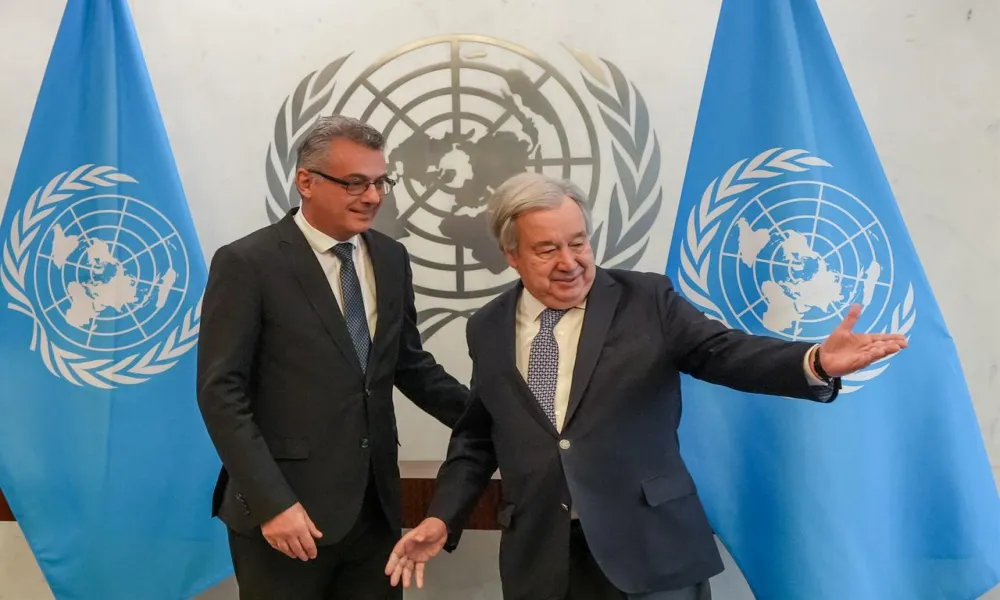
The first direct meeting between Turkish Cypriot leader Tufan Erhürman and United Nations Secretary-General António Guterres did not unfold within a purely ceremonial framework following his election to the leadership of the Turkish Cypriot community. The 70-minute meeting reinforces indications that it did not merely aim to restore communication between the Turkish Cypriots and the UN Secretariat, but formed part of an effort to return the process to a framework of productive dialogue with tangible results.
Erhürman himself emphasised two points. First, that he observed “no reduction of interest” on the part of Guterres. Second, that the Secretary-General’s phrase “we will be in much more frequent contact” carried particular significance. The use of the word “contact”, without clarification of its form, suggests that the substance lay not in procedural detail but in political commitment to continuity.
Useful and productive
The United Nations Secretary-General listened to the Turkish Cypriot leader, who described the meeting as useful and productive. He explained his positions on the basis of the preconditions he has set for the start of dialogue. Both sides focused on prospects for resuming talks and on the need for practical measures to improve daily life.
According to his statements, Erhürman conveyed what he described as the Turkish Cypriot side’s willingness for a solution, while presenting a four-point methodological proposal. He underlined that the process should not consist of “talks for the sake of talks” but should aim at a specific outcome in order to avoid further disappointment within the Turkish Cypriot community.
Particular emphasis was placed on Confidence-Building Measures and the opening of new crossing points. Erhürman expressed the view that such issues should not be referred to international conferences in a “5+1” format but resolved directly in Nicosia by the two leaders. “If the two leaders cannot agree even on a few crossing points, how will they produce a solution to the Cyprus issue?” he asked, adding that agreements at local level would send a positive message of determination.
Erhürman stated that António Guterres remains committed to the Cyprus issue and does not display signs of fatigue or pessimism. He also noted that the Secretary-General recognises the concerns and disappointments of Turkish Cypriots and expressed a desire for more frequent contact in the future. Despite the positive tone, it was clarified that no specific timetables or format for a forthcoming process were discussed during the meeting.
The impact of the meeting between Tufan Erhürman and the UN Secretary-General is expected to become clearer during the scheduled meeting of the two leaders on the 24th of the month, as previously agreed.
Most Turkish Cypriot media reports highlighted that the Turkish Cypriot leader focused on:
- His four-point methodology for launching talks
- The rationale behind the need to lift the isolation of his community
After many years, the positions of the majority of Turkish Cypriots appear before the Secretary-General with what is described as a constructive disposition, aiming to overcome the impasse. This is viewed by some as a new ray of hope for the settlement process.
The procedural framework
Erhürman’s “methodology” seeks to address a long-standing problem in negotiations, according to Turkish Cypriot sources, namely the absence of a clear procedural framework that would guarantee that a new effort would not once again lead to deadlock, as in Crans-Montana. His reasoning is that it is not sufficient to reiterate commitment to a bizonal, bicommunal federation. A specific agreement on method is required before substantive negotiations begin.
Within the Turkish Cypriot community, certain concerns are also being expressed, including among individuals who supported Erhürman.
Political equality
The first concern relates to the rotating presidency, which Erhürman has placed at the core of political equality, referring to the Guterres Framework. However, some circles within the Turkish Cypriot community question whether it is productive to raise this issue in advance, without parallel negotiation of other matters, as part of an overall give-and-take linking governance with security, guarantees and territorial issues.
A second concern relates to the precondition regarding the day after a possible failure of talks.
No return
The idea that, in the event of failure due to the Greek Cypriot side, there would be no return to the current status raises questions. No negotiation begins with predetermined sanctions in case of failure. Success depends on incentives for both sides. The pre-announcement of losing the status quo may function as leverage, but it also carries the risk of entrenching a new deadlock, according to circles mainly within the Republican Turkish Party. At the same time, it is noted that these positions are shaped by a desire not to lose further time or opportunity, as was perceived to have happened under the previous Turkish Cypriot leadership.
In his meeting with António Guterres, the Turkish Cypriot leader sought to present his own version of the process. It is clear, however, that the challenge for dialogue remains twofold. Erhürman must demonstrate that his methodology is not a list of conditions but a genuine tool for negotiation. President Nikos Christodoulides, for his part, is expected to show whether he has the political will to return to a framework that the international community continues to regard as a reference point.