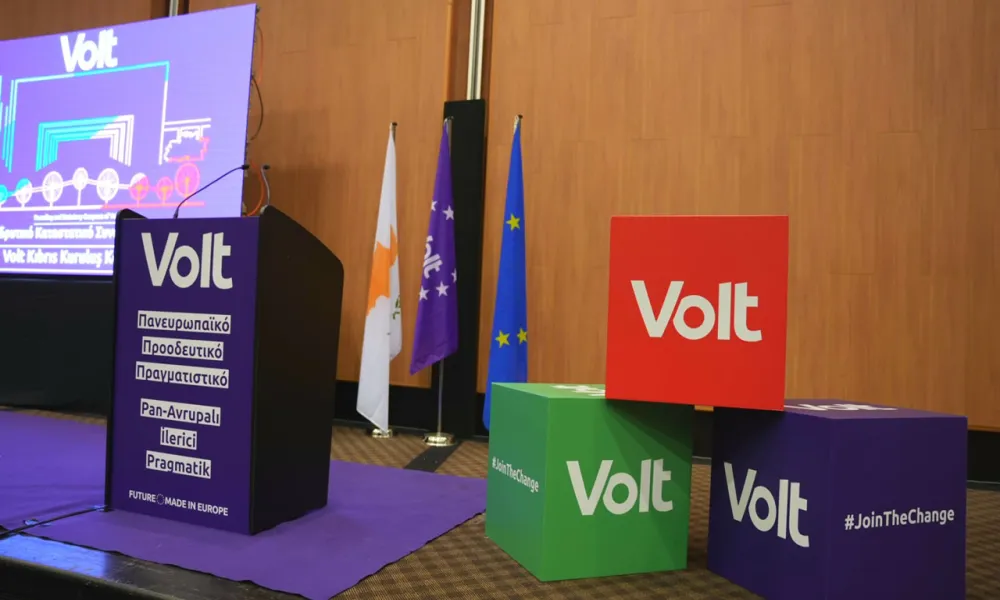
The fierce political spat that erupted last week between ruling party DISY and opposition parties Volt Cyprus and AKEL has put the ideological compass of Volt under the spotlight.
At the heart of the clash was DISY leader Annita Demetriou’s controversial reference to the “others” during a ceremony in Paralimni honoring Tassos Isaak and Solomos Solomou, murdered in 1996. Volt and AKEL condemned the remarks, prompting DISY to fire back by painting both parties as “left-wing.” In a Facebook post, DISY spokesman Onoufrios Koullas went further: “To tell the truth, Volt seems more leftist on the Cyprus issue than even AKEL.”
The move was widely seen as a tactical maneuver, an attempt by DISY to deflect criticism of its leader by shifting the debate toward ideology. The gambit forced Volt into a defensive stance. Co-president Andromachi Sofocleous, writing in daily Kathimerini, stressed that Volt is “neither left nor right, but a moderate political force guided by rational thought.” She argued that Volt is a 21st-century party whose members come from diverse political backgrounds but are united by shared principles, technocratic expertise, and a commitment to pragmatic policymaking.
Sofocleous highlighted policies such as widening tax brackets to ease the burden on the middle class, an appeal that places Volt closer to the political center. Still, she stopped short of calling Volt a centrist party outright.
Left, Right, and the Middle Ground
The debate underscores a broader reality: while parties have the right to define their own ideological identity, their consistency is judged on how closely they adhere to it. In practice, Western politics has seen left and right converge over time. The fall of communism and the dominance of liberal democracy blurred old lines, producing mixed economies, welfare states, and pragmatic compromises that cut across ideological divides.
Mainstream parties in Europe increasingly adopted a “catch-all” approach, tailoring policies to attract the median voter and win power, often leaving space at the extremes for radical left and far-right movements. Even so, clear distinctions remain: the right gravitates toward conservatism, fiscal discipline, and elite interests, while the left pushes for social welfare, redistribution, and state intervention. The middle ground, often home to liberals and social democrats, emerged as a balancing force, largely representing the middle class.
A European Identity
Volt Cyprus, however, is not free to define itself purely through the local lens. As part of Volt Europa, the pan-European federalist party born in the aftermath of Brexit, Volt Cyprus is bound to the ideological framework set by its continental umbrella.
Founded by a small group of young Europeans determined to resist populism and fragmentation, Volt Europa today has a presence across most EU member states. From the outset, it rejected the traditional left-right spectrum, instead promoting federalism, European integration, climate action, and technocratic solutions to common challenges.
No national chapter, including Volt Cyprus, can deviate from this shared platform. While it may tailor its agenda to local realities such as the Cyprus problem, Volt’s foundation rests firmly on European federalist principles.
Federalism and the Cyprus Question
That means Volt Cyprus cannot endorse positions on the Cyprus issue that contradict the federal model of reunification. Nor can it adopt nationalist or exclusionary rhetoric against Turkish Cypriots. Not because it is “leftist” or “pro-Turkish,” but because European federalism, by definition, rejects ethnic exclusion and embraces coexistence. Any other stance would undermine Volt’s identity as a European party.
Yet in Cyprus, the landscape complicates matters. A legacy of insular conservatism, shaped by the island’s delayed modernization and absence of Enlightenment and Industrial Revolution influences, often casts European liberal ideas as inherently “left-wing.” Proposals on minority rights or identity politics, commonplace in liberal democracies, are frequently dismissed by Cyprus’s right and center-right as radical left positions. In practice, defending LGBTQ+ rights or minority protections is not “leftist” but an extension of liberal democratic norms embraced across the West.
In this sense, Volt Cyprus finds itself in a peculiar position. It's accused of leaning left when, in reality, its ideological anchor is neither left nor right, but firmly, and unapologetically, European.