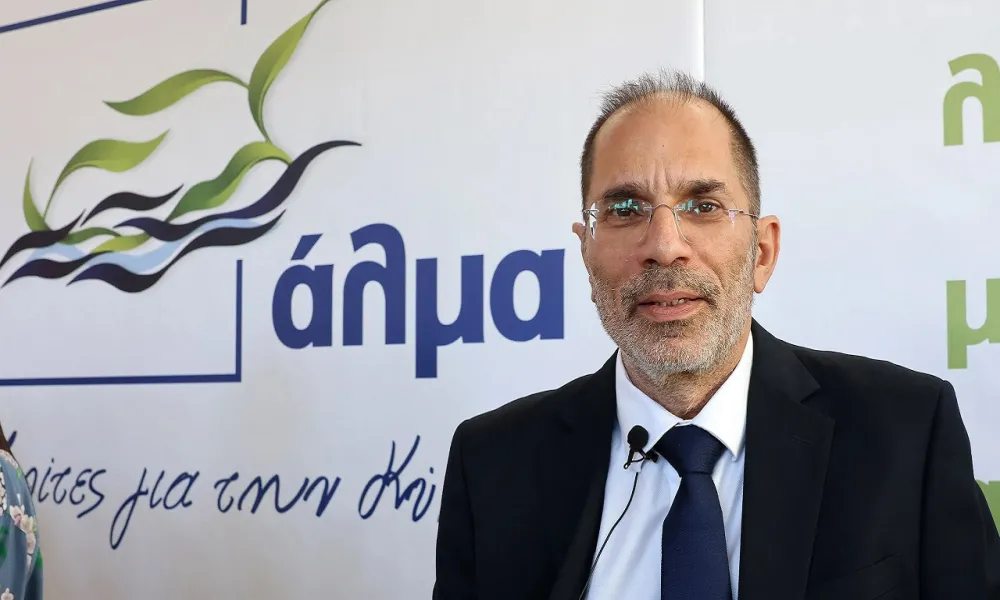
Interview with Stavros Antoniou and Andrie Daniel
Odysseas Michaelides, leader of the ALMA Movement, rejects claims that the party is a short-term vehicle built around his personal ambitions, arguing instead that it is a long-term political project aimed at structural change. In an interview with Politis, he outlines ALMA’s ideological positioning, its electoral strategy, and its stance on future alliances, while sharply criticising what he describes as emerging alignments between established parties.
Polls and political momentum
Asked about recent opinion polls showing ALMA slipping from double-digit to single-digit support, Michaelides argues that the broader picture matters more than headline numbers.
He says the dominant trend across surveys is the steady decline of traditional parties alongside the stable presence of ALMA, which, he notes, records historically high support for a newly formed political movement. Polls, he adds, are useful tools but require careful reading, especially beyond raw voting intention.
Michaelides points to qualitative findings showing high public anger toward the political establishment, continued personal popularity for ALMA’s leadership, and a significant share of voters determined to punish traditional parties. In polls measuring clarified voting intention, he claims, ALMA remains in double-digit territory. What is happening, he argues, is consolidation rather than decline.
Presidential ambitions and the 2033 horizon
Responding to accusations that ALMA exists primarily to support a future presidential bid, Michaelides says the movement has been transparent from the outset.
He recalls that since May 2025 ALMA has spoken openly about a reform horizon extending to 2033, meaning a full five-year term in executive power. According to him, meaningful institutional reform requires both leadership and a strong parliamentary base.
Reading ALMA’s statute, he says, makes clear that it is designed as a permanent political force. “We are not a single-use party, nor a personal vehicle,” he stresses.
Ideological positioning
On whether ALMA belongs to the centre-left or centre-right, Michaelides places the party firmly in what he calls the reformist centre.
He says ALMA draws from classical liberalism, social democracy and political ecology. The movement supports an open economy and healthy entrepreneurship as drivers of growth, while also advocating a strong social state focused on people rather than vested interests.
Dialogue with Irene Charalambidou
Michaelides confirms that there is an open but unpressured dialogue with MP Irene Charalambidou about potential cooperation in parliamentary elections.
He describes their relationship as longstanding and rooted in shared battles against corruption during his time as Auditor General. While he believes a joint effort would strengthen ALMA, he says Charalambidou has chosen, for now, to focus on her parliamentary and OSCE work. Discussions, he adds, will take place later and without deadlines.
Parliamentary cooperation and red lines
If ALMA enters parliament, Michaelides says it will remain outside the political system as it currently operates.
Every vote and position, he argues, will be guided by what he calls “public-interest rationality”. Proposals from any democratic party that genuinely serve the common good will receive support. Measures driven by narrow or self-serving interests will not.
Speaker of the House and Nikolas Papadopoulos
Michaelides rules out backing Nikolas Papadopoulos for Speaker of the House, dismissing such scenarios as premature but also politically illogical.
He accuses Papadopoulos of acting as a key ally of President Nikos Christodoulides, alongside ELAM, while at the same time flirting with DISY. Referring to a recent interview, Michaelides says Papadopoulos has effectively announced an “engagement” with DISY.
In all configurations he outlines, he argues, DIKO has become part of a broader Christodoulides–DISY–ELAM bloc that, he notes, Papadopoulos himself once described as the most corrupt government Cyprus has known. “We have nothing to do with that,” he says, adding that his criticism is strictly political and not personal, expressing respect for the late Tassos Papadopoulos.
Trust and personal credibility
Asked why citizens should believe he will not become part of the same system he criticises, Michaelides points to his professional record.
He recounts 16 years in the Ministry of Transport and more than a decade as Auditor General, during which he says he confronted powerful interests even at the cost of his career. He frames his removal from office as proof of his refusal to compromise his principles.
Party congress and internal process
On whether ALMA will hold an electoral congress, Michaelides says the decision rests with the transitional Executive Secretariat, as provided by the party statute.
Any congress, he adds, will take place after the parliamentary elections. With membership registrations only just beginning, he dismisses the idea of holding an internal electoral process on the eve of national elections as unrealistic.
This interview was conducted for Politis Paper and translated for Politis to the Point.