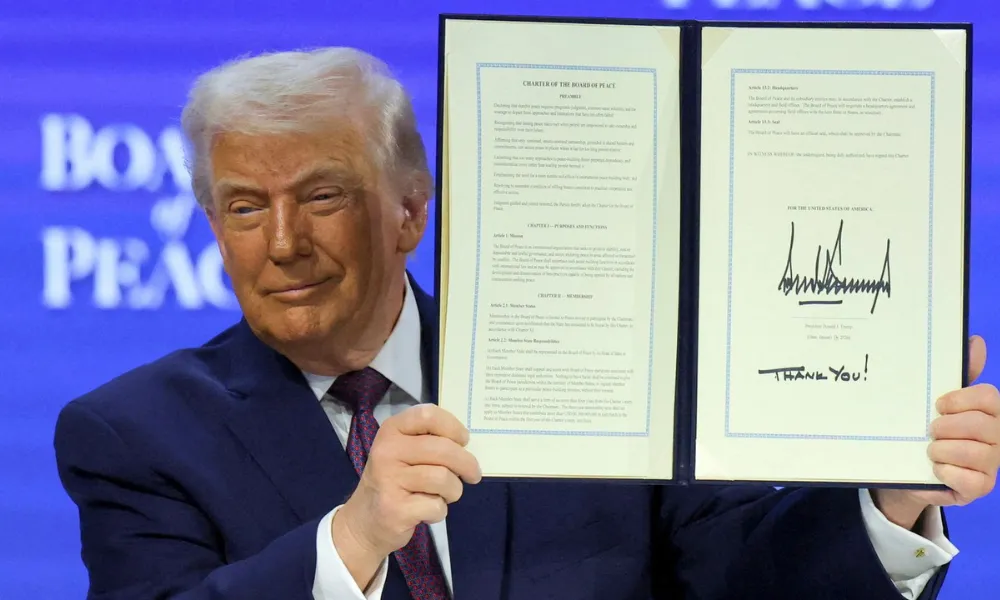
The decision by the President of the Republic for Cyprus to participate as an observer in Donald Trump's Board of Peace for Gaza, a construct of the American President purportedly aimed at reconstructing the region, has sparked strong domestic reactions. AKEL has taken a hardline stance, while the government seeks to justify its decision.
AKEL continues to voice its objections, describing the government’s participation in Trump's Board as a unique example of “ideological obsession.” As AKEL argued yesterday, there is no doubt that the United States is attempting to sideline the United Nations and restructure the international system established after the Second World War. It noted that it is no coincidence that a significant number of countries, including EU member states, rejected Trump’s invitation.
The opposition party maintains that the government’s choice carries enormous risks for Cyprus, which bases its existence, justice, and reunification efforts on international law and UN resolutions, rather than on uncritical support for Trump’s initiatives.
Yesterday, Monday, DISY also joined the debate. The party leader criticised left AKEL, accusing it of reacting a priori with rejection or even demonisation of Cyprus’ participation in international initiatives, filtered through ideological biases.
According to a written statement by DISY leader Annita Dimitriou, “AKEL’s position reveals a one-dimensional reading of international politics, far removed from political realism and contemporary diplomatic reality.” DISY aligns with the government’s position, citing “the country’s European and Western orientation,” yet disregards the scepticism of most European countries. However, DISY emphasised that while Cyprus should participate in international developments, “this does not remove the government’s obligation to timely and substantively inform political forces and society about its goals and objectives.”
Strategic miscalculation
The government presents its decision to participate in the so-called Gaza Board of Peace as a diplomatic upgrade for Cyprus. But is this really the case, or could it be a serious strategic miscalculation with long-term consequences?
-
Firstly, the initiative is highly personalised. It is not an institutional mechanism integrated into a stable international framework, nor is it based on an intergovernmental agreement with permanent status.
This initiative is tied directly to the political identity and objectives of a specific American President. Its lifespan and political influence depend entirely on that President remaining in office. A change in the White House could render the initiative inactive and useless. Cyprus therefore risks investing diplomatic capital in a framework without institutional continuity.
-
Secondly, Cyprus cannot treat issues of international legality lightly. Its very existence, sovereignty, and reunification efforts rely on UN resolutions and procedures.
If a new structure is seen internationally as an attempt to bypass or replace the UN, Cyprus’ participation generates at least a political contradiction. One cannot invoke the absolute supremacy of international law in the Cyprus issue while simultaneously legitimising processes accused of circumventing it.
-
Thirdly, the illusion of geopolitical elevation may prove to be a glaring misperception. Cyprus is a small state with an unresolved national issue and limited influence. Its power derives from its institutional integration within the European Union and its commitment to diplomacy.
Europe, US and Cyprus
Participation in a controversial, personalised forum such as Trump’s creation could give the impression of unilateral alignment with a specific American strategy. This may weaken Nicosia’s European standing without yielding tangible benefits. Evidence of this is the small number of EU countries participating, even as observers, in this Trump initiative.
-
Fourth, if the idea that major powers can create parallel structures while ignoring or sidelining the UN gains traction, international order shifts from a rules-based to a power-based system. In such an environment, countries like Cyprus are objectively disadvantaged. Turkey itself could exploit similar arguments to justify unilateral actions on the Cyprus issue, citing the “flexibility” shown by others.
Political risk
There is also the dimension of political risk. Should the initiative fail or be internationally devalued, Cyprus would be associated with a failed endeavour. Conversely, if it evolves into a mechanism that effectively substitutes the UN, Nicosia would have indirectly contributed to weakening the institutional framework that supports it. In both cases, the benefits are uncertain or potentially hazardous.
The decision of the government of Nikos Christodoulides for Cyprus to participate, even as an observer, in the so-called Gaza Board of Peace highlights the tone and direction of today’s foreign policy. It reflects a deeper tendency towards small-scale grandeur in perceptions of Cyprus’ role, moving away from consistent realism and touching on a familiar flaw of the current government and the President: an unsupported media overexposure pursued at any internal or external cost.