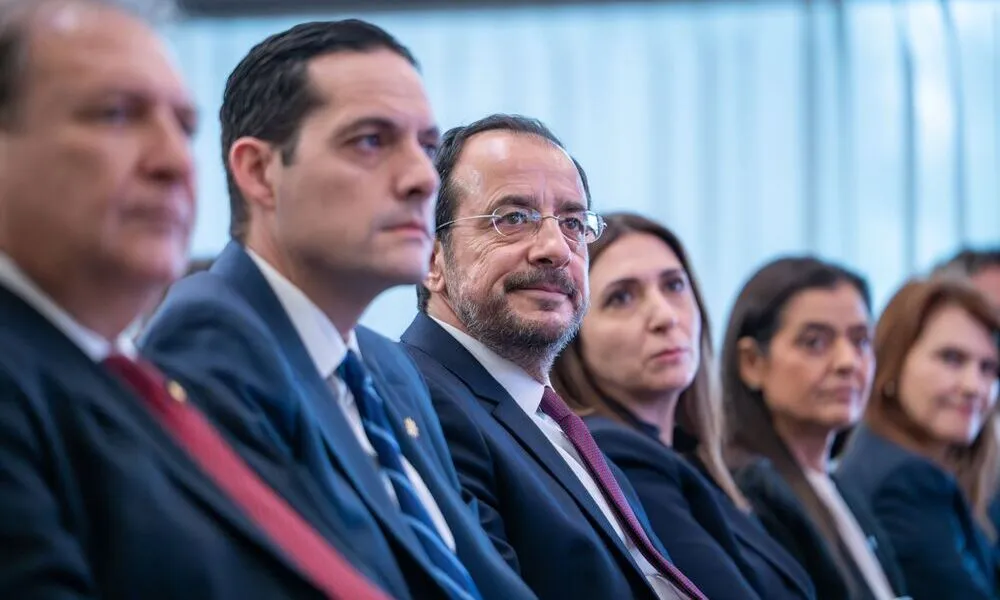
In Brussels for the Spring European Council summit, President Nikos Christodoulides spoke with Corriere della Sera's Francesca Basso about the war in the Middle East and the loan to Ukraine, while voicing Cyprus’ readiness to host talks between Lebanon and Israel. Below is an informal translation of the interview.
What signal should the summit send on the war in Iran?
“It is very important that the European Union sends a message of engagement. I completely disagree with those who claim this war does not concern Europe. That is a naïve view and not how the interconnected world we live in functions. This war directly affects the EU. One of the main topics at the European Council is competitiveness, which is closely tied to energy – and energy is directly linked to the situation in Iran.
The EU should promote a de‑escalation initiative together with other relevant partners: that is what the region’s leaders expect.”
Is the European Union already working on something?
“As an EU member state in close contact with all countries in the region – especially those in the Gulf – I can say they expect a signal. I do not expect that tomorrow (today) we will announce a concrete initiative, but demonstrating involvement and interest is already very important. We must identify the path toward lowering tensions: that is the most important message we should convey.”
Cyprus is on the front line. Some EU states have shown solidarity by sending naval vessels. Is that enough?
“Cyprus remains a safe hub. Everything is functioning normally. We are not on the front line in the sense of being part of the crisis. We experienced a single incident at a British base; Cyprus itself has never been attacked. Life on the island continues as usual. After that incident, I contacted several colleagues on the European Council and was very positively surprised by their reactions.”
Who responded?
“Greece, France, Italy, Spain and the Netherlands reacted immediately by offering support. I did not request this because we were involved in the war – its importance was primarily in reassuring Cypriot citizens.”
You did not invoke Article 42.7 on mutual defence.
“We did not activate it; we are not involved in the war. But the reaction of those states gave real substance to that article. We should use Cyprus as an example: as a Union, we must be ready to act immediately if one day a member state invokes Article 42.7.”
What is Italy doing?
“I am very grateful for Italy’s response. Prime Minister Giorgia Meloni was one of the first leaders to call me to ask about the situation and offer support. Cyprus is an EU member state, but also part of the wider Middle East region. For years we have argued that the EU must be more engaged in the region. I’m glad to have a colleague like Meloni – she always supports this position. In 2024, for example, we were together in Egypt with the Commission President to sign a strategic agreement. Italy is extremely important: Europe needs a strong, active and involved Italy.”
Cyprus is not a NATO member. Do you feel weaker?
“We are part of a strong European family, and that has been demonstrated in practice, not just in words. Moreover, we have strategic partnerships with several countries, including the United States and the United Kingdom. We do not feel weak, but we do want to join NATO.
The reason we are not a member is that Turkey would never accept Cyprus’s accession. I do not agree with those who say European strategic autonomy is impossible: what happened in Cyprus proves the opposite.”
What are relations with Turkey like?
“We cannot change geography: Turkey is and will remain Cyprus’s neighbour. We want good relations with all our neighbours. I also asked Prime Minister Meloni to help us in the dialogue with President Erdoğan. I am ready to invite him to the informal European summit that will take place in Cyprus on 23-24 April. We will invite ten regional leaders to discuss cooperation with the EU and present concrete projects linked to the Mediterranean Pact. I prefer a Turkey that is closer to the EU, because that would mean embracing European values and principles.”
How is the war in Iran affecting your EU presidency?
“It confirms the accuracy of our priorities for the Cypriot presidency: a European Union that is autonomous and open to the world. One reason we are affected by the crisis in Iran is precisely because we are not autonomous. We continue working as planned.”
Hungarian Prime Minister Orbán is blocking the loan to Kyiv. Will there be developments?
“We are in close contact with all partners to find a solution. Presidents Costa and von der Leyen are also in touch with member states. We made a political decision in December and that decision must be implemented – otherwise we lose credibility as a European Union. Despite the difficulties, I am optimistic: we will find a solution.”
The situation in Lebanon is critical. What should the EU do?
“I am in almost daily contact with President Aoun. Lebanon is very important for Cyprus and for the EU. I am very satisfied with the European Commission’s reaction: a few days ago, it announced an urgent increase of €100 million in humanitarian aid for Lebanon – a rapid and concrete response. There is also a public call by President Aoun to launch talks with Israel. We are waiting for Prime Minister Netanyahu’s reply. If it is positive, we will be ready to host the talks in Cyprus. We have excellent relations with both Israel and Lebanon, and the European Council will refer to this initiative.”
What does it mean to be a small country in an EU of 27 – especially regarding the debate on unanimity?
“I understand those who want to change the unanimity rule, and I am ready to discuss it. However, this is not the right time. Opening this issue now could create more division, whereas we need unity and leadership.
At the same time, the current Treaties already offer flexibility. For example, on Ukraine we used enhanced cooperation. So this is not the moment to open a debate that could divide the Union.”
Source: Corriere della Sera