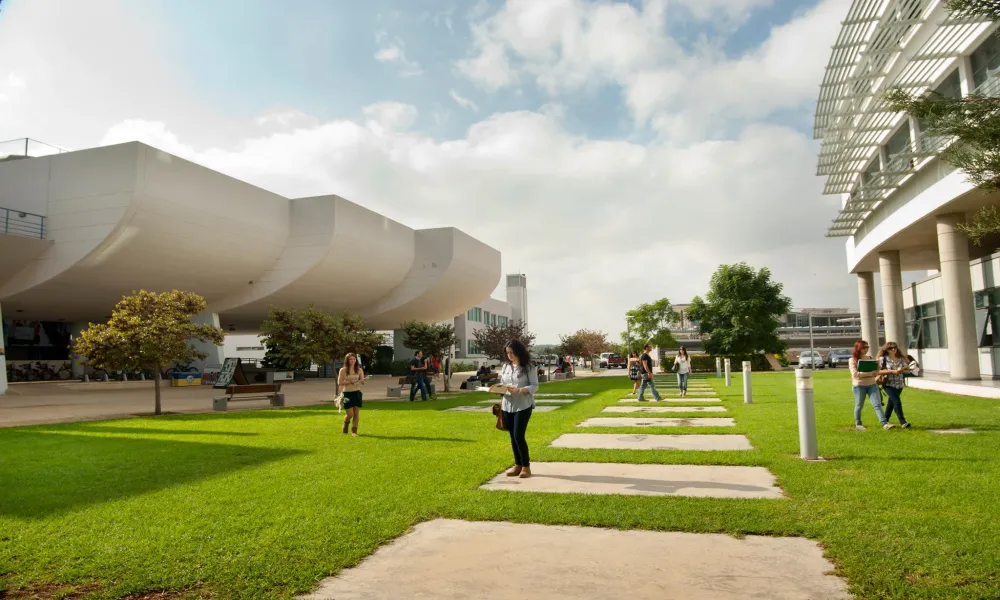
The University of Cyprus (UCY) is accelerating procedures to ensure all required approvals are secured in time. The announcements were made during a media presentation in which the university leadership outlined its strategic priorities for the coming years, focusing on internationalisation, infrastructure and long‑standing pending issues. UCY Council President Tasos Anastasiou highlighted the university’s role as a public investment in society and the economy, stressing the importance of strategic development and strengthening its international presence.
More English‑language programmes from 2027
Rector Tasos Christofides said the university is in a “race against the clock” to launch its first English‑language inter‑university degree programme at the start of the new academic year. The programme will be offered in collaboration with European universities and will be fully taught in English, marking a new phase of development for the institution.
To make a September launch possible, both internal procedures and Cabinet approvals must be completed in time – a goal the university leadership believes is achievable.
It was also clarified that English‑language programmes will not be developed en masse but selectively, with more expected from 2027 in specific fields. According to the administration, this expansion is part of a broader internationalisation strategy. Council Vice‑President Androulla Vassiliou stressed that the university’s next steps are guided by a coherent plan rather than piecemeal decisions.
Foreign‑language programmes will be chosen based on criteria already approved by the university’s governing bodies, including programme viability and financial self‑sufficiency, their potential for internationalisation, interdisciplinarity, and their contribution to society and the economy. Particular emphasis is placed on partnerships with overseas universities, with inter‑university programmes seen as a key tool for strengthening the university’s international profile.
The cautious rollout of English‑language degrees is also mandated by the numerous safeguards imposed by Parliament – a point the rector noted pointedly.
Urgent call on university clinics
Christofides linked the bill on English‑language undergraduate programmes to another long‑discussed but unresolved issue: the creation of university clinics. He issued a clear appeal to Parliament, describing the matter as crucial for the development of the Medical School. Cyprus, he stressed, remains the only country in Europe with a medical school but no university clinics – something that limits both education and research.
He urged MPs to assume responsibility for decision‑making, arguing that leaving the matter to negotiation among stakeholders perpetuates stagnation. “A responsible Parliament must take decisions,” he said.
Major projects under way
The university also presented updates on major infrastructure projects on campus. The Medical School building has been essentially completed and is being prepared for handover, while the Biological Sciences building is in its final construction phase. The university’s photovoltaic park, located within the buffer zone, is already operational, aiming to reduce energy costs and enhance the sustainability of campus facilities.
Change of plans for Faneromeni
Developments are also unfolding regarding the university’s presence in Old Nicosia. The original plan to construct a new building in Faneromeni has been abandoned. Instead, the university will repurpose existing spaces to house the Department of History and Archaeology and associated research units. This approach maintains the university’s footprint in the historic city centre. The relocation is expected to be completed within approximately two years – the time needed for renovations – on property owned by the Archbishopric.
As for the Architecture School, the university’s plan is for it to remain at its current facilities on Kallipoleos Avenue.