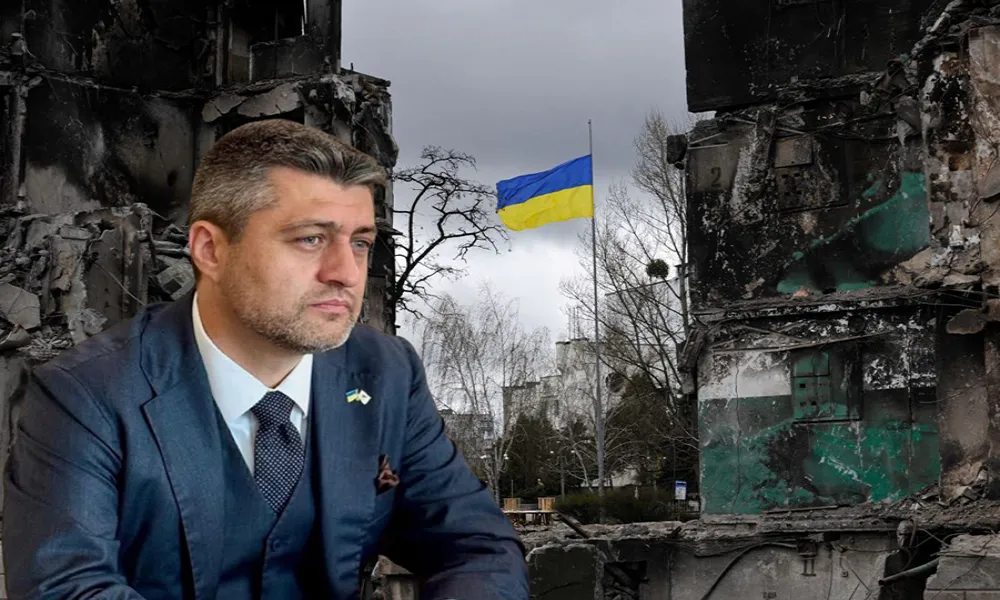

As Europe marks more than four years since Russia launched a full-scale invasion of Ukraine, the human cost of the conflict continues to unfold in devastating ways. In Cyprus, where tens of thousands of Ukrainians have found temporary protection, Ambassador Sergii Nizhynskyi spoke to Politis to the point about the realities of war, the challenges faced by refugees on the island, and the gaps that remain in support.
Nizhynskyi expresses deep gratitude to the Cyprus government and people for their solidarity, but he also underscores the need for more concrete measures: the recognition of Ukrainian diplomas to allow professionals to continue their work, improved access to healthcare and education. He expressed the belief that Cyprus could play a role in the safe return of children stolen by Russian forces. He also discusses the persistent threat of hybrid warfare, noting that Ukrainians can identify the Russian “signature” in disinformation and intimidation campaigns.
Through his words, one can feel the frustration and agony of those living through the war while much of the world continues with “business as usual”, and the urgent call for more media and international attention so as human rights violations and uncertainty that Ukrainians face daily can be fully comprehended.
Memorial week and international cooperation
What is the embassy organising in Cyprus on this occasion?
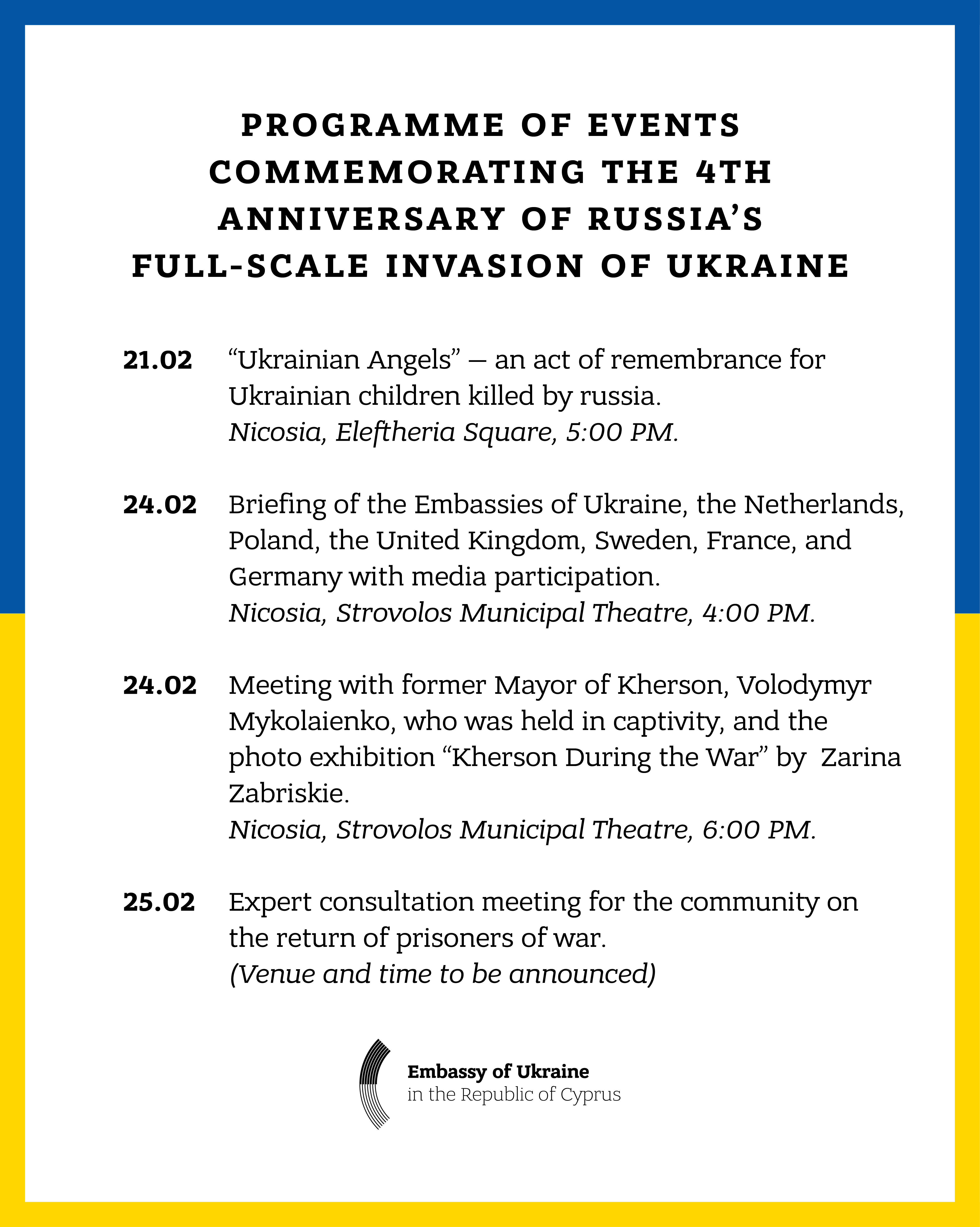
From 21 to 26 February, the Embassy of Ukraine in Nicosia is hosting a Memorial Week to honour victims of the war and civilians who lived under occupation. This is the first time such an event has been organised in Europe in collaboration with 15 embassies: the UK, Netherlands, Poland, Sweden, France, Germany, Japan, the US, and the Czech Republic.
The goal is to show Cyprus, Europe, and the Middle East that this conflict is about more than Ukraine’s independence. It concerns European security as a whole. Victims, both soldiers and civilians, are always our priority.
How do you describe the current situation in Ukraine?
Four years into this full-scale invasion, Russia has lost over 1.25 million soldiers, yet their territorial gains are minimal. Ukraine has recently retaken territory and strengthened positions near Pokrovsk and Kupiansk despite heavy fighting.
Russia continues to weaponise winter, targeting energy infrastructure across twelve regions just hours before the Geneva talks. Thousands are left without heat during freezing temperatures, deliberate attacks on civilians that violate international law.
Geneva’s US-brokered talks are ongoing, but core issues remain unresolved: territory, security guarantees, and Russia’s unwillingness to cease hostilities. Ukraine engages constructively, but the path to peace requires real commitment from Moscow.
European support and US mediation
How important is international support for Ukraine?
It is critical. We appreciate mediation efforts, including from the Trump team and European allies. But peace must be just. Ukraine will not compromise on sovereignty, territorial integrity, or NATO aspirations. We are ready for an unconditional ceasefire, but Russia must demonstrate genuine will, not just strikes.
Cyprus, as an EU member, can help through coordinated sanctions, energy support, and defence investment. A strong Ukraine means a secure Europe, including the Mediterranean.
Ukrainians in Cyprus
How is life for Ukrainians in Cyprus?
Cyprus hosts around 24,600 Ukrainians under temporary protection, with 33,000 registered overall. Ukrainians here are not a burden, they contribute economically, culturally, and socially. They work in tourism, IT, legal services, and entrepreneurship. They bring “clean money”, pay taxes, and reinvest in both Cyprus and Ukraine.
For example, Ukrainian businesses in Cyprus generate jobs and dividends worth billions. They integrate well: they learn Greek, contribute to education, and participate in local society.
Health, education, and professional recognition
What more could Cyprus do to support Ukrainians?
We need more attention to healthcare, education, and recognition of Ukrainian diplomas. Many displaced people are traumatised, including children who survived sexual violence. Psychological and medical support must be provided in Ukrainian.
Recognising diplomas would allow Ukrainian professionals, doctors, teachers, psychologists, to work with their community here. It is not charity, it is efficient, life-saving support.
Cyprus has been a generous host. Ukrainians here are contributing, integrating, and enriching society. But beyond charity, we need recognition of qualifications, medical and psychological support, and awareness campaigns.
Trauma and displacement
I personally helped evacuate tens of thousands of families from Kharkiv, Donetsk, Mariupol, and Kherson. I saw children arriving in minus 11 degrees with nothing but T-shirts. These are not economic migrants; they are fleeing war.
Many leave behind grandparents, homes, and pets. Their mental health needs are immense. Cyprus could enhance support with medical aid, counselling, and education programmes.
Information gap, media coverage and disinformation
How well-informed is Cyprus about the war?
There is a gap. Russian-language channels dominate, and Ukrainian media presence is minimal. We need more cultural diplomacy, books, exhibitions, films, and public events to show civilians’ realities and European stakes. He also calls on Cypriot media to cover more consistently the reality of the war and the human rights violations taking place, so that public understanding is based on facts rather than narratives shaped elsewhere.
Awareness is not just about Ukraine. It is about European security. Countries bordering Ukraine, like Poland, understand this clearly.
The Ukrainian Ambassador spoke to Politis about comments relating to Russian hybrid threats, linking the visit of President Volodymyr Zelenskyy, the Cyprus’ government support to the leak of a video exposing Cyprus internationally just one day after:
“We know the signature of Russian hybrid operations very well. Ukrainians have lived with this for years. Disinformation, manipulation of public opinion, timing of leaks or scandals, these are not new tools. Our experience shows that such tactics aim to create distrust, confusion, and division in societies that support Ukraine. Recognising these patterns is the first step to resilience”.
Humanitarian crises: stolen children
What are the developments relating to the abduction of children by Russia?
Over 20,000 Ukrainian children have been forcibly taken, often with passports changed and taught to forget Ukrainian language and identity. Cyprus could play a mediating role, as Qatar has done, providing a temporary safe place for reunification with families or schooling until permanent solutions are found. Every child returned is a victory for humanity.
Cultural diplomacy and community engagement
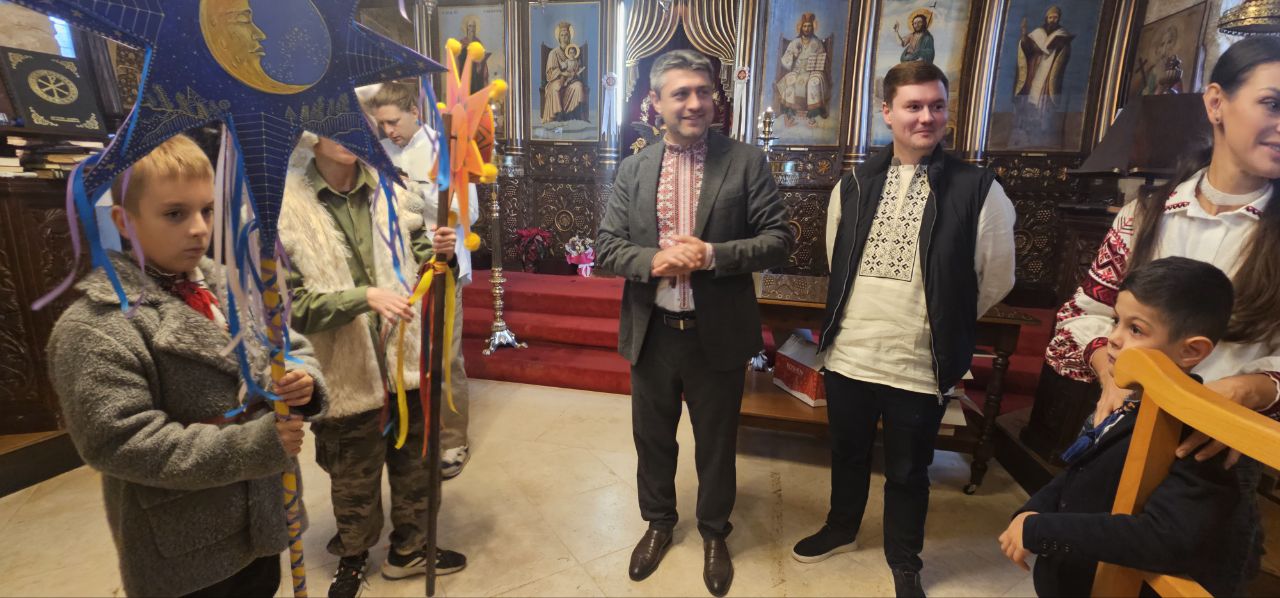
The embassy regularly organises cultural events, concerts, and exhibitions. Notably, Ukrainian artists such as Okean Elzy perform to raise awareness and connect the diaspora.
Cultural diplomacy is a priority. Ukrainians here need information, integration and platforms to express their identity. Exhibitions, music, and educational events create empathy and understanding.
Cyprus-Ukraine cooperation
How is bilateral cooperation progressing?
Cyprus plays an essential role in supporting Ukraine’s EU integration and Schengen aspirations. We also respect Cyprus’ sovereignty and support efforts to resolve the Cyprus issue under UN guidelines.
Ukrainians in Cyprus benefit from intergovernmental committees and networking platforms, but more action-oriented engagement is needed, particularly in social policy, healthcare, and energy support.
This war is not only about Ukraine, but also about defending European values, sovereignty, and human dignity. Every action Cyprus takes, from supporting energy and medical aid to mediating stolen children, strengthens not just Ukraine, but the stability and security of Europe.