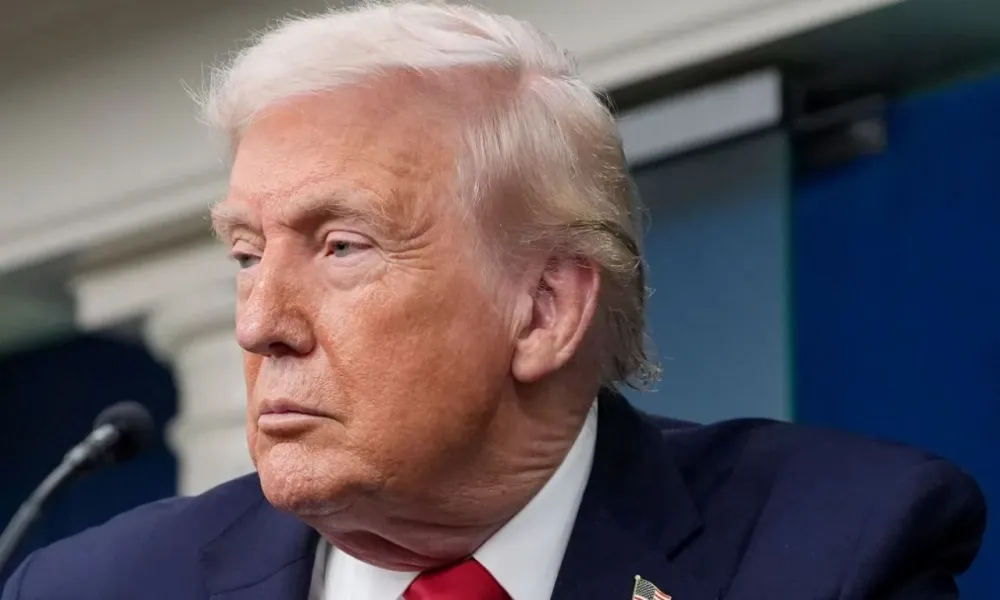
US President Donald Trump said he would raise a new global tariff on imported goods to 15%, up from 10%, in a post on his Truth Social platform.
The increase takes immediate effect, he said, lifting the temporary “global tariff” introduced by executive order a day earlier after the Supreme Court of the United States ruled that a significant portion of his earlier tariffs were unlawful. The baseline rate had been set at 10% and was due to take effect on 24 February.
“As President of the United States, I am raising, effective immediately, the 10% global tariff (…) to the maximum permissible level (…) of 15%,” Trump wrote.
EU signals possible retaliation
The European Union has the tools to respond to Washington’s latest tariff move, France’s Trade Minister Nicolas Forissiertold the Financial Times, urging member states to adopt a “common approach”.
Forissier said he was in talks with EU counterparts and the European Commission following Trump’s decision, which came in response to the Supreme Court ruling against parts of his tariff policy.
“If necessary, the European Union has the appropriate instruments,” he said.
French officials cautioned that it was too early to speculate on the bloc’s response, but options under consideration include the EU’s so-called “trade bazooka” — the Anti-Coercion Instrument (ACI) — which could target US technology companies.
The ACI allows for a broad range of measures, from export controls and tariffs on services to excluding US firms from EU public procurement contracts.
A retaliatory package of tariffs worth more than €90bn on US goods is also available, should the bloc choose to deploy it.
Forissier said Trump’s threats had strengthened EU unity but warned the bloc must be ready to act. “We can no longer afford to be naïve. We must use our tools, not just talk about them. We do not want to be dependent. We do not want to be hostages,” he said.
The European Parliament is due to meet on Monday to discuss a further delay in ratifying a trade agreement concluded with Washington last year.
Inflation concerns
Trump has pressed ahead with higher tariffs despite concerns they are fuelling price pressures and hurting export-reliant companies.
Fabio Panetta, governor of the Bank of Italy, said at a press conference in Venice that the initial impact had been absorbed by US corporate profit margins before being passed on to consumers.
“Overall, tariffs are estimated to have contributed more than half a percentage point to inflation, which remains above the Federal Reserve’s target,” he said, noting that inflation stood at 2.4% in January.
India’s Commerce Ministry said it was “examining all these developments and their implications”.