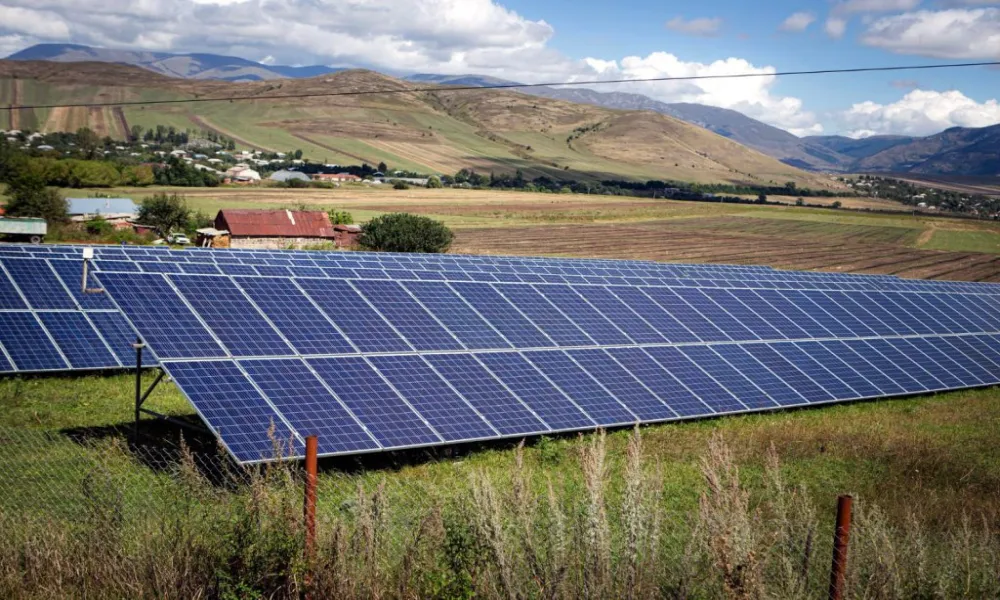
For nearly four years, parliament has been grappling with the issue of the over-concentration of renewable energy projects (RES) on state-owned agricultural land. These developments have often been licensed without proper planning or oversight—even within irrigated land redistribution zones—at a time when global concerns over future food security are mounting. As things stand, the matter is unlikely to disappear from the political agenda. Despite measures introduced by the executive branch, concerns and opposition from local communities persist.
Amid mounting frustration from farming communities—from Kokkinochoria to Paphos—who are witnessing professionals being displaced from lands they have cultivated for decades, communities being encircled by photovoltaic parks near residential zones (to the detriment of their future development and the aesthetic of the landscape), and grazing lands being lost overnight, the House Agriculture Committee is now examining amendments to the legislative framework to rationalise spatial planning policies for RES projects.
This initiative was conveyed to Politis by the Committee's Chair and AKEL MP, Yiannakis Gavriel. "Given the current situation and the apparent lack of political will to put an end to this lawlessness, we are now considering constitutionally sound methods to rationalise the spatial policy concerning RES projects—aiming to protect agricultural land and support the development of local communities. We owe this to future generations. The profits of a few cannot be placed above the public interest," he stated emphatically.
The reality on the ground
The issue affects the entire free territory of the Republic, with Gavriel noting that letters of protest have been received from across Cyprus. "While the authorities insist that the use of agricultural land for RES accounts for only a small percentage of designated agricultural zones in local and national plans, I would argue this does not reflect the reality. It creates misleading impressions. When agricultural land near communities—with infrastructure like roads, electricity, and water—is chosen for RES development, land which is clearly preferred by farmers, it is not acceptable to suggest that similar land is available elsewhere, even if it is remote and lacks the same amenities."
Providing indicative data, Gavriel pointed to the Famagusta district. Excluding rooftop solar installations, major RES projects—primarily photovoltaic—totalling around 58MW have already been implemented there. "This figure alone has already had enormous consequences, triggering justified objections from local communities and authorities. Despite voicing serious concerns and disagreements, they do not appear to be heard."
In addition to completed projects, the Cyprus Energy Regulatory Authority (CERA) has issued licences for RES developments in the Famagusta district amounting to a total capacity of 408MW. "To put this into context, the total installed RES capacity across the entire island currently stands at around 900MW. These numbers point to the devastating consequences that could follow if all licensed projects proceed—not only for agriculture but also for the broader development prospects of affected municipalities and communities," warned Gavriel.
Government measures under scrutiny
In 2023, the Ministers of Interior, Energy, and Agriculture assured parliament that the unacceptable practices of recent years—such as licensing RES projects even within irrigated agricultural zones—would be halted through amendments to the state’s spatial planning policy. This review process was ongoing at the time. Eventually, Interior Minister Constantinos Ioannou revised the relevant directive in July 2024. However, its content has failed to satisfy critics.
"From the outset, we raised serious concerns about whether the new directive would achieve its intended objectives. Unfortunately, it barely differs from its predecessor and fails to provide meaningful safeguards against the misuse of even the most fertile agricultural land," said Gavriel.
He noted, for example, that no category of agricultural land, not even the most productive, has been excluded from RES development zones. Moreover, it remains possible to override objections raised by the Ministry of Agriculture. The only significant change is the introduction of agrivoltaics, where farming activity continues alongside solar energy production on fertile irrigated land. However, Gavriel noted that there have already been complaints suggesting agricultural activity is being phased out entirely on such sites. "There is a real risk this will simply become a loophole for continued encroachment on farmland," he added.
The town planning department, under the interior ministry, responded to concerns over the 2024 directive. According to the department, the leasing of state land for RES projects was officially halted by ministerial decision in May 2023. Since then, no new applications have been accepted.
RES projects on state land continue to be regulated under development plans and ministerial directives—first Directive 2/2006, which was replaced in June 2024 by Directive 1/2024. However, neither directive explicitly prohibits the licensing of RES developments on fertile state-owned land, including irrigated redistribution zones or areas serviced by government waterworks.
Prior to Directive 1/2024, the Director of Town Planning reportedly rejected most applications for photovoltaic parks on fertile agricultural land. A small number of projects were approved, following the success of hierarchical appeals against initial rejections. Under the new directive, development is still permitted on fertile land if the installation meets the criteria for dual land use—as outlined in guidance from the Department of Agriculture—meaning that the land must be simultaneously cultivated and used for energy production, and only for small-scale RES installations.
New measures announced
Asked whether additional measures were being considered to address concerns from local farming communities, the Ministry of Interior shared the following:
As part of the review and publication of Directive 1/2024, feedback was sought from all relevant stakeholders, including organised farming groups. The Parliamentary Agriculture and Natural Resources Committee was briefed prior to the directive’s release, and special sessions were held with the Minister of Agriculture, involving farming organisations.
In a meeting of the Ministerial Committee in June 2025, further measures were adopted based on proposals from the Minister of Interior:
-
Applications to lease state land for RES projects will be rejected if the land is already under consideration by the Department of Lands and Surveys for agricultural or livestock purposes. Pending planning applications in such cases will also be dismissed.
-
State land classified as fertile agricultural land—such as irrigated redistribution zones or land served by government water infrastructure—will no longer be leased for RES purposes. Any pending applications for such land will be immediately rejected.
-
Approval for leasing state land for RES development will be contingent on the project’s ability to connect directlyto the Electricity Authority of Cyprus (EAC) network.
These decisions were formally confirmed by the Minister of Interior during a session of the House Agriculture Committee on 8 July 2025.
Millions for substation upgrades—but rooftops neglected
Gavriel also highlighted what he called a "paradox" in Cyprus’s energy strategy. "Substations in rural areas—where agricultural land is being sacrificed for RES projects—are now largely saturated. In contrast, urban substations, which serve areas where rooftop solar installations are more common, still have significant capacity to accommodate new projects. Instead of prioritising rooftop solar in urban areas—an approach that protects farmland and benefits society—the authorities are choosing to spend tens of millions of euros upgrading rural substations, effectively enabling the continuation of this unchecked expansion."