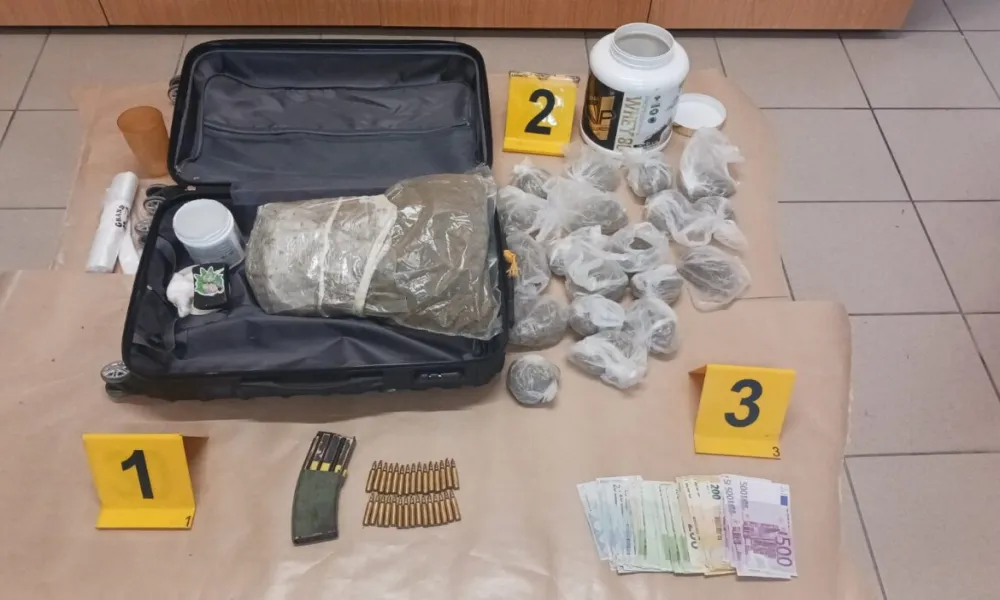
Cyprus has reported record-high drug seizures so far in 2025, but authorities say the figures reflect stepped-up enforcement rather than a surge in trafficking.
Christos Andreou, Head of the Anti-Narcotics Service (YKAN), told the Cyprus News Agency (CNA) on Friday that intensified operations at the Republic’s entry points have doubled the amount of narcotics intercepted compared to last year, even as the number of arrests remains stable.
Record quantities seized
From January 1 to August 31, authorities confiscated 613 kilos of cannabis, 279 kilos more than in 2024 and 39.5 kilos of cocaine, an increase of 33.5 kilos year-on-year. Smaller quantities included 1.5 kilos of cannabis resin and 50 cannabis plants.
By September 19, the totals had risen to 640 kilos of cannabis, 40 kilos of cocaine, 2 kilos of resin, and 50 plants. Police also seized 2,476 cannabinoid products containing THC, ranging from gummies and chocolates to oils, beers, biscuits, capsules, and e-cigarettes—across Cyprus.
Despite the spike in seizures, YKAN recorded 781 cases involving 768 individuals during the first eight months of 2025, nearly identical to the previous year.
“We are not necessarily seeing more drugs,” Andreou emphasized. “We are seeing more effective checks and better targeting at entry points.”
Drug traffickers are adapting quickly, Andreou said, citing a recent case where narcotics were found hidden in cereal boxes. He also warned about Captagon, a synthetic stimulant pill prevalent in Syria and Lebanon and reportedly used by extremists, though it has not yet been detected in Cyprus.
Targeting organised crime finances
Andreou stressed that large drug shipments are linked to organised crime and vast illicit profits. Since 2020, YKAN has conducted 89 financial investigations, freezing €1.42 million and confiscating €833,783. The biggest single-year seizure, €357,383, occurred in 2025.
“Behind the large quantities of drugs lies organised crime with enormous financial gains,” he said.
Beyond enforcement, YKAN continues to expand its prevention work. Under the Early Intervention Programme, 205 young people aged 14–24 were referred to treatment centres this year. Of those, 143 were drug-dependent, while 62 were relatives or members of their support network.
Andreou said the aim is to give young people “a second chance before their involvement with drugs becomes irreversible.”
CNA