By Yiota Hadjicosta
The widespread water outages that struck Nicosia this August, in the middle of a sweltering heatwave, exposed systemic failures in the capital’s water infrastructure — and the urgent need for strategic overhaul.
What began as a planned shutdown by the Water Development Department (WDD) quickly escalated into a multi-day crisis, with thousands of households and entire communities left without running water for up to five days. Citizens complained of poor communication, dry reservoirs, and completely drained private storage tanks.
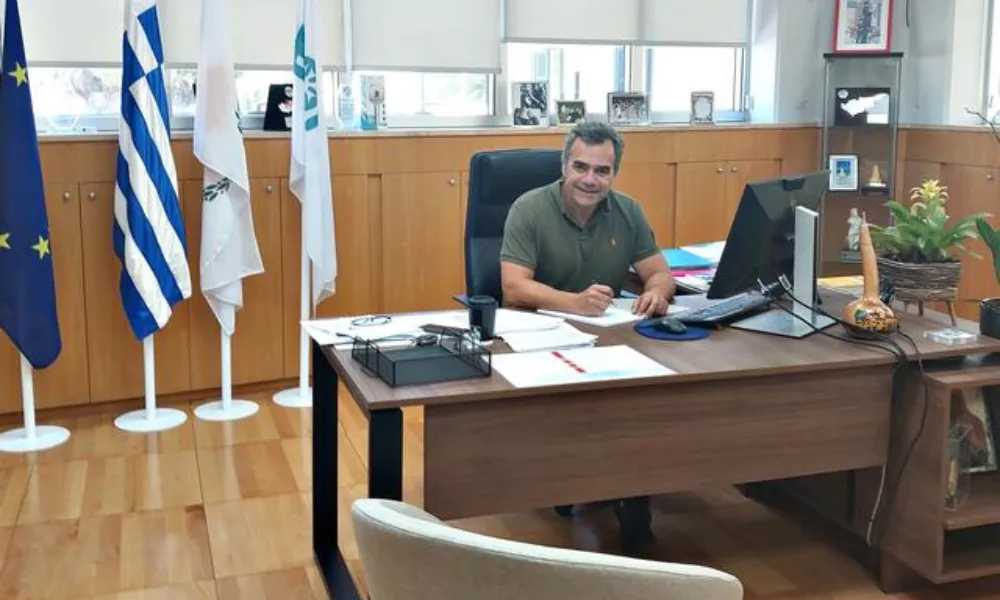
In this interview with Politis, Constantinos Yiorkadjis, President of the Nicosia District Local Authority (ΕΟΑ), explains the chain of events and highlights the structural weaknesses caused by the lack of long-term planning.
Mr Yiorkadjis, what exactly caused the failure in the WDD pipeline, and why wasn’t it possible to prevent or at least contain the consequences?
The WDD had informed the Nicosia ΕΟΑ on 25 August that, due to scheduled works connecting a central supply pipeline in the Lakatamia area, there would be a water cut on Tuesday 26 August from 04:00 until 17:00. The affected areas were Tseri, Lakatamia, Anthoupoli, Dali, Anageia, Ergates, and the Ergates Industrial Zone.
On the same day, the ΕΟΑ issued a public notice to inform residents. However, the works were completed with a five-hour delay, at 22:00. Two hours later, a leak was detected in the new pipeline, forcing an immediate halt.
The following day, the WDD informed us of another supply interruption due to this fault. Repairs were completed by 20:00, and water flow to the ΕΟΑ reservoirs resumed around 22:00. In effect, for 42 hours, no water was supplied to the ΕΟΑ network or the surrounding communities.
Did that resolve the issue?
Not exactly. Water was supplied for about nine hours — from 22:00 on Wednesday to 07:00 on Thursday morning — before being cut off again.
This time, the disruption was caused by a severed underground cable belonging to the Electricity Authority of Cyprus (EAC), during unrelated roadworks on Tseri Avenue. As a result, the WDD pumping station — which supplies the ΕΟΑ’s reservoirs in Lakatamia and Tseri, as well as neighbouring communities — lost power.
Unfortunately, there was no backup generator at the pumping station, so water supply could not continue.
When was the issue finally resolved?
By that stage, after three full days, all public reservoirs, pipelines, and most private tanks had completely emptied.
Although the power failure was resolved relatively quickly, restoring water to premises is a much slower process than restoring electricity. When a pipeline system is empty, it has to be re-pressurised gradually. If water is rushed in too quickly, the pipes can burst due to pressure buildup.
Our crews had to vent air from the network before normal pressure could resume. This process was handled entirely by ΕΟΑ teams. Water flow began to stabilise on Friday 29 August, but due to heightened demand, low-lying areas were the first to recover, while those at higher elevations experienced ongoing delays.
Couldn’t you have increased the water supply to meet this surge in demand?
That’s precisely what citizens were asking — and understandably so. But the answer is no.
The main WDD pipeline in the area has a fixed diameter and was already operating at full capacity — averaging 500 cubic metres per day. It simply wasn’t able to replenish the empty ΕΟΑ and community reservoirs fast enough.
It’s worth noting that the WDD has not carried out any upgrades in recent years to increase pipeline or pumping capacity in this region, despite the population explosion. Today, the Lakatamia area alone accounts for around 30% of total water consumption in the Nicosia district.
There was also frustration about delays in informing the public. Did the WDD and ΕΟΑ handle communication and coordination adequately?
Although the WDD was responsible for the works and the initial announcement, there were indeed gaps in our own communication. We’re already reviewing proposals to launch an SMS alert system, so that residents can be informed in real time about problems, estimated repair times, and progress updates.
That said, I must express a grievance: after three days without supply, when the WDD resumed water delivery and our system was running on empty, residents called in understandably angry. The WDD’s response was, “We are providing water”, implying that responsibility for household supply now fell entirely on ΕΟΑ — while they knew full well that their infrastructure couldn’t deliver more than a limited amount.
The new GLS reservoir in Lakatamia was meant to enhance supply. When will it be operational?
The reservoir has been built, but it’s not yet connected to the WDD supply network. It is expected to become operational before the end of the year.
Once online, it will increase our water autonomy during supply cuts from 13 hours to 37 hours. That’s a significant improvement, but not a complete solution.
How do you assess the cooperation between ΕΟΑ and the WDD during this crisis? Is there a need for a new institutional framework for emergency response?
Immediately after the crisis, ΕΟΑ Nicosia sent a letter to the Minister of Agriculture requesting a meeting to discuss the incident and define a better framework for cooperation between the relevant authorities.
The following week, our Director General and technical teams met with the WDD and submitted specific proposals. Among them:
-
Mandatory presence of WDD and Public Works officials at major construction sites
-
Immediate fault repairs by the WDD, with no postponements
-
Clear, timely communication with the public
-
Guaranteed uninterrupted power supply to pumping stations (with backup generators)
-
Increased water reserves for times of crisis
Additionally, ΕΟΑ requested compensation for:
-
Overtime costs for its crews
-
The use of water tankers to supply the Ergates Industrial Zone
-
Network damage caused by the strain of prolonged emptying and refilling
“We want full responsibility — so we can deliver full solutions”
How does ΕΟΑ plan to improve network resilience and avoid future crises?
Under Cyprus’s Integrated Water Management Law, the WDD — under the Ministry of Agriculture — is responsible for supplying water to ΕΟΑ’s reservoirs.
But for decades, there has been no strategic plan to develop critical water infrastructure in step with Nicosia’s urban growth. As a result, the current system lacks the capacity to handle serious failures or unexpected cuts.
From ΕΟΑ’s side, what’s urgently needed is unified management of the water distribution network — from reservoirs to households. We must be able to deliver water flexibly across the network, with alternative routes where necessary.
During the recent crisis, some communities located near the edges of our jurisdiction had no water — and we had no means to help, because they weren’t connected to our grid.
There’s real potential for small-scale infrastructure projects to connect peri-urban communities to the urban water network. But these are not currently considered because ΕΟΑ does not have full authority.
It has become clear: if we take full responsibility for suburban water supply, we can implement solutions that simply aren’t possible today.