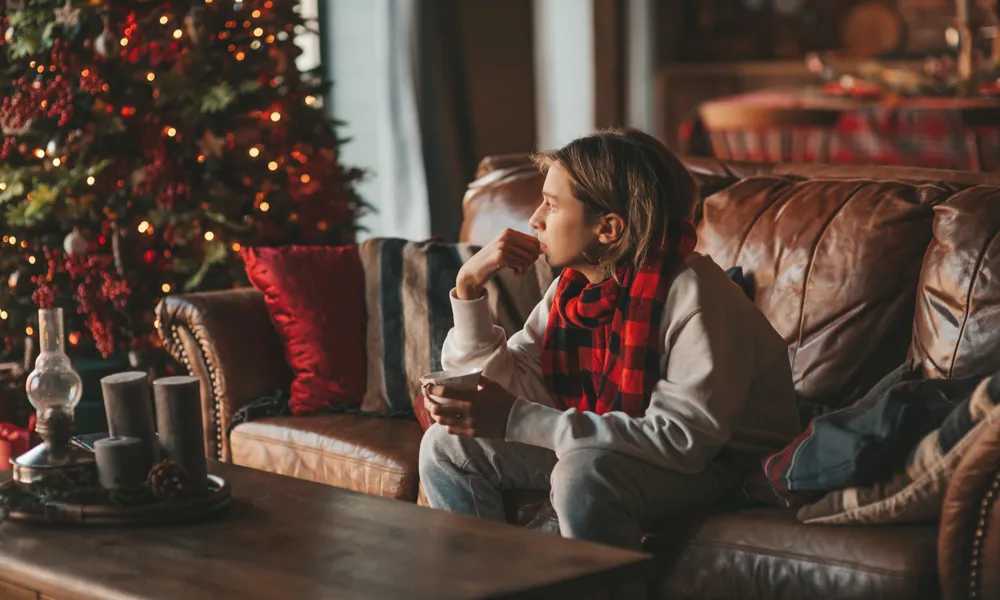
It is a mid-December afternoon in Limassol and Anexartisias Street is already dressed for Christmas. Fairy lights loop across the pedestrian walkway, speakers play the same playlist on repeat and every storefront advertises something “festive”. Yet on one of the benches just off the main street, a 29-year-old barista who works split shifts describes the season very differently.
“I know I am supposed to feel grateful and happy,” she says. “Mostly I feel tired, worried about money and guilty that I am not enjoying any of this.”
Her words capture something that sits uneasily with Cyprus’s image as a sunny, carefree island. Around Christmas, many people report sadness, anxiety or emotional numbness that feels out of step with the lights and slogans around them. Some live with a recognised seasonal mood disorder. Many more experience what clinicians describe as “holiday blues”.
SAD, holiday blues and ordinary stress
Seasonal affective disorder, or SAD, is a form of major depressive disorder with a clear seasonal pattern. Symptoms typically begin in late autumn or early winter, peak during the winter months and ease in spring. People experience persistent low mood, fatigue, oversleeping, changes in appetite and difficulty concentrating. The condition is strongly linked to reduced daylight, which disrupts circadian rhythms and affects serotonin and melatonin regulation.
Globally, SAD is estimated to affect between 0.5 and 3 per cent of the population, with milder seasonal depressive symptoms affecting up to 10–15 per cent of adults.
Clinical psychologist Maria Kakoullis stresses that Christmas itself does not cause SAD.
“Christmas happens to fall around the same time that symptoms of seasonal affective disorder begin to emerge,” she explains. “Because these two coincide, it can appear as though people are becoming depressed because of Christmas, when in fact what may be starting is a biological condition.”
Holiday blues, she adds, are different. They are not chemical but environmental.
“They are linked to external factors,” Kakoullis says. “Being away from family, limited social support, financial pressure at the end of the year and the emotional weight people attach to the holidays.”
The Cyprus reality: sunshine, pressure and a youth mental health crisis
Cyprus sits far from the northern latitudes where SAD was first described. Long hours of daylight and mild winters should, in theory, offer protection. In practice, the picture is more complex.
“You can live in a sunny place and still feel numb, low or emotionally vulnerable during winter,” Kakoullis says. “Especially when biological changes are already present and you add family expectations, social pressure and financial strain.”
This layering of pressure is playing out against an already fragile mental health landscape, particularly among young people. A recent Ministry of Health and UNICEF study found that 86 per cent of young people in Cyprus report high levels of anxiety and uncertainty about the future, while three in four experience constant pressure and stress. Although 60 per cent felt they needed professional mental health support, fewer than half sought it, citing stigma, lack of information and limited access.
Christmas amplifies these pressures. Families gather across generations, often with strong expectations around togetherness and tradition. For some, this offers comfort. For others, particularly millennials and Gen Z returning to parental homes with insecure work or uncertain futures, it brings intrusive questions about careers, relationships and life progress.
Cost of living adds another layer. December is among the most expensive months of the year, and financial strain can turn celebration into anxiety.
There are also groups for whom Christmas highlights isolation rather than connection: migrant workers unable to travel, asylum seekers, foreign students, single parents sharing custody, and older people whose children live abroad. For families with ties to conflict zones such as Gaza, Israel or Ukraine, this winter also carries the emotional weight of war.
Voices from the field
From a clinical perspective, Kakoullis emphasises that it is the interaction between biology and environment that increases vulnerability.
“If someone has a biological predisposition for depression and you combine that with environmental stressors, symptoms can worsen,” she explains. “That does not mean Christmas causes depression. It means pressure layered onto vulnerability can intensify what is already there.”
She also cautions against the expectation of constant happiness.
“You do not have to be happy just because it is Christmas,” she says. “Limiting expectations, spending only within your means and choosing which social obligations you can realistically manage can significantly reduce anxiety.”
Institutional voice: a system under strain
The Mental Health Services of the Ministry of Health operate the public network of psychiatric hospitals, community mental health centres and specialised services, including the 24-hour crisis hotline 1401.
Officials acknowledge rising demand, particularly among adolescents and young adults. The Ministry of Health and UNICEF study highlights long waiting times and fragmented, under-resourced community services that struggle to respond in a timely and youth-friendly way.
Alongside public services, the Youth Board of Cyprus (ONEK) has increasingly placed mental wellbeing at the centre of its youth policy. On 15 December, ONEK launched a Christmas campaign titled “Be the reason someone smiles these holidays”, encouraging small acts of kindness and outreach to those who feel isolated. The messaging reflects a broader shift towards visibility, connection and reduced stigma.
At the same time, ONEK’s own helpline, 1410, has been non-operational for some time. According to information provided to Politis by ONEK official Stelios Papapetrou, the tender for assigning the line to an external operator closed on 19 December, with the organisation awaiting confirmation on whether an operator has expressed interest. In the interim, ONEK directs young people to other available support channels.
What actually helps
Experts caution against simplistic self-care messaging that places responsibility solely on individuals. Still, clinicians point to realistic steps that can help reduce vulnerability.
Kakoullis emphasises the importance of basic regulation: regular physical activity, consistent sleep patterns and attention to diet, all of which help stabilise emotional reactivity. Equally important, she says, is permission to opt out.
“You are not obligated to attend every invitation or meet every expectation,” she notes. “Doing what feels manageable and right for you can make a real difference.”
Social connection remains protective, but it does not need to follow a festive script. A quiet meal with a neighbour, volunteering, or a call with friends abroad may offer more comfort than large gatherings that leave people feeling more alone.
Seeking support early is also critical. Community mental health centres operate across Cyprus under the General Health System, while universities such as the University of Cyprus and Cyprus University of Technology offer counselling and psychotherapeutic services for students.
In a country that markets its sunshine as an antidote to winter gloom, it can be tempting to dismiss these experiences. Yet the data on youth anxiety, the strain on services and the stories heard quietly each December point in the same direction. Christmas in Cyprus is not only about lights on palm trees and full tables. It is also about invisible battles behind closed doors.
And for many, the most important message may simply be this: it is allowed not to feel festive.