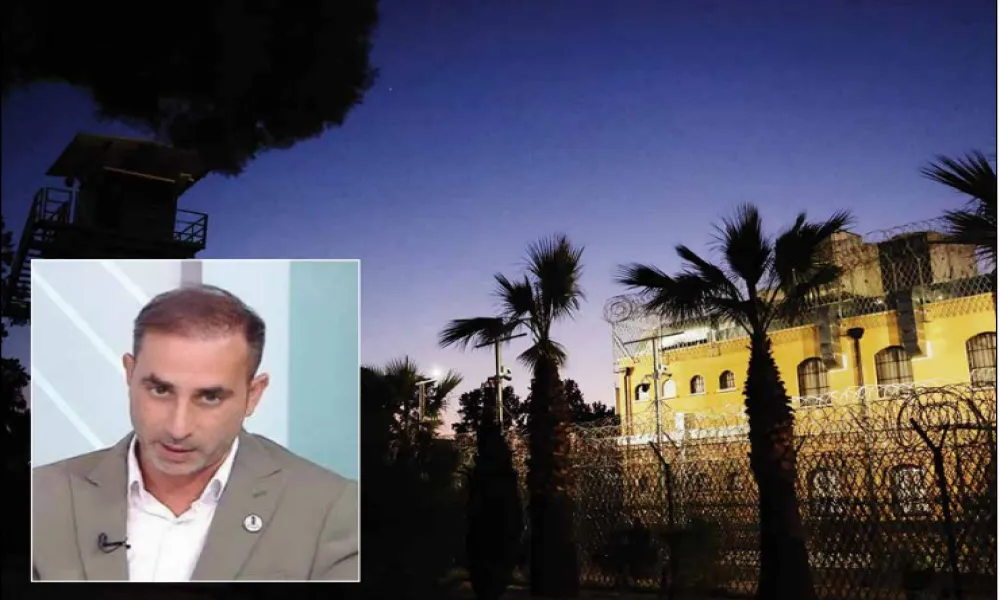
The events unfolding in recent months at the Central Prisons did not come out of the blue. They are the result of a situation that has deteriorated year after year, with problems now having piled up to such an extent that the solutions adopted are inevitably proving ineffective. When these problems extend to matters of security - whether concerning staff or inmates - the need for decisive action becomes imperative. The failings of the correctional institution have been exposed in the worst possible way, either through criminal acts committed within the Prisons or through crimes planned and executed from within inmates’ cells. Indicative are references in a series of court rulings that strongly criticise the conditions inside the Prisons. The President of the Prison Officers’ Sectoral Council of the Isotita Trade Union, Giorgos Maltezos, spoke to P about the situation at the Central Prisons and set out their views on the solutions that must be pursued.
In recent years, the Central Prisons have been at the centre of attention because of the negative developments at the correctional facility. You and your colleagues experience daily life in the Prisons firsthand. What is the real situation, and what are the most serious problems?
The real situation is characterised by serious operational inadequacy and structural dead ends. Staff are required to perform their duties in buildings constructed in 1894, during the British colonial period, which do not meet modern safety and hygiene standards. Moreover, the buildings are not earthquake-resistant and, given the layout of the premises combined with manual locking systems, in the event of a fire they would become a deadly trap for both inmates and staff.
The configuration of the spaces makes effective supervision extremely difficult, while the lack of basic infrastructure - such as sanitary facilities inside cells - further hampers daily operations. Another critical issue is the unprecedented level of overcrowding. According to official data and reports by European bodies, occupancy reaches 226% of capacity. This figure, combined with chronic understaffing, creates conditions of severe congestion that make the implementation of any correctional policy impossible and seriously undermine the institution’s security, as the staff-to-inmate ratio has reached dangerously low levels.
A critical situation
Murders, escapes, suicides, assaults between inmates and other incidents send the message that the situation is out of control. Is this the case?
The situation is indeed critical, and incidents of violence are the result of the objective conditions prevailing. The location of the Prisons within a residential area and adjacent to the buffer zone creates serious security gaps. However, an even more significant problem is the inability to fully utilise technology. Specifically, proximity to the British High Commission imposes technical restrictions on the operation of telecommunications blocking systems (jammers), due to interference caused to the diplomatic mission’s systems.
How can this climate be reversed?
Reversing the situation requires a radical solution: the immediate construction of new prisons at a suitable location outside the urban fabric. Until this goal is achieved, the establishment and operation of a Special Security Unit (based on international models such as SORT/IERT) is imperative. This unit, with specialised training, equipment and operational autonomy, would be able to intervene immediately to suppress disturbances and carry out searches, addressing the gaps created by structural and technological shortcomings.
In your view, which measures should be implemented in the medium term and which in the long term?
In the medium term, there must be an operational separation of security responsibilities. We propose assigning the monitoring of surveillance systems and technological means to the Police, in order to ensure transparency and protect prison staff from pressure. At the same time, it is essential to immediately reinforce frontline staffing by returning experienced personnel currently assigned to desk duties and replacing them with administrative officers.
Top priority must be the relocation of the prisons to new, modern facilities that allow for the proper classification of inmates and the full operation of security systems. In addition, we are calling for the institutional upgrading of the service into a Security Force, so that staff are provided with the necessary legal and disciplinary framework to carry out their duties effectively.
Upgrading the director’s role
Do you believe that the absence of a permanent director at the Prisons since 2022 has contributed to the accumulation of problems?
The lack of permanent leadership has undoubtedly burdened the operation of the department. An organisation required to manage crises of this magnitude needs stable and strong leadership. Temporary arrangements do not allow for long-term planning or strategic decision-making. The director’s position must be upgraded and decoupled from standard civil service procedures. What is required is the appointment of a technocratic crisis manager directly by the Council of Ministers, under a performance-based contract with clearly defined targets. This administration should be supported by a scientific team of specialists, ensuring that decisions are taken in line with international standards and evidence-based practices.
Given the situation at the Central Prisons, can prison officers continue to carry out their duties without distraction?
Working conditions are extremely challenging. Staff are required to operate in an environment of overcrowding and understaffing, while they are often blamed for issues beyond their control, such as the smuggling of mobile phones. As mentioned earlier, the inability to fully operate blocking systems is due to factors related to proximity to the buffer zone, residential areas and the British High Commission - not to negligence on the part of staff.
As a trade union, we maintain a zero-tolerance stance towards corruption and are the first to call for institutional safeguards in inspection procedures, which is why we propose the involvement of the Police. However, we do not accept the blanket targeting of employees, who are making every possible effort to maintain security despite severe understaffing.
An insistence on piecemeal solutions
From time to time, as a trade union, you have sent letters to the Minister of Justice warning of the dangers posed by the current situation. Have your proposals and recommendations been heeded?
We have repeatedly presented our positions both orally and in writing. Unfortunately, to date there has been no adequate response. The insistence on piecemeal solutions within existing, unsuitable facilities does not solve the problem. Our position remains clear: an immediate political decision is required for the construction of new prisons, alongside the institutional strengthening and reform of the security system. Any delay perpetuates a situation that is dangerous both for staff and for society as a whole.
This article was originally published in the Politis Sunday Edition.