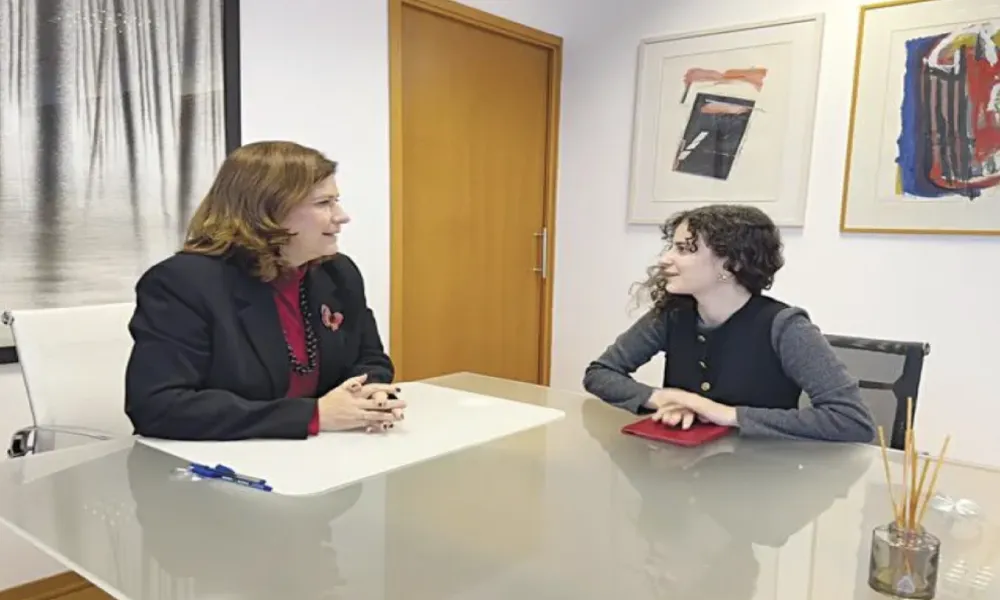
In a year marked by intense debate over the legal status of artists, growing concern about freedom of expression and persistent problems surrounding the housing of cultural organisations, Deputy Minister of Culture Dr Vasiliki Kassianidou speaks candidly to P.
In a wide-ranging interview, Dr Kassianidou addresses the Venice Biennale, the Young Writer Award and the attack on artist Giorgos Gavriil, while outlining the projects that will be prioritised by the Deputy Ministry in 2026, including the status of the artist and the Cyprus Library. Just one day ahead of the official presentation of the cultural programme for Cyprus’s EU Presidency, she also sheds light on forthcoming initiatives and responds to decisions that have been the subject of behind-the-scenes discussion in the cultural sector.
As 2025 comes to a close, what is your overall assessment of the year? Which policies or actions of the Deputy Ministry do you consider successful?
2025 was the year when many things began to come together, as it takes time for results to become visible. In the field of cultural education, for example, one of our most successful initiatives has been the Youth Culture Card. It initially targeted only 18-year-olds, but after taking time to establish itself, it has now been extended to cover ages 18 to 21, with around 11,000 young people having obtained the card. We also added books to the list of eligible expenses. This was one of the most important initiatives launched at the beginning of my term and it has now found its footing.
The same applies to the “Schools as Culture Ambassadors” programme, which was very successful and attracted strong interest from participating schools. It continues this year. The third pillar of cultural education is the reading promotion programme in cooperation with libraries, which was further developed through a second action, “books as lifebuoys”. These are suitcases of books that travel from school to school.
Looking back, what about the challenges? Were there decisions you later considered mistakes or actions that damaged the Deputy Ministry’s image?
Without doubt, the two most contentious issues of the past year were the draft legislation on the status of the artist and the controversy surrounding Cyprus’s representation at the Venice Architecture Biennale. As regards the status of the artist, the discussion is not over. We will return to the issue in the new year, as decisions have already been taken on the next steps. One of these is to continue consultations, since one of the main complaints was that dialogue had not been sufficient, even though it had taken place to a considerable extent.
It makes no sense to pass legislation intended to support the artistic community when that very community has effectively rejected it. This is a challenge we must address in 2026.
As for the Venice Biennale, it became clear that there were procedural gaps on the part of the Deputy Ministry. Extensive discussions have already taken place, both with the Cyprus Architects Association, our partner in the co-organisation, and internally. Clear guidelines have now been issued regarding how this participation should be organised, and I believe similar problems will not recur. In some cases, I think the Deputy Ministry was criticised unfairly, but our focus now is on improving procedures.
What do these changes involve?
First of all, strict timelines and tighter budgetary rules have been introduced. A proposal cannot be approved at €80,000 only for the final budget to rise to €160,000. That reflects how well organised a proposal is. There must be a clear timetable for the next steps after approval. If a catalogue is to be produced, it must be clear when it will be ready, who will review it, how it will be printed and when payment will be made.
We also discussed extensively the pavilion we rent as a country. If our pavilion is located within the Arsenale, its impact is far greater. This is a national participation and a form of cultural diplomacy, as well as a significant investment. We have therefore expressed interest to the organisers, not for the current period, but with a view to 2027.
A disciplinary investigation was also carried out. What were its conclusions?
The investigation was completed at the end of November. Its main conclusion was that the problems arose due to a lack of clear procedures within the Deputy Ministry. Even where mistakes were made, the official involved acted without clear instructions. As a result, no personal disciplinary responsibility was established. The responsibility now lies with us to reinforce procedures.
The Biennale sparked debate on censorship, while we also saw controversy over the State Literary Awards and the recent attacks on George Gavriel. How do you view these issues?
In the Biennale case, accusations of censorship arose because a catalogue bearing the Deputy Ministry’s stamp was published without having been checked or approved. This was a procedural issue, but one involving serious responsibility.
Regarding the State Literary Awards, the situation was different. The chair of the committee publicly opposed decisions taken by a committee he himself chaired, despite having agreed to them. The Deputy Ministry stood by the committee’s decision.
As for George Gavriel freedom of expression in Cyprus is constitutionally protected. This was an exhibition in a private space by an artist exercising his right. Some may have found certain works offensive or in poor taste, but no one was obliged to visit. What happened at the artist’s home is unacceptable and I condemn it unequivocally. No one should face intimidation because we disagree with their art. Especially in an election period, such issues should not be exploited. My regret is that culture only becomes a topic of public debate when controversy arises.
Turning to infrastructure projects ahead of the EU Presidency, is Cyprus ready?
The Presidency gave us an opportunity to push forward infrastructure projects that had been sidelined for years, particularly the upgrading of monuments. Famagusta Gate is ready, with a second phase under way. The Kasteliotissa complex has been fully upgraded and reopened recently. The Cyprus Museum has also been refreshed, with new displays and improved visitor experience, given that the new Archaeological Museum will not be ready in time.
Significant works have also taken place at Kourion, while the wooden footbridges at Chrysopolitissa in Paphos have been restored after being closed since 2017. Digital guides and signage have now been installed at ten monuments.
The Cyprus Library, however, remains without a permanent home. What is the situation?
This is one of our greatest challenges. From the outset, funds were included for a new building, but the process is lengthy. A feasibility study alone can take two to three years. In the meantime, we have been searching for a building to rent, but approvals from multiple authorities are required. The eviction from the Faneromeni building forced us to seek emergency solutions. The Cyprus Library remains a priority and cannot be replaced by a university library, as they serve different purposes.
What about the Cultural Village in Lempa?
The buildings have been completed for about a year. This year we launched a tender process to appoint an organisation to manage the site as a cultural space, while allowing the Deputy Ministry to use it for educational activities. Two proposals have been submitted and are currently under review. I hope one will be approved early in the new year.
And the long-standing issue of a Museum of Modern and Contemporary Art?
This is progressing well. Following recommendations by the advisory committee, we are working towards a unified Museum of Modern and Contemporary Art, with three branches: contemporary art at the State Fair site, modern art at SPΕL, and the Majestic building for temporary exhibitions or educational programmes. During the EU Presidency, SPΕL will host a major exhibition from the state collection, opening on 29 January.
Finally, there has been discussion about the archaeological exhibition at the Louvre. How was the organising body chosen?
When the Department of Antiquities indicated it could not undertake another exhibition, we turned to the only other official body with scientific expertise in Cypriot archaeology: the University of Cyprus. As a public academic institution, it could be directly commissioned. This is why the Archaeological Research Unit was chosen to organise the Louvre exhibition.
This article was originally published in Politis' Sunday Edition for the cultural page Parathyro.