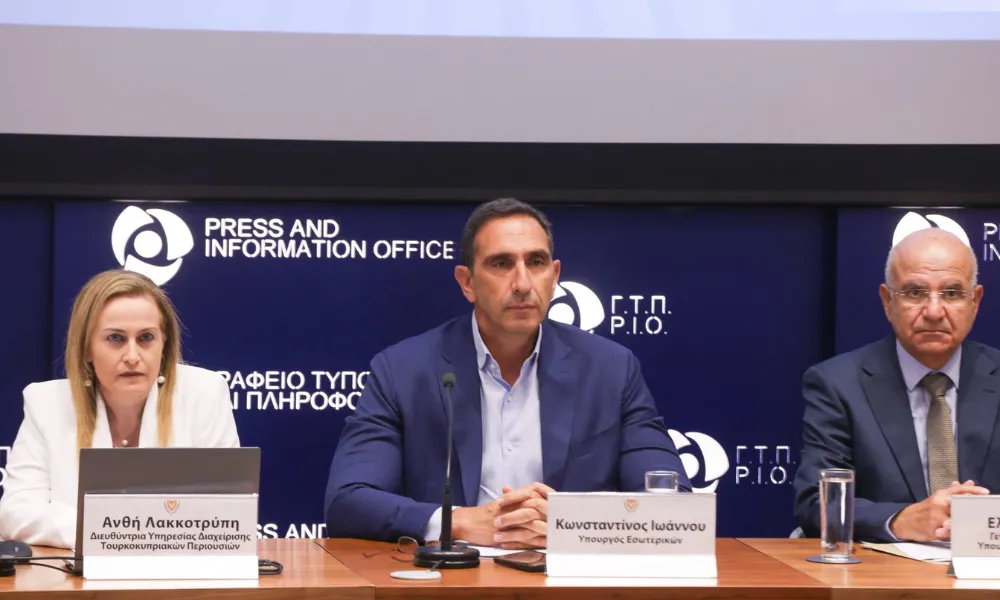

A large-scale effort is under way by the Service for the Management of Turkish Cypriot Properties to address long-standing abuse, illegal use and mismanagement of properties held under state guardianship. Ongoing inspections have revealed the extent of entrenched violations, prompting eviction orders, contract terminations and the recovery of both commercial premises and homes across Cyprus.
According to official data, some 700 lease contracts have been found to contain serious breaches. Of these, around 300 have already been terminated due to non-compliance.
A sweeping crackdown on long-standing abuses
Authorities describe a sustained and systematic effort to reverse what they characterise as years of tolerance and inaction by the state, which allowed the looting and misuse of Turkish Cypriot properties to become widespread. All contracts relating to the use of such properties are now subject to strict scrutiny. Where violations are identified following on-site inspections, all appropriate legal measures are taken to reclaim the properties and reallocate them transparently to eligible beneficiaries.
The findings of the inspections
Violations in commercial premises
Inspections covering 4,032 lease contracts for commercial premises and open spaces used for professional purposes uncovered breaches of essential contractual terms in 512 cases.
- In 146 cases, full compliance was achieved following instructions from the Service.
- In 280 cases, where there was no compliance, contracts were terminated.
- So far, 66 premises or open spaces have been recovered, while legal or other measures are under way for the remaining cases.
Breaches involving municipalities and communities
Checks on Turkish Cypriot properties leased to local authorities revealed the following:
- Out of 275 lease contracts with municipalities, 31 breaches were identified. Thirteen were resolved after intervention, while five contracts were terminated due to non-compliance. Warning letters were sent in the remaining 13 cases.
- Among 589 lease contracts with community councils, 47 breaches were found. Twelve cases were resolved, three contracts were terminated, and warning letters were issued in the remaining 32 cases.
Recovery of residential properties begins
Under a new Action Plan, inspections have been extended to residential properties at an accelerated pace. Over the past two months, 91 homes across Cyprus were inspected.
- In 31 cases, breaches of lease terms were identified and beneficiaries were warned to remedy the violations.
- In six cases where there was no compliance, the Service has already reclaimed the homes.
- Similar measures are being advanced for a further three cases, while legal or other actions are under way for the rest.
Properties now allocated through open calls
Under the new legislative framework, available Turkish Cypriot properties are now offered for lease through public calls, based on measurable criteria and open procedures. To date, the Service has issued three calls, in June 2025, October 2025 and January 2026, covering a total of 114 properties nationwide.
These include 32 homes, 35 commercial premises, 36 open spaces and 11 agricultural plots.
The evaluation of applications submitted under the June 2025 call has been completed in all districts except Nicosia, where the Special Committee is scheduled to meet on February 4, 2026. Applicants have already been informed of the results. Evaluation of applications from the October 2025 call is ongoing. The most recent call, published on January 2, 2026, concerns 56 properties, with applications open until February 16, 2026.
Interest from displaced persons has been particularly strong. Indicatively, more than 744 applications were submitted and assessed nationwide under the October 2025 call alone.
From political connections to points-based allocation
In the past, access to Turkish Cypriot properties was often secured through party affiliation and personal connections, at negligible cost. The new allocation process replaces discretion with documented, measurable criteria, while also reducing bureaucracy through fully digital procedures and significantly shortening application processing times.
The aim, authorities say, is a fairer and more targeted distribution of properties, taking into account the personal and socio-economic circumstances of applicants.
Ending symbolic rents
Reforming rental pricing is described as a central pillar of the broader modernisation of the Service. The objective is to correct long-standing distortions, whereby Turkish Cypriot properties were leased for decades at token, almost negligible rents.
Despite managing properties valued at over €7.5 billion, annual rental income stood at just €5 million.
As clarified by the Ministry of Interior, the goal is not to place undue pressure on businesses or render them non-viable. Instead, the reform seeks a fair balance between cost and benefit for all parties. Rent adjustments are therefore being introduced gradually, over a seven-year period in two or three stages, allowing tenants sufficient time to adapt.
Indicative examples include:
- Office in Limassol: rent increased from €18 per month to €147.
- Office or concrete supply business: from €7 per month to €1,181, with gradual adjustment.
- Kiosk in Larnaca: from €17 per month to €510.
- Pottery workshop in Larnaca: from €5 per month to €360.
Revenues generated from the rental reform are channelled into the refugee programmes of the Ministry of Interior.