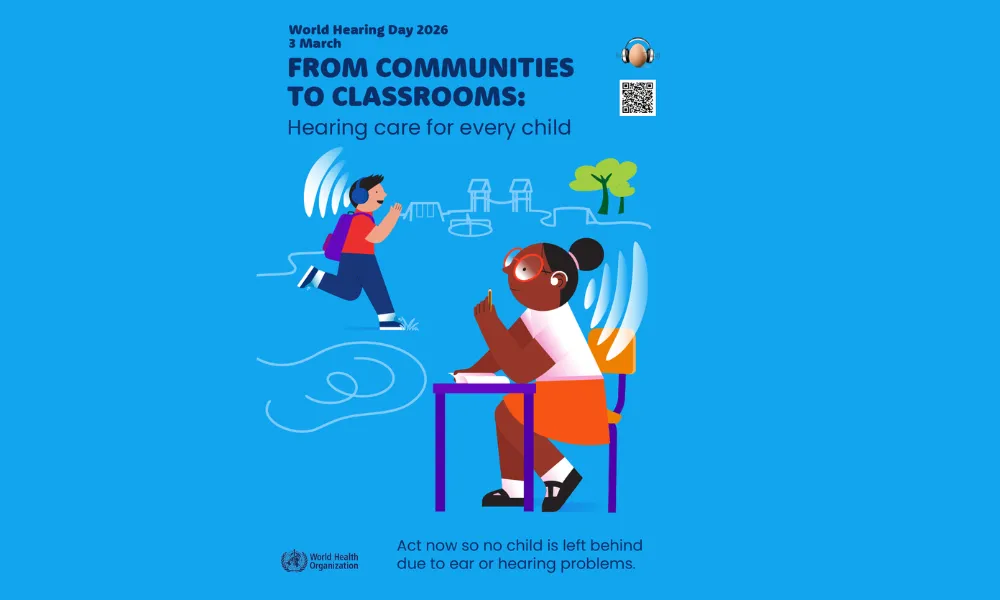
The 3 March has been designated by the World Health Organization (WHO) as World Hearing Day. World Hearing Day raises awareness and encourages health professionals, educators, communities and governments to promote hearing care in order to reduce the global burden of hearing loss. Each year, WHO sets a thematic focus for World Hearing Day, aiming to influence public health policies and implementation practices within national health and education systems. For 2026, the campaign titled “From the Community to the Classroom – Hearing Care for All Children” highlights two key priorities: the prevention of avoidable childhood hearing loss and the early identification and care of children with hearing impairment.
Dr Chrysoula Thodi, Consultant Audiologist, Newborn Hearing Screening Programme,
Centre for Preventive Paediatrics Americos Argyriou
Globally, approximately 90 million children and adolescents aged 5–19 live with hearing loss; more than 60% of these cases can be prevented through simple, widely applicable and low-cost health measures. World Hearing Day, as a policy initiative, is grounded in the need to integrate hearing and hearing care services into existing child health programmes and school systems, creating multiple points of access for children, parents, educators and health professionals. The classroom represents a social environment where collaboration between teachers and health professionals can strengthen early detection and appropriate referral of children with hearing difficulties.
Cyprus constitutes a notable example of good practice in early detection. In 2005, the Centre for Preventive Paediatrics Americos Argyriou launched, and has since coordinated, the first Universal Newborn Hearing Screening Programme in the Mediterranean. The detection rates of the Cypriot Newborn Hearing Screening Programme are consistent with those of the most successful international programmes, recording a referral rate of 0.6% and confirmed hearing loss of 2.8‰ among children in the community. A decisive factor in this success is ensuring that newborns with suspected hearing loss are identified early and directed to specialised diagnostic confirmation and intervention through a systematic process of screening, monitoring and referral.
Certain forms of hearing loss are acquired and appear after the neonatal period, while others develop gradually. Hearing loss is often not visible, resulting in children remaining undiagnosed and without access to specialised care services. A child with unidentified hearing loss may experience delays in language development, difficulties in understanding spoken language, in developing literacy skills, and reduced participation in the classroom. Children with untreated hearing loss demonstrate lower academic performance compared to their peers with normal hearing, underscoring the importance of early intervention within the educational process (Haile et al., Lancet 2021). Delayed identification of hearing impairment has serious consequences for social relationships and for future employment opportunities and social participation.
To document needs within the Cypriot population, the Centre for Preventive Paediatrics Americos Argyriou, in collaboration with the European University Cyprus and the Cyprus Audiology Centre, implemented the Pre-School Hearing Screening Programme (APAS), a research-based screening initiative in pre-school age funded in 2012 by the Research Promotion Foundation (now the Research and Innovation Foundation). The APAS project assessed hearing in 400 children aged 4.5–5.5 years and identified hearing difficulties in 15% of the children. Nine percent of those examined showed indications of immediately treatable hearing loss, such as otitis media with effusion or earwax accumulation, conditions that caused temporary but significant reduction in hearing during critical stages of language and learning development and required medical intervention. Six percent of the children showed indications of hearing loss without an immediate medical explanation at screening level, raising the possibility of permanent hearing impairment. A particularly important finding of APAS was the insufficient follow-up and verification of intervention for children identified, suggesting that some may not have received timely support.
APAS demonstrated that in Cyprus as well, the establishment of systematic screening in pre-school age, at entry to primary school and at defined follow-up intervals constitutes a natural continuation of the neonatal programme and a critical link in the chain of prevention. Public health and education policy must aim to consolidate modern, evidence-based systems for the prevention and monitoring of childhood hearing. These systems:
- include systematic hearing screening linking neonatal programmes with checks at pre-school age, school entry and at specific time points
- require the training of health professionals and educators to recognise, monitor and manage indications of hearing loss
- ensure the connection of school services with specialised referral centres where evidence-based clinical assessment and intervention are provided.
Integrating these processes into the broader framework of child health and school health programmes aligns with WHO guidelines, which advocate broad interdisciplinary and cross-sector collaboration to promote children’s overall wellbeing.
Alongside screening and intervention techniques, policy addressing childhood hearing loss must focus on community education and empowerment so that parents and teachers can recognise early signs of hearing impairment. The contribution of educators is critical, as they are in continuous contact with children and can observe educational or social indicators warranting further evaluation. Systematic and structured cooperation between schools, primary healthcare providers and specialised clinical services can ensure that referral and intervention form part of a coherent public health strategy.
Early hearing care reduces medical consequences and has broader social and economic impacts: investment in prevention and treatment can contribute to children’s smooth integration into the education system, reduce social inequalities and enhance future employability and social participation. Achieving these goals requires collaboration among health, education and social policy bodies to optimise available technical tools and to develop evidence-based policies.
This year’s World Hearing Day informs and challenges us to re-examine institutional, educational and healthcare structures capable of identifying and addressing childhood hearing impairment. The experience of the Americos Argyriou Preventive Paediatrics Centre in universal newborn hearing screening demonstrates that an organised, systematic and universal approach can yield measurable positive results. The next challenge is to establish a continuum of hearing screening and care from birth through school age that provides every child with the opportunity to hear, learn and fully develop their potential, regardless of social and economic constraints.
Chrysoula Thodi, Ph.D., CCC-A, FAAA
Professor of Audiology, Department of Health Sciences, European University Cyprus
Consultant Audiologist, Newborn Hearing Screening Programme, Americos Argyriou Preventive Paediatrics Centre