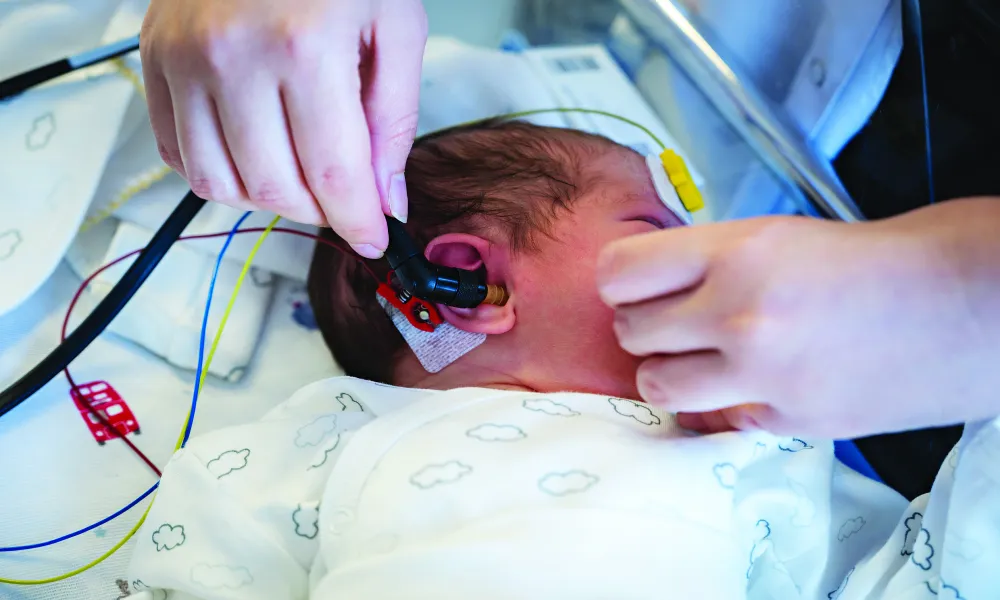
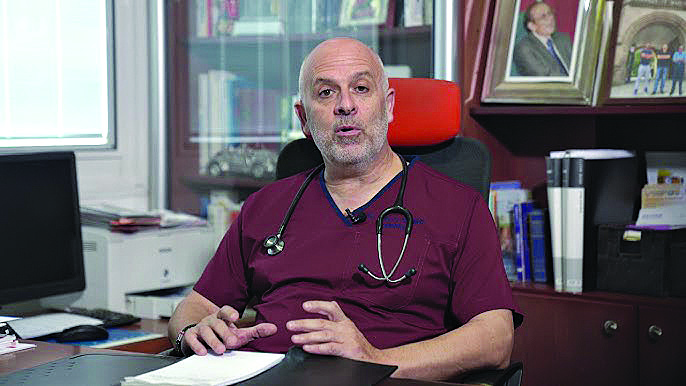
On March 3 - World Hearing Day, Politis to the point spoke with paediatrician Argyris Argyriou about the work and challenges of the Centre for Preventive Paediatrics “Americos Argyriou”.
For decades, the centre has implemented essential prevention programmes covering the entire population of pregnant women and newborns in Cyprus. These include prenatal screening, newborn screening for metabolic diseases, and universal newborn hearing screening, all aimed at the early detection of conditions that can significantly affect a child’s life.
However, as Argyriou tells Politis to the point, the centre’s work continues to face significant challenges, primarily financial but also administrative.
“A charity cannot be doing the job of the state,” he says. “A philanthropic organisation like ours has been doing this work for so many years. Even though it is recognised, we still struggle every year to secure the necessary funding.”
The state currently provides an annual grant of around €385,000, which Argyriou says reflects recognition of the centre’s contribution. Yet this funding covers only part of the real costs.
“We are not talking about huge amounts,” he says. “But it is difficult to live with the uncertainty every year about where the money will come from. We are deeply grateful to the supporters and donors who help keep this work alive.”
Prevention as a public responsibility
The programmes implemented by the centre involve screening tests for all pregnant women and all newborns in the country.
According to Argyriou, in many countries such programmes form an integral part of national healthcare systems or are directly funded by governments.
“In most countries around the world these programmes are implemented by the state, either through a national health system or through direct public funding,” he explains.
In recent years the centre’s work has also received political recognition. In February 2025, the President referred to the prevention programmes as a national point of reference.
Despite this acknowledgement, Argyriou says several issues remain unresolved, particularly regarding the administrative framework governing cooperation between the centre and public authorities, as well as the practical implementation of certain decisions.
Administrative obstacles
In practice, the centre has been implementing key preventive screening programmes for years. Yet its day-to-day operations frequently encounter procedural difficulties related to the coordination between different institutions.
“We are operating somewhere in the middle,” he says.
The issue became particularly visible during the recent effort to expand the newborn screening programme for metabolic diseases.
At present, newborns in Cyprus are screened for two main conditions: phenylketonuria and congenital hypothyroidism. Plans call for the programme to expand to include eight additional metabolic diseases, in cooperation with the Cyprus Institute of Neurology and Genetics and Makarios Hospital.
However, the collaboration between the institutions involved had to be arranged through additional administrative and legal procedures, delaying the programme’s implementation.
“We were told that, technically, tenders should be issued,” he says. “But who would carry out the programmes when we are the only ones doing them and we already do them free of charge?”
Eventually the matter was referred to the Legal Service, which concluded that the cooperation could proceed.
Four years of delay
The decision to expand the screening programme had already been taken in 2022.
“We are now almost in 2026 and it still has not been implemented,” Argyriou says. “We are ready. We could start tomorrow.”
According to him, the Ministry of Health has already allocated the necessary resources, but the process has been delayed due to administrative arrangements that had to be completed beforehand.
Why prevention matters
Beyond the administrative challenges, Argyriou stresses the wider importance of prevention programmes for the health system as a whole.
Early detection of metabolic diseases or hearing impairments in newborns can fundamentally change the course of a child’s life.
“Prevention saves lives,” he says.
“If prevention does not take place, the state will eventually have to cover the cost of treatment and support for the entire lifetime of a child,” he explains. “We are talking about enormous amounts.”
A legacy that began more than half a century ago
The story of the Centre for Preventive Paediatrics 'Americos Argyriou' began more than half a century ago and is closely linked to paediatrician Americos Argyriou, the foundation’s founder.
In the late 1960s, through his work at the Theotokos Foundation in Limassol, he realised that many of the conditions affecting children could have been prevented.
“Seeing children with Down syndrome, chromosomal abnormalities and metabolic diseases, he understood that many of these conditions could have been detected early,” his son explains.
At the time, preventive screening programmes were already being implemented abroad. When he tried to promote the idea in Cyprus, however, the response was limited.
Instead of abandoning the effort, Americos Argyriou moved forward independently. With the support of around 200 prominent residents of Limassol and small private donations, the Preventive Paediatrics Centre was created, initially under the name Centre for the Prevention of Intellectual Disability.
“The government only began providing a small grant much later,” Argyriou recalls.
Even the universal newborn hearing screening programme currently in place began as a private initiative.
“I will not give up”
Today, Argyrios Argyriou says he remains determined to continue the work his father started.
“My father was also my mentor,” he says.
“I have promised myself that I will continue this work until the end. I will keep pressing presidents, ministers and officials until they support the centre.”
For him, the message is simple.
“By helping the centre, you help the children.”