
President Recep Tayyip Erdoğan’s warning that foreign troops deployed to Cyprus must not become permanent may appear, at first glance, as a reaction to immediate developments. In reality, it is the articulation of a deeper strategic doctrine that has been steadily consolidating in Ankara, particularly in the wake of the Iran war and the accelerating militarization of the Eastern Mediterranean.
The meeting held at the Dolmabahçe Presidential Office in Istanbul with Tufan Erhürman, on the eve of the Antalya Diplomacy Forum, was therefore far more than a routine diplomatic engagement. It marked the second official meeting between the two leaders since Erhürman’s election last October, but more importantly, it reflected a shift in the nature of coordination between Ankara and Lefkoşa. The presence of İbrahim Kalın at the meeting underscored that the Cyprus issue is no longer treated solely as a diplomatic file but as a matter embedded within Türkiye’s broader security and intelligence calculus.
Erdoğan’s address at the Antalya Diplomacy Forum brought this strategic framing into the open. By describing the Aegean and the Eastern Mediterranean as a “basin of stability and prosperity,” while simultaneously rejecting “unilateral and maximalist approaches that seek to exclude Türkiye and the Turkish Republic of Northern Cyprus,” Ankara made it clear that it no longer accepts a peripheral role in regional configurations. More strikingly, the emphasis on “the reality of two separate peoples and two separate states on the island” signaled a definitive shift in Türkiye’s Cyprus policy.
Post-June: A new process or old illusions?
Diplomatic momentum is building once again around Cyprus, with expectations rising that a new negotiation process could take shape after June. Yet this renewed activity raises a familiar and unavoidable question: Will this be a genuine attempt at resolution, or merely another cycle of semantic debates revolving around labels and frameworks?
Experience offers a sobering answer. The Cyprus issue has never been resolved through definitional arguments. It has only moved forward when grounded in the realities on the ground.
Today, one of the most striking contradictions lies in the divergence between public sentiment and state policy. According to data from the Center for Migration Identity and Rights Studies (Center for Migration Identity and Rights Studies), an overwhelming majority of Turkish Cypriots continue to support a federal solution. This reflects a deeply rooted societal desire for settlement.
At the same time, Ankara has reached a point where even contemplating a federal model appears increasingly unlikely. This divergence is not ideological but experiential. For years, Türkiye supported federation-based negotiations, only to see each process collapse under what it perceives as the Greek Cypriot side’s maximalist and uncompromising stance. The failure at Crans-Montana in 2017 was not an isolated breakdown but the culmination of a repeated pattern.
From Ankara’s perspective, therefore, the central question is no longer which model is theoretically preferable, but which model has any realistic chance of implementation.
Yet framing the issue solely as a choice between federation and two states risks missing the larger point. Models are instruments, not ends in themselves. The real objective must be to establish a sustainable order that ensures political equality, stability, and security on the island. The name attached to that order is secondary to its functionality.
This is precisely where Erhürman’s proposed four-pillar modality gains relevance, particularly its insistence that failure in negotiations should not result in a return to the status quo. Without such safeguards, any process risks becoming yet another exercise in repetition.
The true test of the post-June process will therefore lie in whether the parties can move beyond entrenched positions. If one side insists that federation is the only acceptable outcome while the other maintains that only a two-state solution is viable, the process will stall before it even begins. What is needed instead is a functional approach, one that prioritizes how a settlement will operate rather than what it will be called.
The realities of the island are clear. There are two separate administrations, two distinct political structures, and divergent security perceptions. The international system treats the two sides asymmetrically. Economic and diplomatic isolation persists. Any model that ignores these realities is destined to fail.
The essential questions are therefore practical. How will political equality be ensured? How will decision-making mechanisms function with effective Turkish Cypriot participation? How will security arrangements address the concerns of both sides? How will energy, trade, and regional cooperation be structured? If credible answers can be found, the label attached to the solution will become largely irrelevant.
Pyla: From technical dispute to sovereignty question
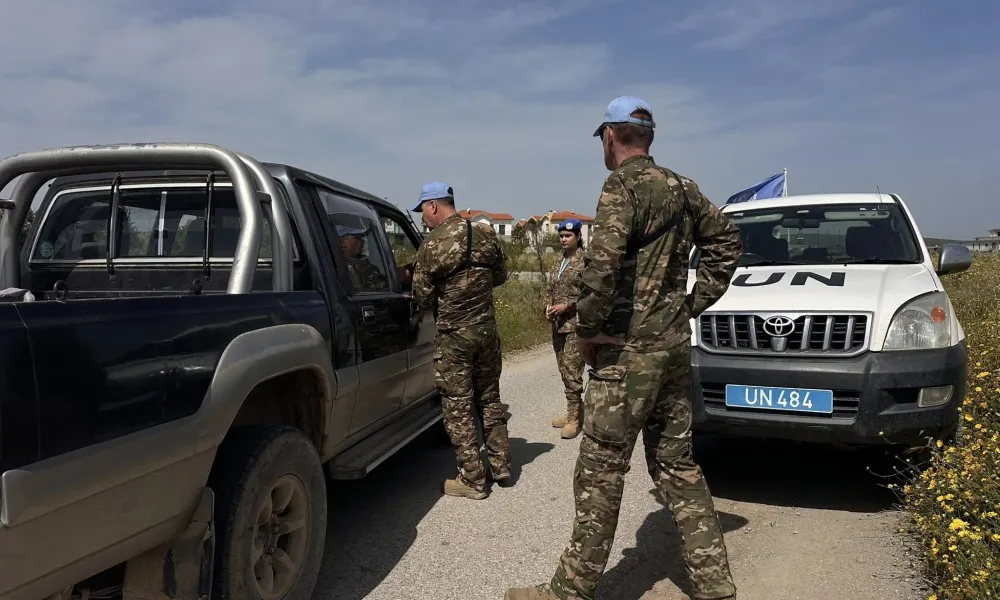
The recent tensions in Pyla illustrate how quickly technical issues can escalate into questions of sovereignty. What began as a veterinary inspection related to a foot-and-mouth disease outbreak evolved into a broader confrontation involving Turkish Cypriot "authorities", UN peacekeepers, and the Greek Cypriot administration.
This escalation was not accidental. In Cyprus, even technical matters unfold within a politically and legally contested environment. The role of the United Nations Peacekeeping Force in Cyprus has become central to this debate, with growing perceptions among Turkish Cypriots that its implementation of neutrality often works to the advantage of the Greek Cypriot side.
The dispute over the status of the Pyla plateau is therefore not merely technical. It reflects a deeper concern that incremental practices may gradually reshape the status quo to the detriment of Turkish Cypriot claims.
For the anticipated post-June process, the lesson is clear. Unless the gap between realities on the ground and assumptions at the negotiating table is addressed, progress will remain elusive.
Deterrence without escalation
The positioning of Turkish armored units north of the ceasefire line was widely portrayed as an escalation. In fact, it was a calibrated signal. No violation of the buffer zone occurred, underscoring that Türkiye’s approach remains one of deterrence without provocation.
Ankara’s objective is to prevent unilateral changes on the ground while avoiding a cycle of escalation that could draw in broader international actors. This balance is particularly critical in the lead-up to a potential negotiation process.
Erhürman’s emphasis on de-escalation complements this posture. His statement that “we have never been in favor of tension, nor will we be” reflects a deliberate effort to align firmness on sovereignty with restraint in tactics.
Foreign troops: The real fault line
At the heart of Erdoğan’s warning lies a deeper concern about the growing foreign military presence on the island. While European deployments are framed as temporary responses to regional instability, Cyprus has a long history of “temporary” arrangements becoming permanent.
The issue is not the presence itself, but its trajectory. Rotational deployments can evolve into enduring infrastructure. Logistical support can become operational capability. Over time, such developments can fundamentally alter the island’s strategic balance.
Any post-June negotiation process that ignores this evolving military landscape risks starting from an inherently unequal footing.
Public sentiment: Hope and anxiety
The findings of the Center for Migration Identity and Rights Studies reveal a complex public mood. While there is strong support for a settlement, there is also deep concern about security risks and geopolitical shifts.
This dual sentiment will shape the viability of any future process. Without credible security guarantees, public support for a settlement cannot be sustained.
A new equation for a new reality
Cyprus is no longer a static conflict. It is a dynamic geopolitical node where regional rivalries, energy politics, and shifting alliances converge.
Türkiye’s message is unambiguous. Turkish Cypriots are equal stakeholders on the island, and Türkiye is an indispensable actor in any sustainable arrangement.
The post-June process, if it is to succeed, must be built on this reality. Otherwise, it risks becoming yet another chapter in a long history of missed opportunities.