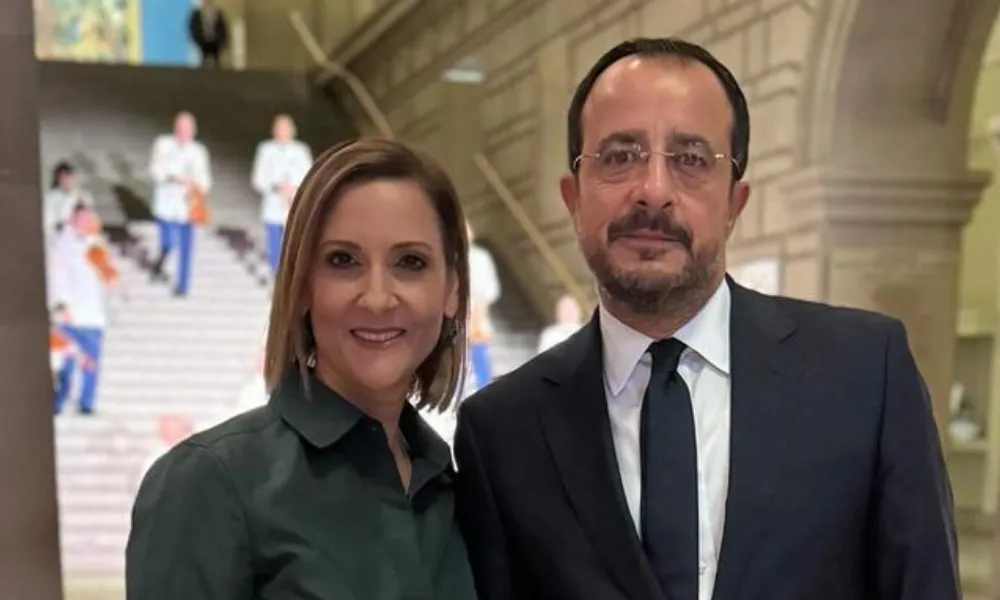

At the final cabinet meeting of the Anastasiades government, held on 22 February 2023, the Council of Ministers approved a request by Philippa Karsera for unpaid leave from the Ministry of Foreign Affairs on grounds of public interest. The decision was deemed necessary to allow her to carry out the particularly demanding duties of First Lady without impediment. Karsera, a career diplomat at the Foreign Ministry since 1999, held the rank of Minister Plenipotentiary at the time. She also undertook not to claim the educational allowance paid to diplomats to cover their children's private school fees, and to withdraw from an ongoing process to fill four Ambassador positions at grade A15, despite having been called to interview by the Civil Service Commission.
The return
On 2 October 2024, Karsera chose to return to work, taking up the post of Director of Consular Affairs while continuing to fulfil her duties as First Lady. The simultaneous exercise of both roles raises a series of institutional and ethical questions that are difficult to ignore. Karsera now has a line manager, a Director General, and a political superior in the form of the Minister of Foreign Affairs, who was appointed by her husband. Would anyone dare reprimand her or displease her in any way? Is there a realistic prospect of her receiving any evaluation other than "outstanding"? Subordinates of Karsera have raised complaints about aspects of her conduct and management style in the workplace, during the periods when she is present at the Ministry while also carrying out First Lady duties during working hours.
The promotion
A process to fill ambassador positions is currently underway before the Civil Service Commission. Politis has confirmed that Karsera is among those seeking one of these posts. Rival candidates believe one of the positions is effectively earmarked for her. The more sceptical among them ask the obvious question: is there any realistic chance that the wife of the President of the Republic will not be awarded the promotion she is seeking in the public service?
The counterargument
There is, of course, a counterargument. Does Karsera not have the right to work, to be financially independent and to continue her professional career? And why should she not be positively assessed for an ambassador position if she holds the required qualifications, and holds them in abundance? From this angle, one could argue that being First Lady is not an advantage for Karsera but a burden, generating prejudice against her and providing grounds for challenging whatever process the Civil Service Commission follows.
The institution under scrutiny
This column's view is that Karsera should not have returned to the public service for as long as she holds the position of First Lady, for the reasons set out above. Having returned, however, she has every right to seek promotion and every right to appeal to the courts if she believes she has been treated unfairly. Even if the Civil Service Commission conducts a process that is entirely lawful, it remains open to challenge in the court of public opinion. In an environment where citizens' trust in institutions has already been shaken, Karsera's participation alone in the ambassador selection process generates reasonable impressions of favouritism, regardless of whether she holds the necessary qualifications.
The central question here is whether the state and its institutions can guarantee, without shadow or suspicion, that everyone is judged by the same standards. Can they? Those who hold and exercise power would do well to internalise this: public trust is earned only through absolute transparency, rigorous justification and consistent application of the law, without exceptions.