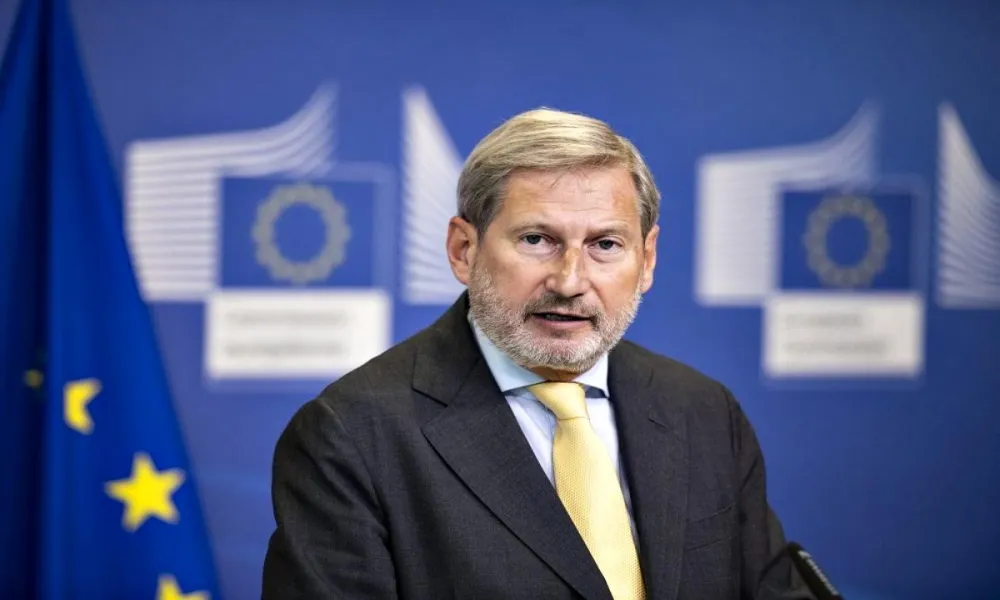
The European envoy for the Cyprus issue, Johannes Hahn, is seeking an autonomous and initiative‑driven role. He chooses to address Cypriot citizens directly, proposing strong incentives for reunification that go beyond the constraints of long‑standing stagnation. His approach is already meeting objections from the Cypriot leadership.
In a public intervention through an interview with “Politis” (20 December), Hahn revealed a proposal by the European Commission to include, from now, a provision for EU funding of Cyprus’ reunification. Taking the leaderships by surprise, Hahn stated specifically that the European Commission has submitted a clause in the Multiannual Financial Framework (MFF 2028–2034). This clause stipulates, as he said, that “in the event of the reunification of Cyprus, the EU budget must be revised to reflect the settlement and the additional financial needs that will arise from reunification”.
Based on previous EU experience, the reference to “additional needs” mainly concerns significant investments in infrastructure projects, reconstruction of areas and relocation of populations due to territorial adjustments. The amount of funding proposed by the Commission has not yet been determined. It may exceed three billion euros and the reaction of those directly concerned, namely the Cypriot government, remains to be seen.
Involvement at all stages
During his private meetings in Cyprus (11–12 December), Hahn appeared well‑prepared, essentially proposing a comprehensive European plan to support the UN process “at all stages of the procedure”, which is also his mandate according to the conclusions of the European Council (April 2024). His initial goal is to change the climate and bring the EU closer to the Turkish Cypriot community, but he needs the cooperation of the Greek Cypriot leadership, which also represents the EU member state. “Engagement is an investment and not a concession”, was his characteristic message, directed mainly at President Christodoulides. So far there has been no reaction from the Cypriot government.
Hahn included proposals supported by the EU in the form of Confidence Building Measures until negotiations under the UN resume. These include opening new crossing points, strengthening bicommunal trade, harmonising Turkish Cypriot regulations with the acquis, doubling existing assistance through the 2006 Financial Regulation and promoting projects of bicommunal benefit. He also described the need to intensify efforts for the island’s development and to bridge the economic gap of the Turkish Cypriots during negotiations and, importantly, to make a concrete and early provision for the financial needs of reunification in the new EU budget, the Multiannual Financial Framework 2028–2034.
All this shows that the EU is in full high‑level coordination with the UN, which supports exactly the same approach.
Discomfort
Cyprus’ President Nikos Christodoulides was caught off guard by Hahn’s proposals. Hahn acts on behalf of the European Commission and therefore his proposals must be approved by the Council and the Cyprus government will be called to take a position. So far, however, the government has not offered even the slightest positive comment. It views Hahn’s autonomous action as differing from what Christodoulides had sought when he pushed for his appointment.
The former Austrian Commissioner is taking initiatives, speaking publicly and urging the leaderships to stop calling on the EU to act while knowing that it has experience and numerous tools for intervention that are, however, blocked. When Greek Cypriot interlocutors ask him for EU intervention on the Cyprus issue, Hahn replies that they too must show political will and tangible signs of commitment for results to emerge. “You are also Europe”, he reportedly said in confidential meetings held during his stay on the island.
Hahn met both President Christodoulides and, for the first time, Turkish Cypriot leader Tufan Erhürman. He also organised meetings with political parties, including DISY and AKEL, where he demonstrated detailed knowledge of the outstanding issues since the talks collapsed in Crans‑Montana. Hahn also conveyed messages identical to those delivered by María Ángela Holguín, urging all sides “to be ready for developments”.
Silence
The Presidential Palace is applying a strategy of silence to downplay the envoy’s proposals. This, however, raises questions that the Cypriot President will soon need to address. From his public statements, Christodoulides does not wish to have confidence‑building measures placed before him as pressure points. He does not prioritise opening new crossing points nor does he favour bicommunal benefit projects such as the photovoltaic park in the buffer zone. He insists that substantive negotiations on the Cyprus issue must come first, without preconditions. But he does not explain whether he wants the strategic issues of the day after, including the financial needs of a settlement, to be addressed now. He prefers a “controlled” process over time, without commitments.
Deadline
The provision of more than three billion euros for a peace programme in Cyprus within the new EU budget must be finalised by the end of 2026. The silence suggests a degree of discomfort that may escalate. The only statement the Cypriot President has made regarding the EU envoy concerned “the need for close cooperation between the European Council and Hahn, who has already begun contacts with several EU member states”. He cited for this (19 December) a relevant paragraph in the conclusions of the Danish Presidency.
The Cypriot President also clearly disagrees with the immediate reactivation of the ad hoc Committee for the harmonisation of Turkish Cypriot regulations with the acquis. Speaking in Lefkara (21 December) during the presentation of the priorities of the Cypriot Presidency, Christodoulides said that he “supports the existence of this committee”, but added that “it should resume its work when negotiations restart”.
Peace plan
The EU has a precedent with the peace plan for Northern Ireland. Significant funds were absorbed across three successive EU MFFs, requested by the directly concerned parties, the United Kingdom and Ireland.
In the past, the only comparable move was the declaration of intent by European Commission President Jean‑Claude Juncker in January 2017 at the Geneva Conference, announcing EU funding of 3.2 billion euros. This contribution was never communicated to the Cypriot public and “disappeared” after the collapse in Crans‑Montana six months later.
Since then, the EU has contributed to reunification efforts (restoration of monuments, missing persons, various small projects) only through the existing Financial Regulation, with a few tens of millions of euros. The Cypriot government has not even stated whether it supports doubling the Regulation’s funds.