
By Fiona Mullen, Director, Sapienta Economics
Events of the past few weeks have driven home the urgent need to reduce security risks in the Eastern Mediterranean region among countries that have all been targets of attack from Iran and its allies. The drone attack on the British Sovereign Base Areas (SBAs) has brought to Cyprus and its surrounding waters the deployment of F-16s from both Greece and Turkey, as well as a whole bunch of frigates and other military assets from other countries.
I have heard both optimistic and pessimistic readings of these developments. The optimists says that Greece and Turkey are on the same side, defending the region, or even, according to some versions, jointly de facto defending Cyprus. The pessimists say that Turkey sent F-16s as an answer, and therefore as a warning, to Greece sending F-16s, and that a build-up of forces in any region of the world is always a risk: an accident waiting to happen.
Either way, as the world tumbles around us, we need to make sure that Greece and Turkey do not go to war because of a build-up of military assets in Cyprus and that Turkey and Israel do not go to war over Syria, or Cyprus, or Iran.
The US ambassador to Turkey, Tom Barrack, has already indicated that the way to do this is through regional commercial deals. He has hinted that regional deals should involve energy and Cyprus.
Below is an idea for what a grand energy deal might look like. I have made these arguments before. I am repeating them because they are more pertinent than ever.

The basic energy deal: electricity interconnectors and gas routes
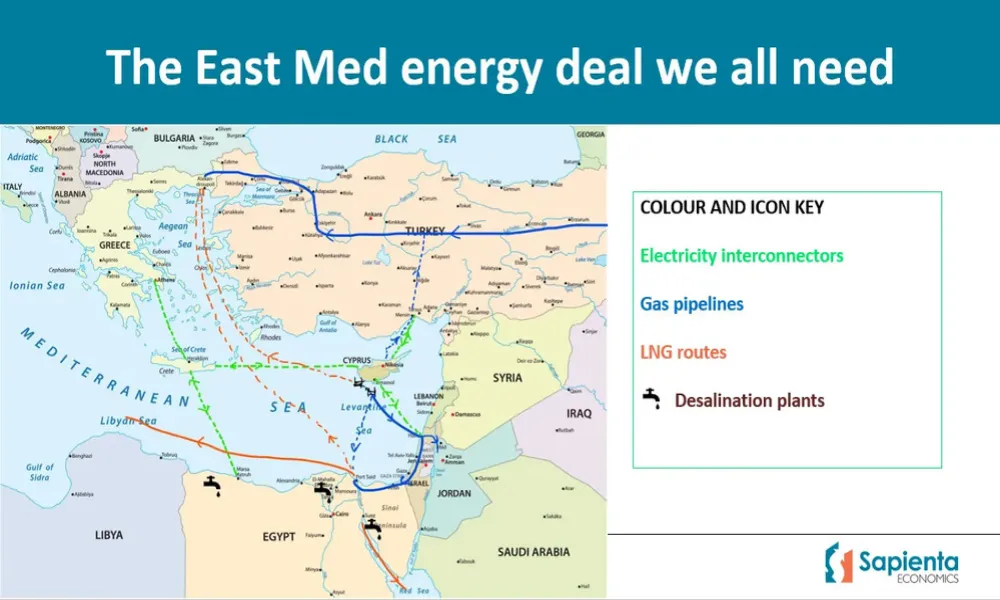
Electricity interconnectors for everyone. Cyprus has the best solar profile in Europe, which means it has a great potential to gain from electricity interconnectors that link Greece, Cyprus, Israel, Turkey, and Egypt, and potentially Jordan, Lebanon, Syria and Gaza. This will allow Cyprus to sell electricity to meet the enormous and growing energy demand in Egypt. In addition, if we assume that the grand energy deal means that Turkey and Israel no longer have a reason to pursue proxy conflicts, there will also be growing markets in Lebanon and Syria and Gaza as these economies stabilize. Regional markets will also grow because of the increasing need for energy-hungry desalination plants. As water scarcity increases conflict risk, it also has positive knock-on effects for regional security.
Natural gas routes. Israel is uncomfortable with the fact that it only has one major expandable export route for natural gas, namely Egypt. (It also sells quantities to Jordan but these cannot be expanded as much.) A grand energy deal involving natural gas will allow Israel to diversify by sending natural gas to Turkey. An extra bonus would be if the gas comes via Cyprus. Cyprus will benefit because it has been waiting decades to switch to cleaner, lower-penalty fuels for electricity generation. Right now we still have no idea when the long-promised liquefied natural gas (LNG) import terminal will be finished. Turkey will benefit because it has been trying to diversify its gas imports from Russia (and now potentially Iran). If Israeli gas can also be hooked up to Turkey’s massive international gas transit network, the gas can also make its way to Europe, thus helping to diversify EU gas sources. How does Greece benefit? By using some of the Israeli gas heading to Turkey, we might finally get that land-based LNG production plan that the Republic of Cyprus has longed for. That LNG will go to Alexandroupolis in Greece, where it will be be sold up the new “vertical corridor”. Greece will also benefit because part of this grand energy deal is that Turkey removes objections to Greece’s (and Cyprus’) offshore natural gas exploration.
Who makes it happen?
I believe that you need two outside players to make this happen. First, the US. The US has a big commercial interest here because both ExxonMobil and Chevron are involved in gas developments in Cyprus, Greece, Israel and Turkey. And these days “commercial opportunity” is music to the ears of the US leadership.
As European gas diversification will also benefit the EU, I think it would be wise to spread the risks and get the EU involved too. The European Commission can re-purpose the East Med pipeline: the white elephant that was supposed to bypass Turkey and send natural gas, at non-viable expense, all the way from Israel to Italy. Instead of pretending that this would ever attract enough private finance to be built, the EU should declare that it is prepared to fund an East Med pipeline that reduces both security and energy risks and to make it clear that this means a pipeline that goes from Israel to Cyprus, from Cyprus to Turkey, and from Turkey to Europe via the trans-national pipelines.
Will it happen?
It will only happen if:
- the key players understand that energy cooperation is the number one opportunity for reducing security risks in the region; and
- they put their backs into making it happen.
At all levels, from ministers down to embassy officials, it requires political savvy, diplomatic courage and consistency of purpose.
There is a deal to be made here; and it might just save us all.
This article first appeared on sapientacyprus.substack.com