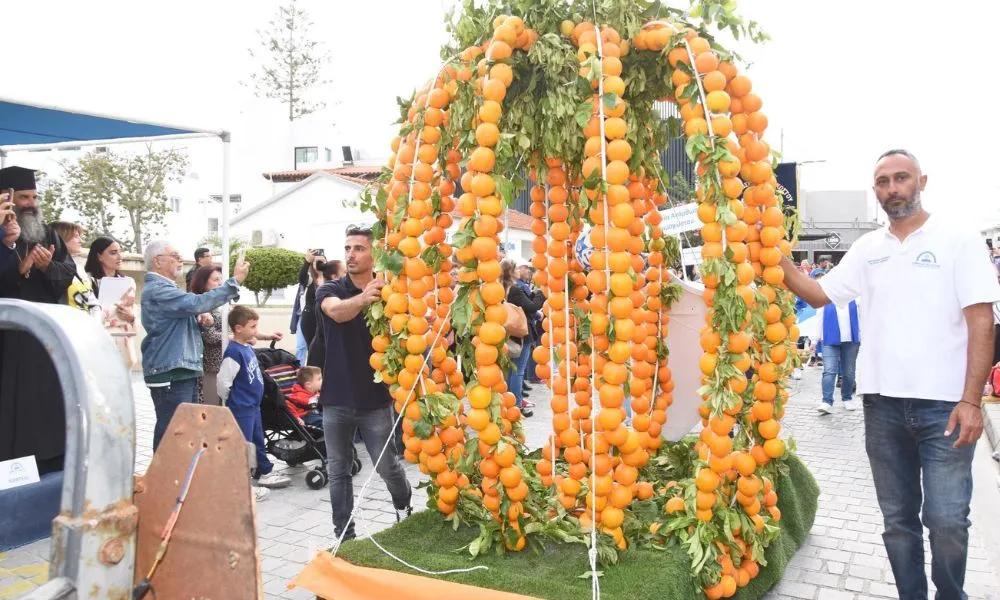
With an impressive and emotionally charged event held on Saturday, 2 May, at the amphitheatre of the THALASSA Municipal Museum in Ayia Napa, the historic Famagusta Orange Festival was revived, bringing back memories of another era from the occupied city of Evagoras. The event was organised through a collaboration between the Municipality of Famagusta and the Municipality of Ayia Napa.
Through the festival’s imagery and symbolism, the city of Famagusta took centre stage, reaffirming that it remains alive through memory, culture and its history. In her address, Agriculture Minister Maria Panayiotou, representing the President of the Republic, highlighted the revival of the Orange Festival as an act of remembrance, continuity and preservation of the identity of occupied Famagusta. She stressed that culture and collective memory remain vibrant and creative despite adversity.
Panayiotou also underlined the festival’s historical role as a symbol of culture, progress and social cohesion, as well as its strong link to agricultural production and citrus cultivation.
In his remarks, Ayia Napa Mayor Christos Zannettou said the revival of the Orange Festival represents a meaningful act of historical continuity and collective memory for Famagusta. He also referred to the close cooperation between the municipalities of Ayia Napa and Famagusta, aimed at showcasing historical events and traditions of the occupied city.
Famagusta Mayor Simos Ioannou emphasised that the city lives on through memory, dreams and younger generations, noting that the revival of the Orange Festival offers a symbolic journey into Famagusta’s past, rich in creativity, optimism and culture.
The event opened with a parade starting from Ayia Napa’s small harbour and ending at the THALASSA Museum, featuring organised groups and cultural associations from both municipalities. Leading the procession was a vintage car carrying the Orange Festival queen of 1967, Anthoula Charalambous.
The artistic programme included musical performances by the Cyprus Police Philharmonic Orchestra, songs by the Famagusta Municipal Choir and improvised traditional verse by Elias Hatzimichael and Marios Ppatsias. The ritual performance “Dance of the Hesperides”, choreographed by Elena Tofa, was also presented, alongside an audiovisual tribute to past Orange Festival queens, with special reference to Anthoula Charalambous (1967) and Olga Kazamia (1972), both of whom attended the event.
This was followed by the music and dance performance “The Garden of the Hesperides”, featuring acclaimed Cypriot artists Koulis Theodorou, Dimitris Mesimeris and Frederiki Tombaizou, accompanied by dance and cultural ensembles.
The evening culminated with a performance by Famagusta-born artist Stelios Chiotis, who delivered the song “Famagusta”, a hymn to the occupied city.