


This article was first published on Parathyro
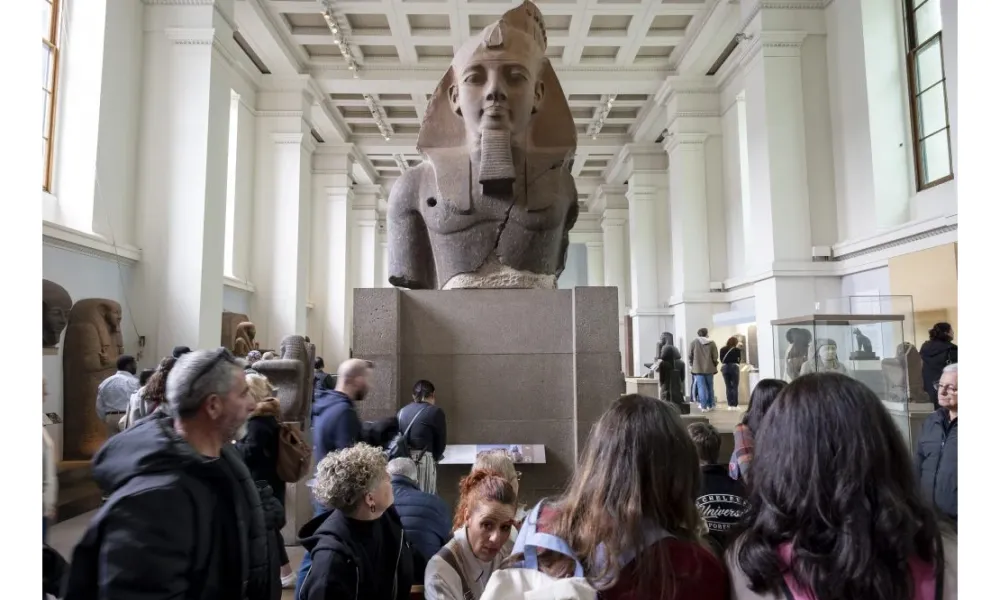
The British Museum has revised the labels accompanying ancient artefacts from the Middle East, removing references to “Palestine” from displays in its Ancient Near East galleries, a move that has sparked criticism from academics, activists and members of the public.
Why the terminology was changed
The changes became public following protests by the advocacy group U.K. Lawyers for Israel, which argued that using the term “Palestine” to describe cultures that existed centuries before the name was established risks projecting a modern political identity onto ancient civilisations. According to the group, such terminology obscures the later emergence of the kingdoms of Israel and Judah.
The museum said the updates followed public feedback and reflected a reassessment of the term’s historical neutrality. While “Palestine” was widely used as a geographical descriptor from the late 19th century, the museum acknowledged that the term is no longer considered politically neutral due to contemporary realities and the ongoing Israel Palestine conflict since October 7, 2023.
Museum response
In an emailed statement, the British Museum said the revision of labels in the Levant gallery and parts of its Egypt displays has been under way for more than a year and was not a direct response to the recent letter from U.K. Lawyers for Israel, which was sent only last week.
A museum spokesperson said that for maps depicting ancient cultural regions in the later second millennium BCE, “Canaan” is considered a more appropriate term for the southern Levant. The region broadly corresponds to present day Israel, Palestine and Jordan, and in some definitions includes southern Lebanon and Syria.
The spokesperson added that the museum continues to use United Nations terminology for modern borders, including Gaza, the West Bank, Israel and Jordan, and refers to “Palestinian” as a cultural or ethnographic identifier where appropriate. The museum said it would continue reviewing labels as part of ongoing refurbishment plans.
Reactions and criticism
The decision has drawn sharp criticism from scholars and activists. Historian and author William Dalrymple described the move as “ridiculous” in a social media post, noting that one of the earliest references to Palestine appears in the Egyptian monument at Medinet Habu, dating to 1186 BCE.
Marchella Ward, a lecturer in classical studies at the UK’s Open University, told Middle East Monitor that she frequently uses the term “ancient Palestine” in her research. She said claims that the term only dates back to the late 19th century are inaccurate and contribute to the erasure of Palestinian history.
Petition and wider debate
Activist Taghrid Al Mawed launched an online petition calling on the British Museum to reinstate the term “Palestine” in its displays to reflect historical accuracy. The petition gathered nearly 6,800 signatures within a single day. Al Mawed is a former voluntary chief executive of the UK based Palestinian Refugee Project and was excluded last year by local authorities over what they described as divisive social media posts and administrative shortcomings.
Giovanni Fassina, executive director of the European Legal Support Centre, said U.K. Lawyers for Israel has also pressured other public institutions to alter their narratives. Last month, the Open University stopped referring to the birth of the Virgin Mary in “ancient Palestine” following a complaint by the group. The World Museum in Liverpool has likewise announced a review of the term “Palestine” on several labels describing the Early to Middle Bronze Age in its Ancient Egypt gallery.
The European Legal Support Centre is working with Forensic Architecture to launch a public database later this month documenting around 900 cases of what it describes as anti Palestinian repression in the UK between January 2019 and August 2025.
With information from artnet.com