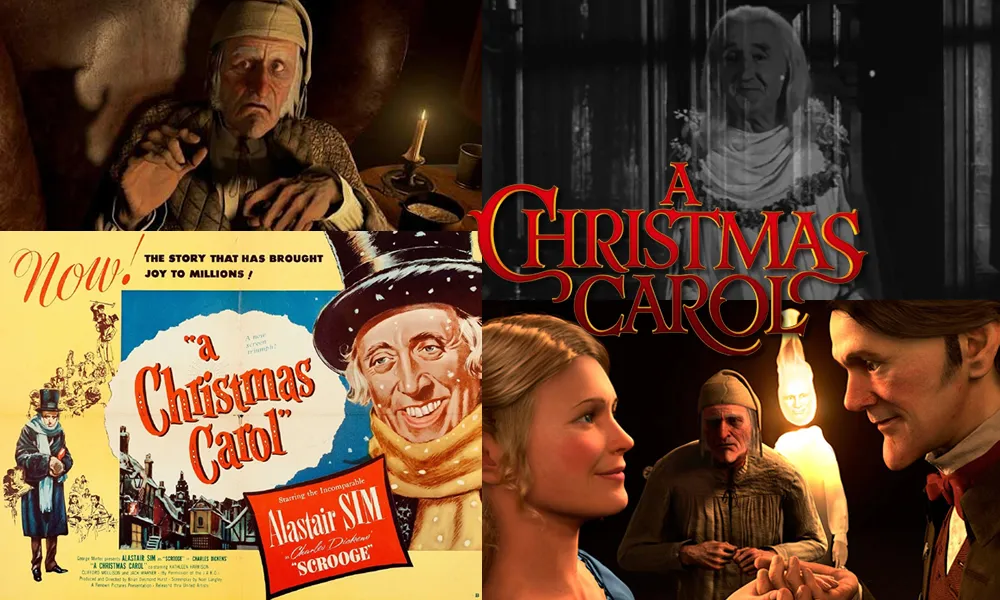
No story has shaped Christmas cinema more profoundly than A Christmas Carol, and its many adaptations offer cinephiles a fascinating study in how filmmaking styles evolve while timeless themes endure. Whether it’s the stark moral clarity of the 1951 Alastair Sim version or the digital ambition of Robert Zemeckis’ 2009 motion-capture adaptation, Dickens’ ghostly tale remains endlessly adaptable and endlessly relevant.
At its core, A Christmas Carol is cinematic because it is visual by nature: time travel, spectral visitations, memory as landscape. The best adaptations understand this and lean into atmosphere. Fog-soaked Victorian streets, candlelit interiors, and exaggerated shadows owe a debt to German Expressionism and classic Gothic cinema. These films don’t just tell a story, they conjure a world.
For cinephiles, Scrooge himself is the great role. Actors approach him as both monster and man, balancing misanthropy with buried vulnerability. This oscillation makes the story feel earned rather than didactic, showing how technical choices serve narrative and thematic goals.
The joy comes not merely from his redemption, but from watching performance slowly thaw, posture softening, voice lifting, eyes brightening. Cinephiles can study both versions for how directors manipulate space, camera, and performance to externalise character change. A Christmas Carol endures because it visualizes moral transformation.
What elevates A Christmas Carol above simple seasonal comfort is its moral seriousness. It confronts wealth inequality, social neglect, and personal accountability without softening the blow. Christmas here is not about excess, but empathy and about community. Christmas fairytales do that and its fine because it’s so satisfying!
Every year brings new interpretations, yet the story persists because it understands cinema’s greatest power: showing us who we are, who we were, and who we still might become. In that sense, A Christmas Carol isn’t just a Christmas film, it’s the blueprint.