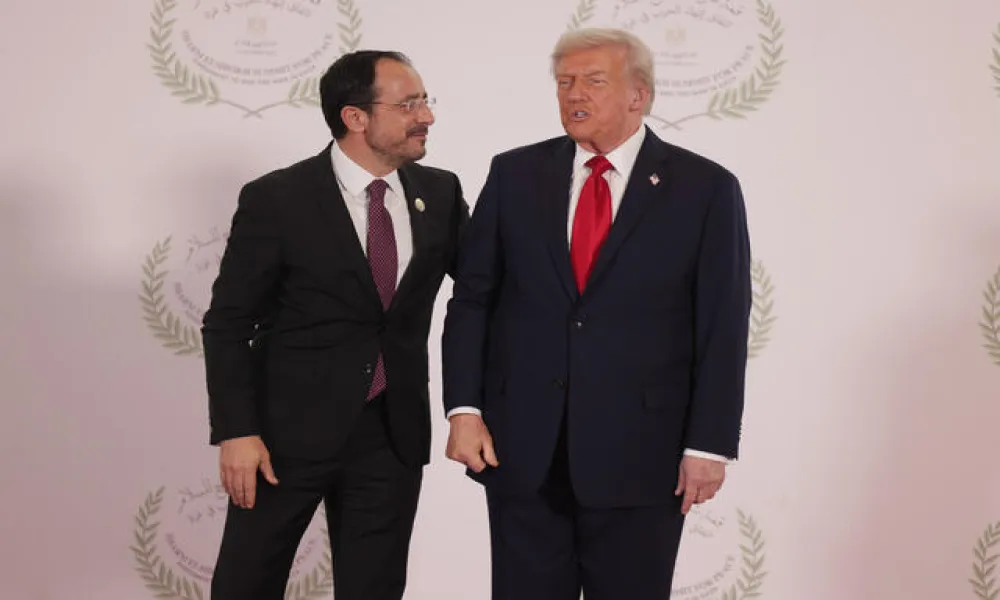

Those monitoring international developments shudder at the idea of Donald Trump getting involved in the Cyprus issue. Those unaware of what's happening around them however, just get lost in the small circles and therefore do not shy away from displaying their enthusiasm about a possible involvevement of the US President.
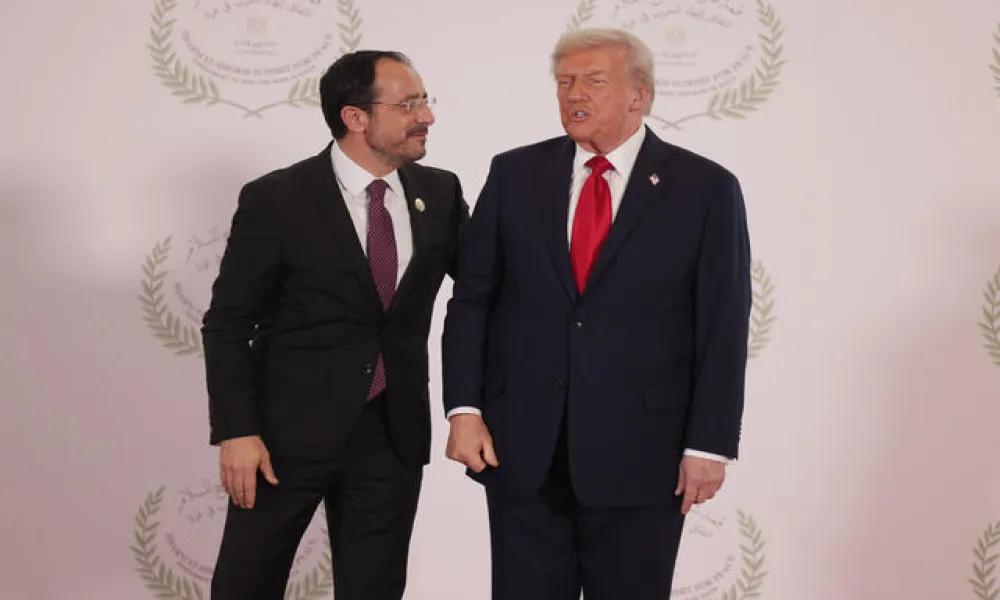
A few days ago I was engaged in discussion over the issue with a Turkish colleague, who follows the Cyprus issue quite closely and is in a position to know at least what is transpiring in Ankara. The current assessment is that the new Christodoulides-Erhurman dialogue does not have a good chance of a substantive result.
'Only a Trump intervention will solve the Cyprus issue', he told us.
US President expectations or not, this doesn't mean that not all parties involved are not happy with the mere existence of a process. Turkey is just discussing for discussion's sake, in light of other claims in the wider region and Cyprus wants to maintain a useful momentum that is usually helpful in three directions.
Firstly, it keeps Turkish tensions low key, it provides Christodoulides time to build 'ambitious and emblematic alliances', which he believes will allow him to negotiate the Cyprus issue under better terms and thirdly it allows the Presidents' time to better handle the internal front on the way to the 2028 Presidential elections.
The timeframe
The second half of 2026 is considered by many as a decisive time for developments on the Cyprus issue. With the right political will, the first half of next year might see the conclusion of negotiations, with the final conferences and referenda scheduled for the 2nd half., all under the auspices of the UN.
Antonio Guterres, retiring in 2027, would be absolutely happy if he could facilitate a solution to a long standing problem such as the Cyprus issue, particularly when the international organisation has been locked out of every other major international issue, such as the Palestinian problem, Syria, Ukraine and so on.
If the Cyprus issue remains unsolved through to 2027, it's possible that the leading players and priorities might change, with all established facts gone. Namely what every Cypriot politician calls the 'General Assembly, UN Security Council resolutions and EU legislation'.
What changes in the field
Following the Gaza war, the Eastern Mediterranean and Middle East regions are witnessing new balances, built in parallel circles, such as energy and connections, security/deterrence and a reshuffling of diplomatic roles, with Europe, according to the Guardian, politically weaker and the US more agreeable.
What do we see:
• Energy is being forged as a catalyst for alliances-for example the Israel-Egypt deal for the sale of natural gas from the Leviathan deposit by 2040 strengthens, according to the Financial Times, the role of Egypt as an LNG/export gun and ties in Israel with neighbouring states through long term trade agreements.
• Electrical connections being considered geopolitical infrastructure: The EU is promoting the Great Sea Interconnector as a critical work breaking the island's energy isolation as the last member state outside the European network and turns Cyprus-even though the government, depending on local players, does not really see it, from a consumer to a regional architecture hub.
• Minilateral security alliances are being forged: The logic of small alliances, like three plus one is being strengthened, pertaining to maritime security and antiterrorism (USA- Israel-Greece-Cyprus). But they could be more effective if Turkey was taking part.
The basic players
The US want to provide a security umbrella in the Eastern Mediterranean and a substantial contribution in building a new trade architecture guided by President-businessman Trump. The US can work as a deal accelerator, in energy deals for example, as well as a guarantor of deterrance. But they often seek financial trade offs.
The EU is operating in the area as both a coordinator and a financier in the energy market, but its finding it difficult to speak with a single political voice over the Middle East. EU power is derived through network projects, such as connections or energy highways as well as market regulations. Cyprus is in a critical area and its connection through Greece is fast becoming a European priority. It's doubtful though if this is understood by its leadership, who's been manipulated by local interests.
Τurkey, having a revisionist role, is trying to gain additional brownie points through a series of claims in the Eastern Mediterranean, its strategy being not to stay out of energy and security designs. It's practically attempting to impose that nothing, including exclusive economic zone rights. cables or pipelines, can go through the region, without its final say so. It also wants to become an energy hub towards Europe, bad relations however with Greece and the pending Cyprus issue are limiting this ambition, as it is usually excluded from energy alliances, such as EMGF.
Israel now, through military power, technology and energy deposit has gained a significant regional infuence. It has already locked in energy exports and infrastructures with neighbouring countries in the Eastern Mediterranean, like Greece and Cyprus. Its main competitor is Turkey, with some communication over a number of issues, including Syria, but also suspicious of each other and competing for the leading role.
The Trump role
What could Cyprus gain through the reshuffling of balances in the region? However small its gaining geostrategic value over the past few years as an EU member in the Eastern Mediterranean, as a gateway/network hub and a platform for security cooperation.
Cyprus could benefit even more by a settlement of the Cyprus, as it would include the 100 million Turkey market in the equation, beyond Greece, Egypt, Israel and Lebanon.
The passage of time and the possible Donald Trump involvemenet in the region might leave everyone unhappy.
In today's conditions, Cyprus can take part in the geopolitical reformation of the area as a small but credible player, a catalyst for the political and economic cooperation of all regional states, as an honest broker.
Developments and the rearrangement of balances in the region, without a settlement of the Cyprus issue, make the country part of the problem, or as the US ambassador in Ankara Tom Barak put it, 'an abscess'.
No one wants Trump to clean this abscess. According to a Thomas.B.Edsall article in the New York Times last week, 'Trump's political behaviour and mentality are not complex but build around raw narcissism and a clearly egocentric view of power. The central axis of his administration are personal interest, image and both himself and his family becoming richer at the expense of public interest and institutions'.
Within such a framework, Cyprus is in danger of being considered as collateral damage in a wider give and take setting with Turkey, which might be catastrophic for both communities in Cyprus.