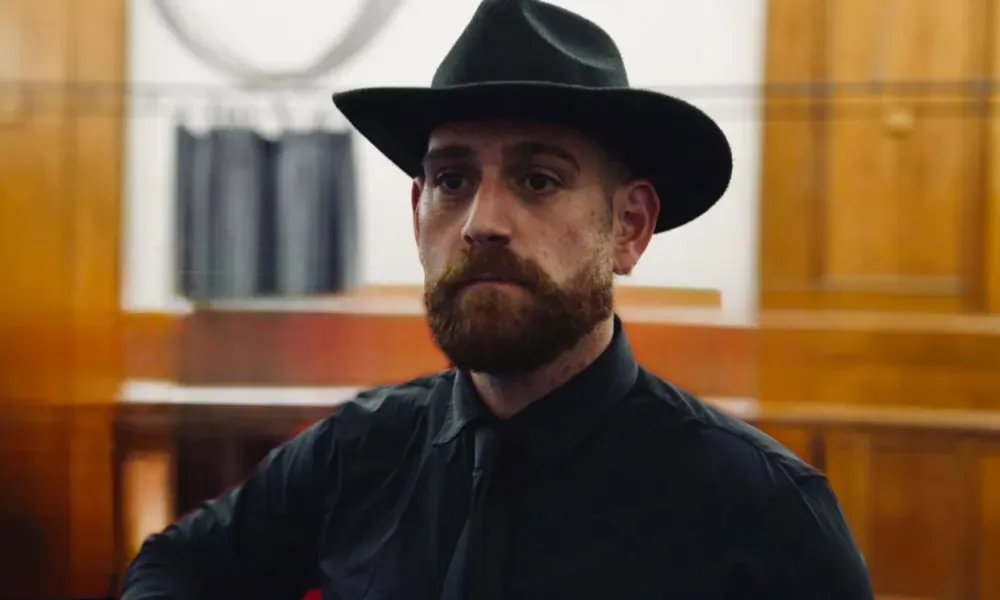
Dimitris Dimitriou, known as "Kafataris", was born and raised in Meniko and, although he says he was always an actor in life, acting entered his world much later, almost by accident. He combines Shakespeare with The Odyssey and loves Hong Kong cinema because these seemingly incompatible schools of performance share a common characteristic: stage combat. Carrying the name "Kafataris", inherited from his grandfather's nickname, which loosely translates as "good friend", Dimitris speaks to Politis and introduces us to the distinctive world of stunt performers.
His first steps began at the age of 18 at the Halkanores Idaliou Cultural and Athletic Club, which he discovered through friends and whose atmosphere won him over immediately.
"That's where I learned things I still use today," he says.
He experimented with various jobs, enrolled in graphic design studies, which he abandoned in his third year, and later worked for several years at Cyta. Theatre, however, never left either his life or his heart, as he continued taking part in Halkanores activities in his spare time.
"At some point I realised I couldn't continue doing what I loved only as an amateur."
What prevented you from pursuing theatre earlier?
"Unfortunately, in Cyprus you're not encouraged to do something different from everyone else, even though my parents supported me in everything. I wish I had started theatre much earlier. Of course, it also has to do with maturity. It took time before I realised I couldn't live without it. That's why it's very important to be in an environment that encourages you to do something different. It took me five or six years to reach the suffocating point where I had to leave everything behind, and another five or six years before I stopped thinking I was the strange one who left."
When did you realise you wanted to do it professionally?
"A defining moment was Comic Con Cyprus, where I met actor Miltos Yerolemou, who played Syrio Forel in the first season of Game of Thrones. I remember there were so many people and I managed to convince the others to let me go to the front. I was the last person to speak to him that day and told him I wanted to do what he does.
"That's where I attended my first Stage Combat workshop with swords. It was the first time I realised there was an entire professional field built around it.
"I went home, opened Google and searched for the ten best drama schools in England. I wanted to study acting and learn Shakespeare in his own language. At the same time, I wanted to learn stage combat for theatre, so I identified the only school that offered it. I left for London, attended my first audition and got in. I've been here ever since and have been working in the field for a decade."
Why stage combat?
"As a child I was a huge fan of Marvel, comics, fantasy films, animation and Hong Kong cinema, which I watched with my father. I grew up with anime, while in Cyprus people have only recently started paying more attention to it. I was always fascinated by stories with heroes, battles and grand narratives.
"I studied for three years and then began combining acting with stage combat. I've always been an active person. I practised martial arts and trained with weapons and swords."
Snapshot from a set where Dimitris "Kafataris" worked. Courtesy of the artist.
What was the beginning like in England?
"It wasn't easy. Many people told me I was crazy for leaving things behind to pursue something so uncertain and that I'd come back crying. I left with a smile and still think about it with a smile because I knew that's what I wanted.
"After drama school, in 2019, I gradually started working as a fight director on theatre productions. I helped actors develop fight scenes, understand why every movement takes place and how it serves the story. It's something I love very much and I consider myself lucky that I still do it.
"I also performed in some Shakespeare productions and later worked on a video game where you wear the special motion-capture suit that records a character's movements.
"Then the pandemic turned everything upside down. Like everyone else, we started again from the beginning. Until your network opens up, you'll do a job for free or at half-price, and later people come back with better opportunities. That's how it works here. Now I have two agents as well as my own network, but it took me ten years to get here."
So your career moves between acting and stage combat...
"Exactly. My degree covered acting and stage combat for theatre and film, although if you ask me what I love most, the answer will always be theatre. The connection with the audience and the energy you receive from a live performance is unique. It cannot be replaced.
"In theatre you also have more rehearsal time, more opportunities to experiment, see what works and what doesn't, and change it. In film you have to make decisions much faster. That has its own challenges, especially when you have to repeat a scene dozens of times because of small details."
What is the industry like in London, a city regarded as a global centre for both theatre and film?
"It's difficult. There's a lot of competition. It's not enough to be a good actor. You also need connections with the right people so you can find yourself in the right places.
"The fact that I'm Cypriot in England brought its own challenges and it took time to adapt because the humour is different, the references are different and the culture is different. It requires a lot of hard work and tremendous discipline.
"There are far more opportunities than in Cyprus, but also far more competition. You have to be ready all the time because nobody is going to hand you anything.
"It's true that salaries in Cyprus are much lower than abroad. That's also a major reason why many people go overseas. We have very creative people in Cyprus and everyone is passionate about what they do, but when you're not paid enough it holds you back.
"As for state support, there are processes in place, but they come with enormous bureaucracy. You have to document everything in your application and justify it. Funding exists, but it's very difficult to secure. You have to go through specific channels that accept the message you want to communicate or meet specific criteria, such as the size of a production. You have to know how to navigate it."
What are you working on now?
"At the moment I'm a fight director for a major company at the Kit Kat Club, where some very big names perform, including Eddie Redmayne. It's one of the biggest theatres in London's West End. It's a great pleasure to work there whenever they need me and to collaborate with such important and talented people.
"At the same time, I work on films and television series in the action department, from police productions to science fiction projects, both in supporting and advisory roles.
"I prefer fantasy or period productions, with swords, superpowers and dystopian elements because a good film is judged in the details. You may shoot a fight scene perfectly, but because the lighting wasn't right, you need to do it again and it may not come out exactly the same. That drives me crazy."
How is AI affecting your work?
"We're living through a very strange moment for culture. We still don't know how to move forward or what we can publish, which is why we double-check every piece of work we do because it can be used to generate content with our faces and movements.
"They pay good money, but then another question arises: how are we going to continue working in the future?
"Whatever comes, we have to deal with it as it appears. Hopefully those responsible will do what's best for us and we won't face negative developments.
"AI essentially aims to reduce production costs. For example, theatre productions are creating posters with AI instead of working with graphic designers. When that became known in London's artistic community, people were immediately divided. Some didn't even want to attend the productions and boycotted them, while others supported them because they had small budgets and had to do the best they could with limited resources.
"Technology is a tool. Human beings are what make the difference."
The Odyssey chapter
Dimitris often works on television and film productions as a member of action teams, meaning performers who staff combat scenes. Depending on the production, the term "stunt performer" is often used.
That is how he found himself on the impressive set of Christopher Nolan's highly anticipated The Odyssey.
What was it like working on such a major production?
"It was an incredible experience. From the first moment, you could tell you were standing beside people operating at an exceptionally high level.
"Just observing people like Matt Damon and the rest of the cast, seeing how they work, how they speak and how they approach their craft, makes you better. It was both an honour and a responsibility. There were moments when I thought to myself, 'Where have I ended up?'
"But very quickly I realised I had to give my absolute best. There was no room for mistakes. There was no 'tomorrow'. When you reach that level, you have to prove you deserve to be there and you realise that success comes through hard work.
"The sense of teamwork also helped enormously because we all operated as one team. You could feel that team spirit because the conditions were very demanding. That's what made it such an impressive experience. We were all together, through the sweat and through the cold."
What is it like working with Christopher Nolan?
"Just by observing how he works with his team, you understand why he is where he is. There is professionalism, enormous attention to detail and a deep respect for practical effects.
"Expectations were high for everyone, whether you were first on the cast list or last, but at the same time there was respect for every member of the crew. For me personally, it was a unique opportunity to learn."
Did filming in IMAX affect your work?
"Absolutely. I can't speak about technical details, but as a performer you felt that nothing was hidden.
"I had the sense that every movement, every reaction and every detail would be visible. So I felt much greater pressure to be precise and focused. It was quite imposing."
Were you ever interested in becoming purely a stunt performer?
"At first, yes. But over time I found myself more in the role of fight director and the person responsible for designing and coordinating the action, something I enjoy just as much."
Have you ever been seriously injured?
"No. Neither I nor anyone under my responsibility, and I'm very proud of that because safety is the most important part of our work.
"I've taken a few hits, but there has never been a serious injury. I remember once I was hit in the eye and my father asked me what I was going to do.
"I instinctively replied that I was going back to work.
"I love what I do and I've sacrificed so much to get here. That's what I told him. Rehearsals exist precisely so that mistakes can be identified before we reach the performance or the shoot."
What comes next?
"I have my own team and company called Titanborn, meaning 'born from Titans'.
"We train people, work on projects and try to develop the field further.
"At the same time, I'm coordinating stunts for a video game that is still in development and I continue trying to open doors, not only for myself but also for other Cypriots who want to enter this field.
"If a young person in Cyprus reads my story and believes in themselves a little more, that is worth more to me than any credit in a film."