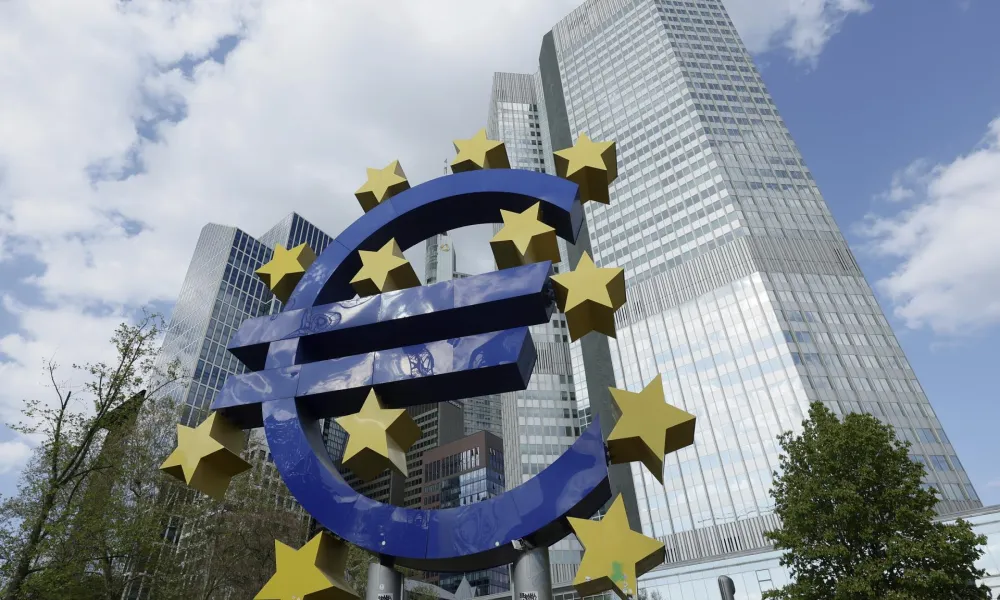
The European Central Bank is expected to leave interest rates unchanged at its meeting this Thursday, as it waits to assess whether the surge in inflation driven by the US-Israeli war against Iran will prove transitory or begin to weigh more heavily on economic growth.
Markets have increased their bets on a rate rise following the global energy shock triggered by the conflict, which is already pushing consumer prices higher across the eurozone. Inflation in the eurozone jumped to 2.6% in March, exceeding the ECB's 2% target. The bank has warned that in its worst-case scenario, inflation could climb considerably higher.
ING economist Carsten Brzeski said the ECB's pre-war mantra that it was "well positioned" on rates no longer holds. "The bank has returned to crisis mode, shifting its focus from long-term forecasts to real-time developments," he added. Economists nonetheless expect the ECB to keep its benchmark deposit rate at 2% on Thursday, the level it has held since June 2025, as it waits to see how the conflict develops.
Trump has extended the ceasefire with Iran to allow more time for peace talks, and active hostilities have largely ceased, though the Strait of Hormuz remains largely closed to tanker traffic. Economists also note that energy prices have not risen as sharply as they did following Russia's invasion of Ukraine in 2022, and that supply chains are not facing the same degree of disruption.
'We are not in a hurry'
Despite the spectre of 2022, when the ECB was criticised for moving too slowly to raise rates as inflation climbed, policymakers have sent a clear signal that they are not rushing. "We are not in a hurry," Latvian central bank governor Martins Kazaks, a member of the ECB's rate-setting Governing Council, told the Financial Times last week. "We still have the great luxury of collecting data and forming our view," he added.
Rate rises would also add further strain to the eurozone's already sluggish economy, whose manufacturers are facing fresh pressure from the energy shock. A survey published last week showed eurozone business activity contracted for the first time in 16 months in April as a result of the conflict's knock-on effects.
In the United States, economists have revised down their expectations for rate cuts as the Iran energy shock adds inflationary pressure. The Federal Reserve is also expected to hold rates steady when it meets on Wednesday.
All eyes will be on ECB President Christine Lagarde's press conference following Thursday's decision for any signals on the interest rate outlook. She is likely to repeat the formulation used in recent weeks, that the bank is "well positioned" to handle the fallout from the war, while declining to commit to any future decisions. Speaking in Berlin last week, Lagarde said the bank faces "double uncertainty," as it remains unclear both how long the shock will last and what its broader economic consequences will be.
Source: CNA