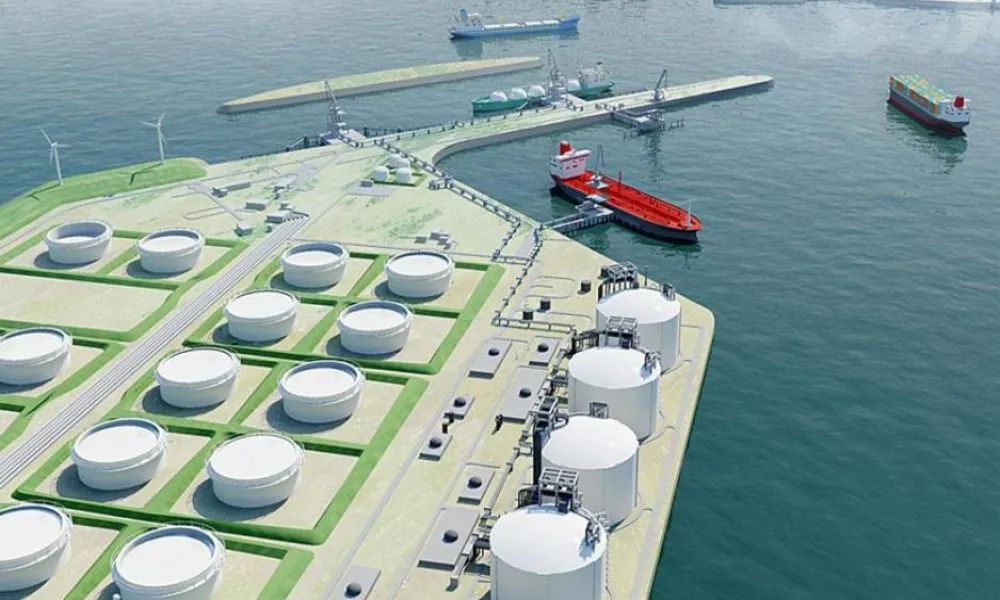
The ambitious energy project at Vasiliko, once hailed as the cornerstone for bringing natural gas to Cyprus—has veered into uncharted waters once again.
New revelations, reported by Omega Channel and expanded on in an article by former Transmission System Operator director Christos Christodoulides in Phileleftheros, shed light on the precarious state of the Vasiliko LNG import terminal. The findings push back, perhaps indefinitely, the completion of the project and the long-awaited arrival of natural gas in Cyprus’ electricity production. The delays deepen the country’s energy uncertainty, keeping households and businesses shackled to high electricity prices.
Energy Minister Giorgos Papanastasiou confirmed the gravity of the situation, telling CNA that the government is now managing the “damage limitation” phase.
Where things stand
Christodoulides outlined two stark problems in his piece:
-
The subcontractor responsible for building the jetty has flatly refused to take responsibility for the condition of materials and infrastructure that require repairs or reconstruction. “If the subcontractor who knows the state of the works won’t accept liability, how can serious bidders be expected to do so through an international tender?” he asked.
-
The project manager, Technip, tasked with assessing the infrastructure and preparing the next stages, is reportedly considering scrapping everything and rebuilding from scratch. The reason: a lack of certification from internationally recognized bodies for the existing equipment and materials.
“If this is true, then it’s time to take the taxpayer seriously,” Christodoulides said. “Cypriots have been waiting for natural gas to lower their electricity bills and to ensure there is no risk of power cuts.”
Omega Channel, citing project insiders, reported that Technip has already flagged major safety risks if the terminal were to operate in its current state. The project manager is expected to deliver a report to the Natural Gas Infrastructure Company (ETYFA) in early September, and leaks suggest it may even recommend halting construction altogether.
The energy minister did not deny these technical concerns. Instead, he stressed that accountability will be sought if the grim scenario is confirmed: “This government is managing the limitation of damage. Any responsibilities must be attributed to those design and technical decisions that may now pose safety issues.”
Meanwhile, the “Prometheus” floating storage and regasification unit (FSRU), the vessel central to the project, remains docked in Malaysia for modifications before test operations can begin.
From flagship to fiasco
The Vasiliko LNG terminal, designed to include onshore facilities for gas reception, storage, and regasification alongside the Prometheus FSRU, was touted as the most critical energy project in modern Cypriot history. Its goals were ambitious: slash electricity costs, reduce emissions, and secure the island’s energy supply.
Instead, delays mean key power plants, including a 160MW unit at EAC and a 260MW unit at PEC, remain idle. Cyprus is still burning heavy fuel oil and diesel, costly and highly polluting fuels.
The burden falls squarely on consumers. Cypriots already pay some of the highest electricity prices in the EU, and there is no sign of relief. On the contrary, the cost of purchasing emissions allowances adds an estimated €1 million a day to the economy. Businesses face eroded competitiveness while households brace for more strain.
Calls for a clear plan
Papanastasiou has acknowledged that “responsibilities around the project’s design and technical decisions must be assigned”—a tacit admission of flaws in planning and management. But accountability alone will not resolve the crisis. What Cyprus now demands is a clear, realistic plan:
-
When and how will the Vasiliko project be completed?
-
How can safety and technical adequacy be guaranteed?
-
What alternative measures can secure Cyprus’ energy supply in the meantime?
What was meant to usher in a “new energy era” is now shaping up as one of the country’s most expensive missteps.
Is “Plan B” Aphrodite?
Christodoulides argues that Cyprus should consider a backup strategy: piping gas directly from its own Aphrodite field.
“We could still bring natural gas from Aphrodite via a simple and cost-effective ‘tie-back’ pipeline,” he wrote. “With a modest onshore treatment unit at Vasiliko, the gas could be used immediately for power generation, covering the country’s relatively small annual needs of around 0.6 bcm.”
He calls on the government to scrap plans for the FSRU and renegotiate with Aphrodite’s operator to build a direct subsea pipeline. “This is the only solution for Cyprus,” he insisted. “It would be professionally planned, costed, and delivered. Unlike the tragic LNG terminal project, which no one knows when, or if, it will be completed or at what final price.”