
A year after the Cabinet approved emergency measures to address water scarcity through small private desalination units, uptake remains limited. According to the Ministry of Agriculture, only seven hotel applications have so far been approved, out of a total of 13 submitted under the simplified licensing procedure.
Current status of applications and approvals
According to data provided to Politis by the Ministry of Agriculture, 13 applications have been submitted under the simplified procedure for small private desalination units with a daily capacity of up to 1,500 cubic metres.
Of these, seven applications, all concerning hotel units, have been approved. The remaining six applications, submitted by hotels and farmers, were returned for additional information or design modifications.
At this stage, beneficiaries who have obtained a water abstraction project permit are in the process of preparing and ordering the required equipment, in line with the terms of their licences. Once construction is completed, operators must secure a certificate of approval and a water abstraction licence from the Water Development Department before the units can enter full operation.
Expected impact on the water supply system
The approved projects are expected to ease pressure on the general water supply system once operational. Even assuming an average output of 1,000 cubic metres per day per unit, the seven approved projects could collectively provide around 7,000 cubic metres of water daily.
Representatives of the Cyprus Hoteliers Association indicated to Politis that the approvals are notable given the objective difficulties faced by many hotel operators in joining the scheme.
Environmental and operational obstacles
Data from the application process suggest that environmental constraints remain a major deterrent. A large number of hotels are located near Natura 2000 areas or protected forest land, raising concerns over permitting by the Departments of Environment and Fisheries.
Additional issues include the protection of marine life from brine discharge through submerged pipelines and noise pollution generated by desalination units. These factors complicate environmental licensing and increase uncertainty for potential applicants.
Scheduled meeting with hotel operators
These issues are expected to be discussed at a meeting between the Ministry of Agriculture and hotel operators on 17 February. Officials from the Water Development Department and the Department of Environment will brief participants on the scheme and address concerns raised by applicants whose projects encountered obstacles.
According to sources familiar with the process, the meeting aims to explore solutions within the existing legislative framework to facilitate wider participation.
Coastal constraints in the Paphos area
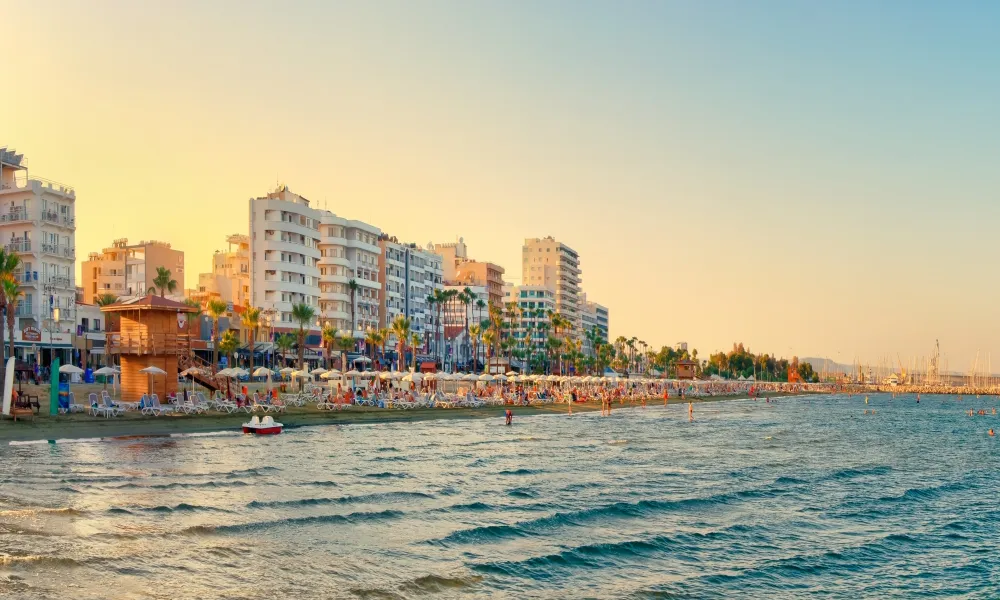
Hotel operators cited the coastline of Kato Paphos and Geroskipou as a representative example of the challenges involved. According to a hotelier who spoke to Politis, hotels in these areas are built in close proximity, making it difficult to install desalination units without causing noise disturbance to promenade users and hotel guests.
Landscape impact and renewable energy integration
Hoteliers have also expressed concern about installation timelines, seeking to avoid construction works during the tourist season due to visual and noise disruption. They have further requested support for integrating desalination units with renewable energy sources and energy storage systems to allow night-time operation.
Legal safeguards are also being sought to ensure that, in periods of sufficient rainfall and water availability, operators will not be required to suspend the operation of desalination units in which they have invested several hundred thousand euros. Cooperative models involving shared desalination units are also under consideration, alongside broader water management measures within hotel operations.
Existing use of desalination by hotels
According to the Ministry of Agriculture, some hotels in Cyprus already operate small desalination units with positive results. A large hotel unit in Limassol is reported to supply its swimming pools with desalinated water, although the unit involved is of limited capacity.
Limited prospects for agricultural uptake
In the agricultural sector, which has been heavily affected by water allocation cuts over the past two years, including a 33 percent reduction planned for 2026, the Ministry of Agriculture is also promoting participation in the desalination scheme.
Commenting to Politis, the General Secretary of the Pan-Cyprian Farmers Union, Christos Papapetrou, expressed reservations about the prospects of agricultural applications, citing environmental licensing as a key concern.
He stated that while the policy direction is correct, implementation procedures create obstacles, including differing approaches between government departments. He added that the state has an obligation to install large-scale, low-cost desalination units for agricultural use or to subsidise water costs, as is done for desalinated water supplied for domestic purposes.
Simplified licensing and grant scheme
On 26 March 2025, the Council of Ministers of Cyprus approved a simplified licensing procedure for small private desalination units producing up to 1,500 cubic metres of water per day, as part of measures to address water scarcity.
The scheme applies to hotel units, district local authorities and communities acting as water supply authorities for drinking water purposes, as well as to agricultural holdings, golf courses, water parks and related facilities for irrigation.
At the same time, the Cabinet approved a grant scheme with a total budget of €3 million. Eligible beneficiaries include licensed and officially classified hotel units that have completed the licensing process and obtained a water abstraction project permit. District local authorities and communities acting as water suppliers may also receive grants.
Grants range from €65,000 to €300,000 for individual installations and from €95,000 to €550,000 for group installations serving more than one hotel unit, depending on capacity.
Further support is available under the Large Investment Measure of the Common Agricultural Policy Strategic Plan 2023–2027 for agricultural desalination units, subject to eligibility criteria and the securing of permits from the Departments of Environment and Water Development.
Source: Politis Sunday edition