
Cypriot students are facing mounting financial and social pressures as the cost of living and studying continues to rise, while key support mechanisms remain unchanged for more than a decade. In an interview with Politis, the President of the Pan-Cyprian Federation of Student Unions outlines the need for an urgent renegotiation of the student grant and a broader redefinition of student social policy.
Student challenges across public and private institutions
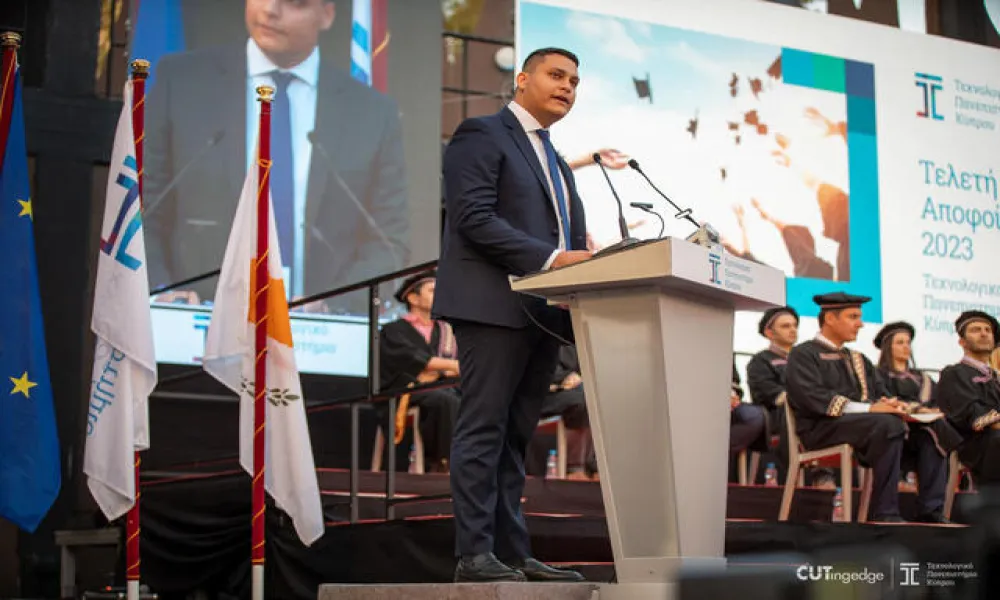
The President of the Pan-Cyprian Federation of Student Unions (POFEN), Konstantinos Karseras, highlighted the main challenges faced by Cypriot students studying in both public and private institutions in Cyprus, as well as those studying abroad.
According to Mr Karseras, housing constitutes one of the most acute pressures on students and their families, describing it as a structural issue of social policy. He stressed that without a coherent and institutionally consistent approach, housing costs will continue to undermine equal access to higher education.
He added that issues of equal treatment extend to the level of the student grant and access to equipment and facilities, underlining the need for a national strategy to ensure genuinely equal opportunities for all students, regardless of institution or economic background.
Rising cost of living and student welfare gaps
Responding to questions on the most pressing problems faced by students today, Mr Karseras linked them directly to the increased cost of living and studying. High rents, transport costs and basic living expenses are creating significant strain, while student welfare and social support schemes remain insufficient.
Additional challenges include the connection between studies and the labour market, access to internships and concerns about employment prospects after graduation. For students studying abroad, further difficulties arise in relation to bureaucracy, recognition of qualifications, delays in benefit payments and limited institutional communication with the Cypriot state.
Housing pressure and shortage of student accommodation
Housing conditions were described as particularly restrictive in Nicosia, Limassol, Larnaca and Paphos. Limited availability of student accommodation, combined with rapid rent increases, has forced most students into the private rental market, where prices often exceed family income capacities.
POFEN advocates for a comprehensive student housing policy, centred on the creation and expansion of student residences. Proposed measures include cooperation between the state, universities, local authorities and private investors, use of state land through the Cyprus Land Development Corporation, and incentives for private-sector student housing projects. Complementary measures such as rent subsidies and improved public transport were also identified as necessary.
Delays in University of Cyprus student halls
Mr Karseras referred specifically to the long-standing delays in expanding student halls at the University of Cyprus, an issue repeatedly raised with the university, the Ministry of Education, the Ministry of Finance and the House of Representatives.
He noted that while the project is widely recognised as necessary, it remains unresolved despite growing demand. POFEN continues to press for clear timelines, proposing public-private partnerships, use of state land, European funding and integration of student housing into a broader national housing strategy.
Actual cost of studying in Cyprus
According to available data cited by Mr Karseras, average monthly living expenses for a student in Cyprus range between €700 and €1,000, depending on the city and lifestyle. However, he noted that in practice, costs can reach up to €1,600 per month, particularly in cases of above-average rents.
Student grant no longer reflects reality
On the adequacy of the student grant, Mr Karseras stated that it does not meet current needs. The income threshold of €59,000 and grant amounts have remained effectively unchanged for more than 13 years, despite sharp increases in living and study costs.
He pointed out that a large segment of the middle class is marginally excluded, while €8 million in allocated funds remained unused in 2024, indicating shortcomings in social targeting. POFEN proposes a structural revision, including indexation of income thresholds to inflation, fairer assessment of assets, avoidance of abrupt exclusions for minor income differences, and automatic annual adjustment linked to the Consumer Price Index.
Targeted provisions were also proposed for families with multiple students, first-year students facing higher initial costs, financially independent postgraduate students, and students at private universities who risk not receiving their degrees due to financial hardship.
Role of the Student Social Support Body
Asked about the Independent Student Social Support Body following the videogate affair, Mr Karseras stressed the need to distinguish operational failures from the institution’s core purpose.
POFEN does not support abolishing the body, but calls for its institutional strengthening and reform. According to Mr Karseras, student support for tuition fees and rent remains necessary, particularly in a high-cost environment, but must be underpinned by clear criteria, effective oversight and public accountability. He described the body’s role as complementary to state social policy, not a substitute for it.
Access to equipment and learning resources
Mr Karseras described the current situation regarding equipment and learning resources as uneven. While some institutions have made progress, disparities persist between faculties and between public and private universities.
A key concern relates to the cost of textbooks and educational material, which is increasingly borne by students. POFEN has therefore proposed the establishment of a Student Book Service, providing free or low-cost textbooks through central supervision by university libraries and a digital platform. Broader investment in laboratories, libraries, digital infrastructure and teaching equipment was also identified as necessary.
Public transport and student-friendly infrastructure
Despite rapid growth in tertiary education over the past decade, Mr Karseras argued that supporting infrastructure has not developed at the same pace. Public transport was highlighted as a major weakness, with insufficient frequency, limited coverage and unsuitable timetables for student needs.
POFEN proposes enhanced student discounts, dedicated university routes, night services, a digital student transport card, and sustainable mobility measures such as Park and Ride schemes and cycling infrastructure.
Source: Politis Sunday edition