
By Tasos Yiasemides
Although the disease is not transmitted to humans, its economic consequences can prove devastating, particularly for a country where livestock farming is a critical pillar of agricultural production and exports.
The Cypriot countryside is not facing only a veterinary problem. It is confronting a multi-layered economic challenge, with immediate income losses, increased fiscal costs and serious risks to the country’s international trade reputation.
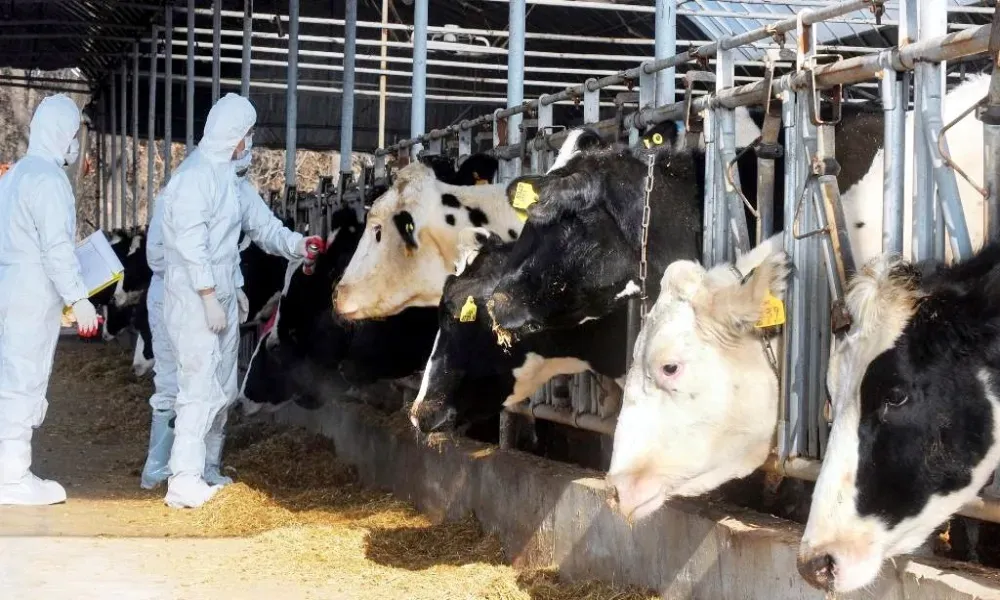
Foot-and-mouth disease is characterised by high fever, lesions in the mouth and on the feet of animals, and difficulty in feeding and movement. The result is a dramatic drop in milk production and a significant deterioration in the condition of animals intended for meat production. In cases of widespread transmission, authorities are forced to proceed with mass culling of herds to contain the disease.
For livestock farmers, this translates into an immediate loss of income. The loss of a productive animal affects not only the current period but also the future potential of the herd. Replacement requires time, capital and often new borrowing, further burdening the financial viability of farming units.
Milk production, the key raw material for Cypriot dairy products, is directly affected. At a time when the cost of feed and energy remains high, an outbreak of foot-and-mouth disease acts as a multiplier of existing pressures.
The importance of the problem becomes even more pronounced when considering the role of halloumi in the Cypriot economy. Halloumi, registered as a Protected Designation of Origin within the European Union, is one of the country’s most significant export products, generating hundreds of millions of euros in annual sales.
Its production relies on sheep and goat milk and, in some cases, cow’s milk. Any disruption in milk supply has cascading effects on processing, exports and ultimately the trade balance.
In the event of a widespread outbreak, the risk is not limited to reduced production. There is always the possibility of restrictions or stricter controls by importing countries. Even if products are not deemed a public health risk, a country’s reputation as a “safe producer” may be shaken. In a globalised market, trust is as important as quality.
Management
Managing a foot-and-mouth outbreak requires the immediate mobilisation of state mechanisms: veterinary inspections, disinfection measures, the imposition of quarantine zones, movement controls and reinforced border surveillance. All of these entail costs.
At the same time, the state is called upon to compensate farmers for animals that are mandatorily culled. Compensation is necessary to prevent the economic collapse of farms, but it places additional pressure on the state budget. In a period of fiscal discipline, such emergency expenditures limit the capacity for investment in other sectors.
Moreover, rebuilding livestock capital requires financial tools, subsidies and possibly access to European funds. Delays in restoring production may create long-term gaps in the market.
The primary sector does not operate in isolation. A broad network of activities develops around livestock farming: feed producers, transport operators, slaughterhouses, dairy industries and export companies.
Restrictions on the movement of animals and products affect the entire supply chain. Delays, increased transport costs and uncertainty over deliveries create suffocating conditions for small and medium-sized enterprises operating with limited profit margins.
If the crisis is prolonged, price increases in basic meat and dairy products on the domestic market cannot be ruled out. In a society already facing inflationary pressures, such developments would further burden households and exacerbate social inequalities.
Livestock farming is a primary source of income for many rural areas of Cyprus. The reduction of livestock capital and ongoing economic uncertainty may lead to the closure of small units that lack sufficient reserves.
The loss of jobs in rural areas has a dual dimension: economic and demographic. The depopulation of rural regions, the migration of young people to urban centres and the ageing of the agricultural population worsen an already existing sustainability problem.
Europe has experienced serious foot-and-mouth crises in the past, notably the 2001 outbreak in the United Kingdom, which cost billions of pounds and led to the culling of millions of animals. Those events demonstrated how quickly an animal disease can evolve into a national economic crisis.
For Cyprus, the lesson is clear: prevention is far cheaper than recovery. Strengthening biosecurity measures, strict adherence to protocols on farms and continuous training of producers constitute an investment, not a cost.
Resilience planning
The current circumstances highlight the need for long-term resilience planning in the primary sector. This includes the creation of an emergency fund for animal diseases, the strengthening of veterinary services with personnel and technological tools, digital traceability of livestock for faster detection of cases and incentives for insurance coverage of farming units.
At the same time, active diplomatic management is required to maintain the confidence of trade partners. Transparency and rapid communication with international markets reduce the risk of excessive or unjustified restrictions.